The microscope stage determines how samples are scanned and revisited throughout an experiment. Stage size,
motorisation, positioning precision, and compatibility with environmental control units directly influence the type of
experiments that can be performed.
While benchtop systems typically include motorised control in XY and Z, performance, accuracy, and flexibility can
vary between models.
This overview compares stage types commonly used in benchtop microscopes and highlights the key factors to consider
when evaluating a system.
| Stage Type |
Characteristics |
| Manual stages |
- No motorisation in XY and Z; all movement is controlled manually.
- Budget-friendly option suitable
for open-frame instruments only.
- Can be challenging to operate, particularly for precise repositioning.
|
| Motorised stages |
- Provide automated movement in all three spatial dimensions (X, Y, and Z).
- Enable advanced imaging
workflows including multi-position acquisition, tile scanning, large-area imaging, and multi-well imaging
(provided the control software supports these modes).
- Must deliver accurate and reproducible movement to ensure
consistent imaging and reliable return to defined coordinates.
- Should accommodate a wide range of sample holders
(slides, dishes, multi-well plates) and ideally support integration with stage-top incubators.
|
| Piezo stages |
- Enable extremely precise and rapid movements in XY and Z with nanometre-level positioning
stability.
- Typically used for specialised applications such as single-molecule localisation microscopy (SMLM) or
ultra-fast volumetric imaging.
- Add significant cost to the overall microscope system and are generally not
required for standard benchtop microscopy applications.
|
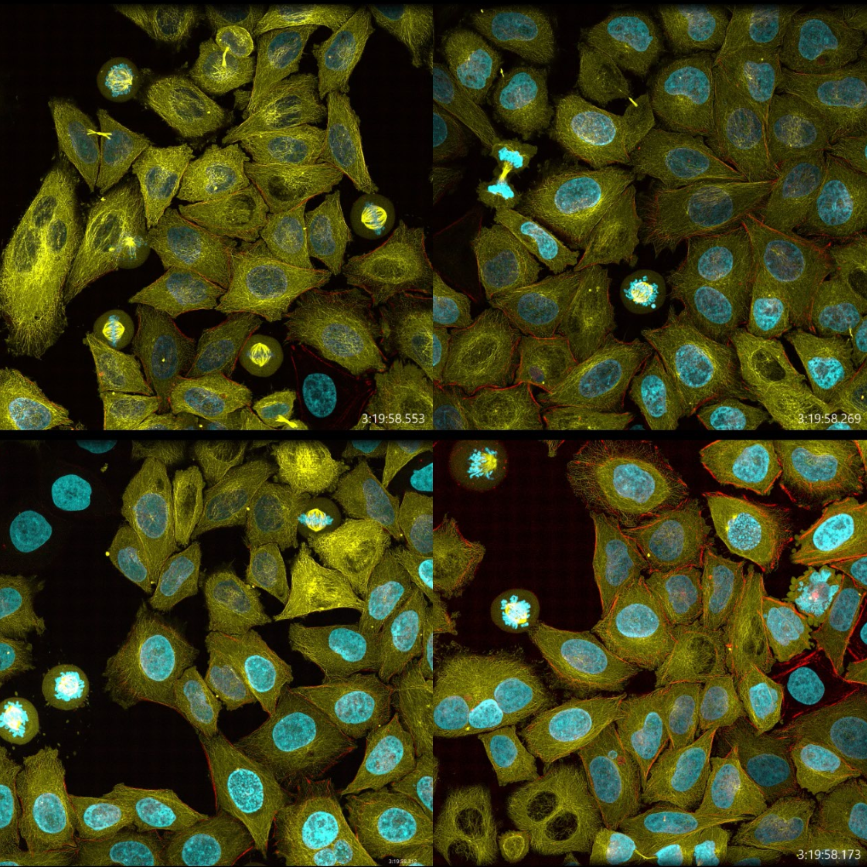
Fig. 1 — Multi-position imaging of mammalian cells with BC43 using confocal imaging mode over 4 hours. At each
time point, 4 independent positions were imaged with 3 channels and 15 Z stacks per position. The focus Seek &
lock mechanism maintained focus while navigating between positions. Image credits: Ines Baião-Santos, Álvaro Tavares
– Universidade do Algarve; Claudia Florindo – Oxford Instruments.
Exploring Benchtop Fluorescence Microscopes?
Learn more about the key technologies, components and practical considerations involved in selecting a benchtop
fluorescence microscope.
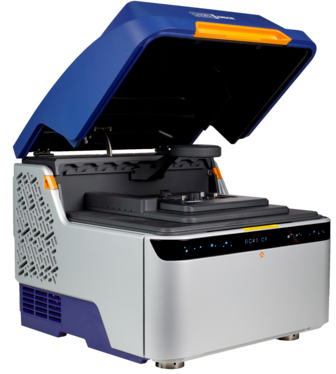
BC43 – Exceptional Performance, Certified Quality, High Productivity
BC43
features a fully motorised, software-controlled XY and Z stage with high positional accuracy. It is suitable for
demanding applications including tile scanning, 3D imaging, multi-position workflows, and long-term time-lapse
experiments.
← Back to Learning