The future of Raman microscopy may depend as much on automation strategy as on optical performance. Automation is
helping researchers standardise experiments, improve reproducibility, and implement sophisticated characterisation
procedures. As applications become more specialised and datasets continue to grow, automation is becoming an essential
part of modern Raman microscopy.
In the following interview, Dr. Matthias Finger, Senior Application Scientist at Oxford Instruments,
discusses why automation is becoming essential for Raman microscopy, how it supports
correlative characterisation and specialised applications, and what role AI may play in
future research workflows.

Dr. Matthias Finger began working with Raman imaging during his doctorate in Chemistry at TU Dresden
(Germany) and has 15 years of experience with Raman microscopy. As a Senior Application Scientist at Oxford
Instruments, he supports customers worldwide through training, technical consultation, and guidance on complex
application challenges.
Why is automation becoming such an important topic in Raman microscopy?
Matthias: Automation is becoming so important in Raman microscopy because it is now viewed as a
foundation for scalable and reproducible scientific research rather than a mere convenience feature.
Research workflows are becoming more complex, datasets are becoming larger, and requirements for ease of use and
reproducibility are increasing. Thus, scientists and lab managers no longer evaluate instruments solely based on
optical performance. They also expect efficient workflows, standardised procedures, and reliable results across users
and laboratories, as well as appropriate training and application support.
This shift is particularly visible in both multi-user facilities and highly specialised research groups. In core
facilities, instruments are often operated by users with different experience levels and requirements. In these
environments, automation reduces variability and accelerates onboarding of new users. For highly specialised
applications, such as semiconductor characterisation, measurements often need to be repeated across many samples or
combined with complementary characterisation techniques. Automation helps researchers perform these experiments
efficiently and consistently while generating the large datasets required for data-driven research approaches.
Reflecting this trend, automation and AI-enabled experimental platforms are receiving increasing attention in many
funding programmes and research initiatives.
What does automation mean in Raman microscopy today?
Matthias: Modern Raman microscopy automation extends far beyond simple motorised hardware.
State-of-the-art systems can automate instrument setup, data acquisition, and experimental workflows. Researchers can
additionally develop custom applications and software for automating complex measurement routines and data processing.
When considering automation options, think of a series of increasing capability levels.
- Instrument automation forms the basis. Motorised microscope components enable remote control and
operation in enclosed environments such as glove boxes. Automated calibration and alignment routines additionally
improve reproducibility.
- Workflow automation builds on this foundation by streamlining recurring experiments. Predefined
standard settings and measurement sequences can be reused to ensure consistency and accelerate repetitive tasks.
- Programmable automation extends these capabilities further. Researchers can create
application-specific measurement routines and integrate external hardware using programming languages such as
Python, LabVIEW or C#. This is valuable when standard workflows are not sufficient for specialised or complex
research tasks.
- AI-assisted automation lowers the barrier for creating custom solutions. Modern AI tools can help
researchers translate experimental goals into draft software routines, which facilitates implementing
application-specific automation.
Whether the objective is standardising workflows or implementing highly specialised measurements, automation helps
researchers perform experiments reproducibly and at scale, while reducing manual effort. As a result, scientists can
focus more on interpreting their results and less on repetitive experimental procedures.
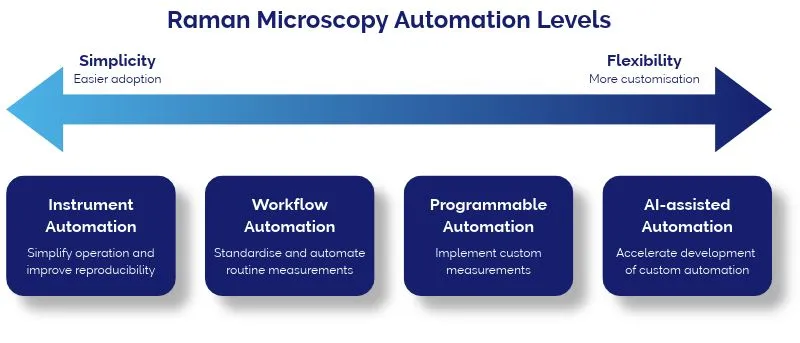
Modern Raman microscopy automation extends beyond instrument control automation to standardised workflows,
programming custom routines, and AI-assisted approaches.
What are the main challenges that automation helps researchers address?
Matthias: The main challenges that automation addresses are reproducibility, efficiency, and
workflow standardisation. Automation allows researchers to spend less time configuring instruments and more time
interpreting results.
Many Raman experiments still involve repetitive manual steps, such as instrument setup, calibration and alignment,
and recurring acquisition and analysis sequences. These tasks are time-consuming and can introduce user-to-user
variability. Automation helps reduce manual intervention and standardise routine procedures. For example, automated
alignment and calibration procedures ensure reproducible measurement conditions, while predefined, automated workflows
ensure that experiments are performed consistently by different users. This also makes advanced Raman measurements
more accessible for less experienced users, because crucial instrument settings are predefined and measurements can be
easily executed.
Another important challenge is scalability. When measurements must be repeated across hundreds or thousands of
samples, automation is crucial for executing experiments efficiently under defined conditions and generating large,
consistent datasets.
Importantly, automation reduces routine effort without compromising flexibility. Experienced users can still
configure complex experiments. For the most specialised applications, researchers can even develop custom software
routines that combine measurement control, external hardware integration, and data processing for specific research
tasks.
Where does automation deliver the greatest benefits in Raman microscopy?
Matthias: Automation delivers the greatest benefits for specialised applications that involve high
throughput, recurring workflows, or multimodal characterisation.
Semiconductor characterisation is a strong example. Applications such as wafer-scale mapping of stress, strain or
doping often require highly specialised measurements to be repeated under defined conditions. Automation helps ensure
consistency while increasing throughput.
In life science research, large datasets are often required for studying biological variability or for screening
applications. Automated acquisition can help researchers generate statistically meaningful datasets efficiently.
Other application areas that may involve large sample volumes and recurring measurement procedures include
pharmaceutical research, particle analysis, and industrial quality control.
Some applications also depend on automated hardware for practical reasons. Measurements performed in enclosed
environments require remote operation of microscope functions because direct access to the instrument is limited
during the experiment. Examples include studies of air-sensitive materials inside glove boxes or biological samples in
environmental chambers.
Core facilities and multi-user laboratories gain advantages because the same instruments are often used by
researchers from different disciplines and with different experience levels. Automated calibration and alignment, and
standardised workflows can help maintain consistent data quality while simplifying training and onboarding. At the
same time, research groups and industrial laboratories with highly specialised and recurring measurement tasks benefit
from automation for generating large datasets efficiently.
Why is automation particularly valuable in correlative Raman microscopy?
Matthias: Automation is particularly valuable in correlative Raman microscopy because multiple
complementary imaging techniques must be coordinated precisely and reproducibly. As researchers combine Raman imaging
with methods such as photoluminescence (PL), second harmonic generation (SHG), atomic force microscopy (AFM), or
white-light microscopy, the complexity of data acquisition increases significantly.
In manual workflows, researchers traditionally need to configure and perform each measurement separately, which
requires repeated instrument adjustment, settings definition, and sample repositioning. Automation transforms these
individual measurements into one coordinated workflow. Once the area of interest and acquisition parameters are
defined, multiple images are acquired sequentially with different imaging techniques integrated in the same
microscope. The automated approach requires only minimal user intervention, maintains consistent spatial alignment,
and generates intrinsically co-registered datasets.
The benefits are higher throughput and improved reproducibility, as well as a more practical approach to multimodal
characterisation. Researchers obtain complementary information from multiple techniques while avoiding many of the
manual steps traditionally required to correlate the resulting datasets. This is particularly valuable when the same
correlative characterisation must be repeated for large sample numbers.
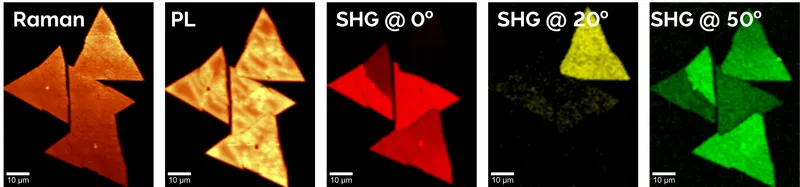
Raman, PL, and polarisation-resolved SHG images of WS2 flakes acquired from the same sample area using an
automated workflow. By integrating multiple complementary imaging techniques in a single routine, automation
streamlines correlative imaging and multimodal characterisation. Read more in our application note: Automated Raman, PL and SHG Imaging Workflow for 2D Materials
Characterisation.
How is AI changing the way researchers approach microscope automation?
Matthias: AI is changing microscope automation primarily by lowering the barrier to creating custom
automation solutions. Researchers no longer need to start every automation project from a blank page. Based on a
description of the scientific objective, AI tools can help identify useful approaches in published literature and
suggest implementation strategies. AI coding agents can be used to generate draft Python scripts and accelerate the
development of custom measurement workflows and application-specific automation concepts.
This is particularly interesting for research groups that have strong expertise in their scientific area but limited
software development resources. AI can help translate experimental requirements into an initial software application
that researchers can then review, adapt, and validate. As a result, scientists without extensive programming
experience are enabled to create or customise automation tools for specialised research tasks.
However, scientific oversight remains essential. AI can accelerate implementation, but researchers must still define
their scientific question and verify that a software application is appropriate and performs reliably under real
laboratory conditions.
What role will automation and AI play in the future of Raman microscopy?
Matthias: Automation and AI are likely to play an important role in expanding what researchers can
achieve with Raman microscopy. As characterisation approaches become more specialised and datasets continue to grow,
automation will make it easier to perform complex measurements reproducibly and at scale. Future laboratories will
likely expect instruments to integrate more seamlessly with data infrastructures, external software platforms,
information management systems, and complementary characterisation tools.
I also expect more researchers to develop application-specific software solutions that integrate measurement control,
data processing, and analysis for specific scientific tasks. AI will help accelerate the development of these tools,
and their adaptation to evolving scientific requirements. It will also make advanced automation accessible to a
broader range of users.
At the same time, successful research will continue to depend on scientific expertise. Researchers define the
objectives, establish validation criteria, and interpret results. The future is therefore unlikely to involve fully
autonomous systems replacing the scientist. Instead, automation and AI will lead to increasingly capable tools that
boost productivity, reproducibility, and scientific insight.
Conclusion
Automation in Raman microscopy is evolving from a collection of convenient instrument features into a foundation for
connected and integrated research environments. Automation capabilities range from automated instrument functions and
standardised workflows to programmable and AI-assisted automation. Different laboratories may require different levels
of automation, but the underlying objective is often the same: performing repetitive measurements reproducibly and
efficiently, and at a scale that would be difficult to achieve manually. This allows researchers to focus on
scientific interpretation rather than routine experimental tasks.