Expert interview with Dr. Billy Hale, Product Manager for NMR Spectroscopy at Oxford Instruments
Benchtop NMR spectroscopy is rapidly changing how researchers and industrial labs approach chemical analysis. Once
restricted to large, high-maintenance facilities, benchtop NMR can now deliver advanced analytical performance in
compact, user-friendly platforms. To explore what's driving this evolution and which features matter most, we
spoke with Dr. Billy Hale, Product Manager for NMR at Oxford Instruments.

Dr. Billy Hale, NMR Product Manager, Oxford Instruments
Question 1:
Benchtop NMR has seen strong growth in recent years. What's behind this trend?
Billy: NMR has always been a gold standard for structural and quantitative analysis, but high-field
instruments traditionally required significant infrastructure such as cryogens, vibration isolation, dedicated rooms,
which made them inaccessible for many labs.
Advances in permanent magnet technology and platform design have changed that. Today's benchtop NMR systems
deliver reliable, high-quality data in a footprint that fits on a lab bench, without cryogens, at a fraction of the
operational cost. This opens access for teaching labs, QC environments, and interdisciplinary research groups that
previously could not consider NMR.
Question 2:
Providers of NMR spectrometers often talk about frequency—60 MHz or even 90 MHz—as a key specification. Why is this
important?
Billy: The operating frequency, which correlates with magnetic field strength, is fundamental to NMR
performance. It governs two things: sensitivity and spectral resolution.
Sensitivity scales with the 3/2 power of the magnetic field, so moving from a lower to a higher MHz system improves
the signal-to-noise ratio significantly. This means you can detect smaller amounts of material and reduce the number
of scans, speeding up data collection.
Resolution improves because higher frequency gives better chemical shift dispersion. Peaks spread out more, which is
critical for resolving complex mixtures or overlapping signals. It's not about "higher is always
better," but rather matching field strength to the complexity of your samples and analytical goals.
Question 3:
Beyond frequency, what features matter most in a benchtop NMR platform?
Billy: Users today look for flexibility and scalability in their systems.
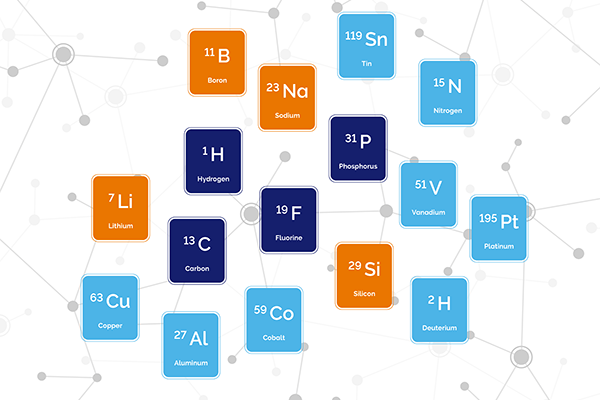
One of the most important aspects here is broadband capability. It allows observation of many nuclei beyond
traditional 1H, such as 13C, 31P, or 11B and is critical for analysing
samples in more detail. Some systems enable the users to exchange probes quickly to further increase flexibility.
To support both simple 1D experiments and advanced 2D methods such as COSY and HSQC for detailed structural analysis,
it is also essential to have a broad range of pulse sequences available.
It is also important, if the benchtop platform provides flexible solutions such as for temperature or flow
experiments, so the system remains adaptable to different analysis needs.
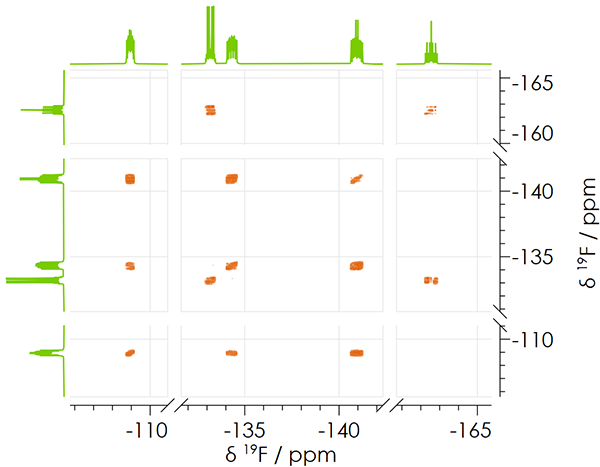
COSY NMR spectrum of a mixture of isomers of bromotrifluorobenzene
Question 4:
In Oxford Instruments benchtop NMRs, you offer wide-range temperature control and flow NMR. How relevant are these
features in practice?
Billy: Both features address analytical challenges our customers have. Diffusion studies are
critical in fields like battery research, where electrolyte stability and ion transport depend on temperature. Having
a variable temperature range in the NMR system allows researchers to replicate real-world conditions and study
performance under different scenarios.
Flow NMR adds a time dimension to experiments, as it enables continuous, inline monitoring without interrupting a
reaction. This has become increasingly important in chemical development and manufacturing, where real-time insights
are key to improving process control and efficiency.
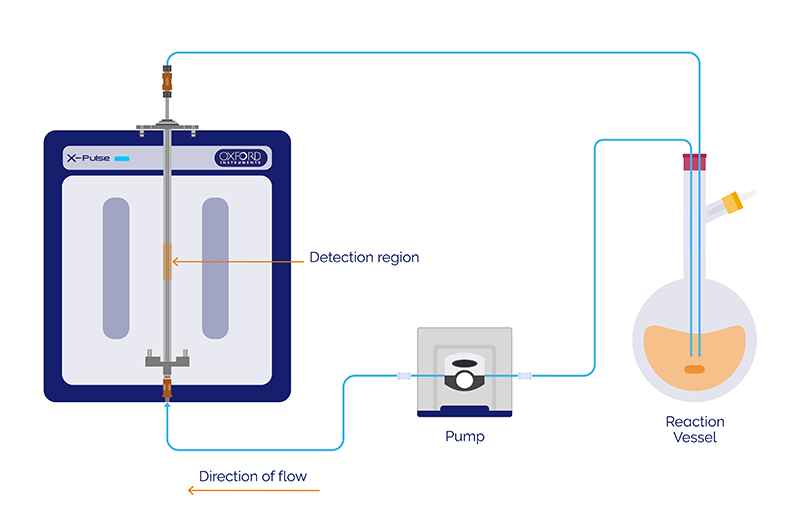
Flow NMR Setup
Question 5:
What role does broadband capability play in NMR?
Billy: Broadband capability is all about flexibility and future-proofing. Many labs begin with
proton (hydrogen) analyses, but as projects expand, you often need to analyse carbon, phosphorus, or less common
nuclei. A broadband-capable system allows this without replacing the instrument.
In multi-user environments, like academic or industrial core facilities, broadband ensures you can support a diverse
user base without being locked into a single application area.
Question 6:
How do you see automation shaping benchtop NMR adoption?
Billy: Automation makes a real difference in how people use benchtop NMR. It starts with basics like
automated tuning and parameter setup, which save time and reduce operator dependency. Adding automated sample handling
and sequence execution means labs can run batches or overnight measurements without supervision.
Whether you're in industry running multiple QC checks or in research environments, this translates into higher
throughput and more consistent results with less day-to-day intervention.
Question 7:
Software often makes or breaks usability. What are customers asking for in NMR spectroscopy software?
Billy: Customers are asking for two things: simplicity for novice users and high
experimental control for experts. Users want an interface that guides them through experiments but
still provides flexibility to edit acquisition parameters or define custom pulse sequences.
Features like system optimisation, and one-click workflows make NMR accessible to non-specialists while preserving
research-grade capability for advanced users. Integration with data processing and export options is also key for labs
that need traceable reporting and compatibility with industry data standards.
Question 8:
What are the most common applications you see for benchtop NMR today?
Billy: Benchtop NMR is extremely versatile, supporting a wide range of analytical tasks from
academic research to industrial quality control.
Traditionally, NMR has been a mainstay in chemistry research, where many tasks can now be performed
in benchtop systems.
In the pharmaceutical sector, benchtop NMR is widely used for accurate quantification of active
ingredients, checking batch purity, and detecting impurities.
Energy research is another important area, where benchtop NMR helps study ion mobility in battery
electrolytes or assess solvent stability under different temperature conditions.
In polymer and material science, it is often applied to monitor monomer conversion and verify the
structural consistency of composites. We also see increased use in advanced materials, including studies on
semiconductor materials.
And, of course, benchtop NMR systems are used in education, giving students hands-on experience in
spectroscopy without the complexity of a high-field setup.
Question 9:
Where do you see future development of NMR instrumentation heading?
Billy: Integration and automation will continue to grow, think smarter workflows, advanced data
management, and seamless connectivity with other analytical techniques. We also see an emphasis on reproducibility and
remote access, which supports multi-user environments and distributed teams.
Benchtop NMR will increasingly serve as a bridge between classical high-field NMR and point-of-need analytics,
offering performance and flexibility in a scalable, user-friendly format.
Question 10:
From your perspective, what should labs consider before investing in benchtop NMR?
Billy: Start with your analytical needs: Which nuclei do you need to measure? How complex are your
samples? Will you require 2D experiments or advanced modules like gradients or variable temperature? Beyond that,
think about scalability and flexibility. Research priorities change, so choose a platform that lets you upgrade rather
than replace. And finally, don't overlook system usability and reliability. An instrument that fits into
day-to-day workflows and delivers trustworthy results without constant specialist oversight will have the greatest
impact.
If you are looking for more detailed information, I can recommend looking into our Buyer's Guide that summarises the most relevant features in an NMR
system.
Closing Statement
Benchtop NMR has matured into a versatile platform technology. With improvements in magnet design, broadband
capability, and automation, these systems now deliver performance once reserved for large-scale instruments. For many
labs, they are becoming indispensable for routine and advanced analysis alike.