Introduction
Polymers are macromolecules composed of repeating structural units. They exhibit diverse properties that can be tailored for specific applications that range from flexible packaging materials to robust aerospace components. Central to understanding and optimising polymer behaviour is the accurate determination of molecular weight, which directly influences properties such as strength, flexibility, and solubility (Figure 1).
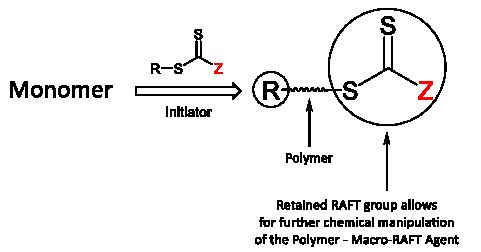
Fig. 1 — Generic example of a Reversible addition–fragmentation chain transfer (RAFT) polymerisation.
Monitoring polymerisation processes in real-time is useful for gaining information into chain growth mechanisms, reaction kinetics, and polymer characteristics. This capability is valuable in modern research trends, such as machine-learning-driven optimisation and automated experimental workflows.
A variety of analytical techniques have been used to study polymerisation and determine molecular weight, each with its advantages and limitations. Among these, gel permeation chromatography (GPC) is widely regarded as the standard method for molecular weight determination. However, diffusion ordered NMR spectroscopy (DOSY) has emerged as a powerful technique for characterising polymers by measuring molecular self-diffusion coefficients, with the added advantage of enabling real-time reaction monitoring unlike GPC. By utilising the relationship between diffusion and molecular size, DOSY can distinguish between different components in mixtures with similar chemical environments. This is achieved through the application of pulsed field gradients, which encode spatial information into the NMR signal. The resulting diffusion coefficients are extracted by analysing the attenuation of signal intensity as a function of gradient strength.
This application note discusses the advancements in DOSY NMR for polymer analysis using the Oxford Instruments X-Pulse benchtop spectrometer. The work here was performed in collaboration with the Haddleton group at the University of Warwick, where DOSY was successfully applied to monitor the real-time polymerisation of methyl acrylate. Subsequent work to this has also been published, providing additional validation of the approach and showing its potential.
Diffusion-ordered NMR spectroscopy (DOSY)
Combining DOSY NMR with FlowNMR represents a significant advancement; this allows for the continuous acquisition of diffusion data during dynamic processes. FlowNMR works by integrating the NMR analysis into a continuous flow system, enabling real-time monitoring of chemical reactions or processes without the need for manual sampling (Figure 2). This configuration is advantageous in industrial and academic research, where real-time data acquisition and minimal disruption to the flow process are required. Diffusion analysis by FlowNMR allows to study changes in molecular size, reaction progress, and polymerisation kinetics under constant flow conditions. It eliminates the need to pause or disrupt the flow for diffusion measurements. This offers a more seamless approach to monitoring complex chemical systems.
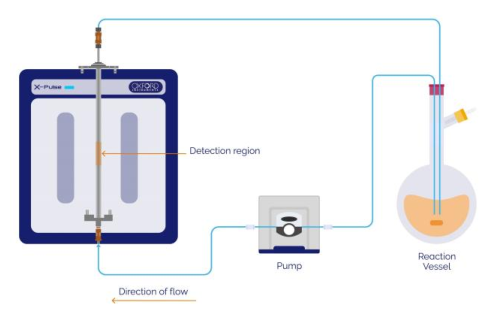
Fig. 2 — FlowNMR apparatus consisting of a reaction vessel, transfer lines, pump, and flow cell.
However, there are challenges applying DOSY within FlowNMR, predominantly due to the difficulty of distinguishing between molecular diffusion and sample flow. The continuous renewal of magnetisation in a flowing sample complicates measurements such as diminished signal intensities, as it displaces pre-magnetised samples. These effects are problematic for the acquisition times required for DOSY, which typically extend to about five minutes or more; this complicates the accurate measurement of diffusion coefficients as well as potentially obscures transient intermediates and induction periods.
The X-Pulse Spectrometer for Diffusion Measurements in FlowNMR
The Oxford Instruments X-Pulse benchtop spectrometer addresses these challenges associated with diffusion measurements in FlowNMR applications. Unlike conventional NMR spectrometers, the Z-axis gradient is aligned parallel to the main magnetic field (B0), while the magnet geometry ensures that B0 is perpendicular to the sample and the direction of flow (Figure 3). This configuration enhances gradient efficiency and ensures reliable diffusion measurements, particularly under flow conditions.
Among the different DOSY sequences available, the Pulsed Gradient Spin Echo (PGSE) is widely used for encoding molecular displacement information into the phase of the NMR signal. Accurate measurements require precise gradient alignment and a symmetric magnetic field to prevent artifacts and ensure robust data quality. The X-Pulse design achieves this with its uniform magnetic field (Figure 4).
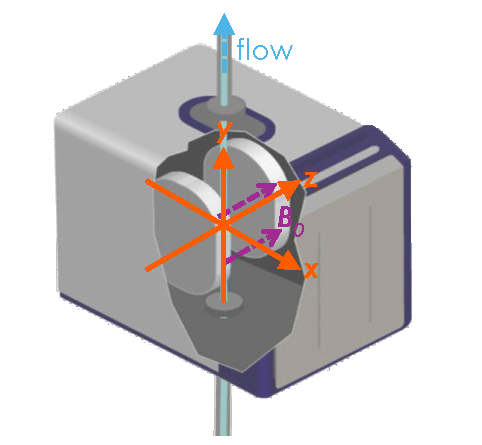
Fig. 3 — Gradient axis on the X-Pulse, relative to B0 and the flowing sample.
The X-Pulse spectrometer minimises issues common in other spectrometers, such as anisotropic diffusion measurements or artifacts caused by misaligned gradients. Misalignments with B0 can disrupt echo formation or distort signal decay which leads to unreliable data (Figure 5). By ensuring consistent echo formation and a strong signal-to-noise ratio (SNR), it delivers sharp, high-resolution spectra. This robust performance makes the X-Pulse an ideal choice for complex diffusion studies in both static and flow conditions.
Showing the X-Pulse's Capabilities – Diffusion Coefficient of Water
To demonstrate the X-Pulse's axis gradient capabilities, the diffusion of water was first measured along the x-, y-, and z-axes under static conditions (Figure 4). The results showed smooth signal attenuation curves and linear Stejskal-Tanner plots for all three axes, confirming the uniformity of the gradient fields and the reliability of the spectrometer in encoding molecular displacement. These consistent results validate the X-Pulse's capacity to perform accurate diffusion measurements on all three axes under ideal, non-flowing conditions. However, when these measurements were extended to flow conditions, a significant distinction emerged.
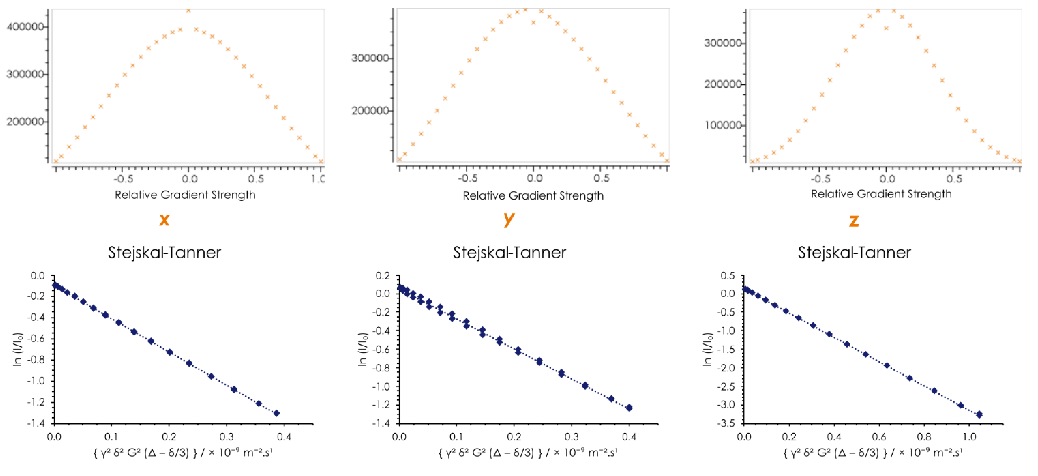
Fig. 4 — NMR Signals & Stejskal-Tanner plots at static conditions.
At a flow rate of 1 mL/min, diffusion measurements along the x- and z-axes remained consistent, while those along the y-axis experienced noticeable disruption (Figure 5). This highlights the importance of the X-Pulse's unique design, where the major gradient axis (z-axis) is aligned parallel to the magnetic field (B0). This configuration ensures stability and accuracy during flow conditions. In contrast, many other spectrometers align the y-axis gradient with B0, making it more susceptible to flow-induced disruptions, as observed in these experiments.
This distortion becomes even more pronounced at higher flow rates, where measurements along the y-axis degrade further. This shows the importance of the X-Pulse's design, which ensures reliable diffusion measurements by avoiding artifacts and inaccuracies caused by misaligned gradients.
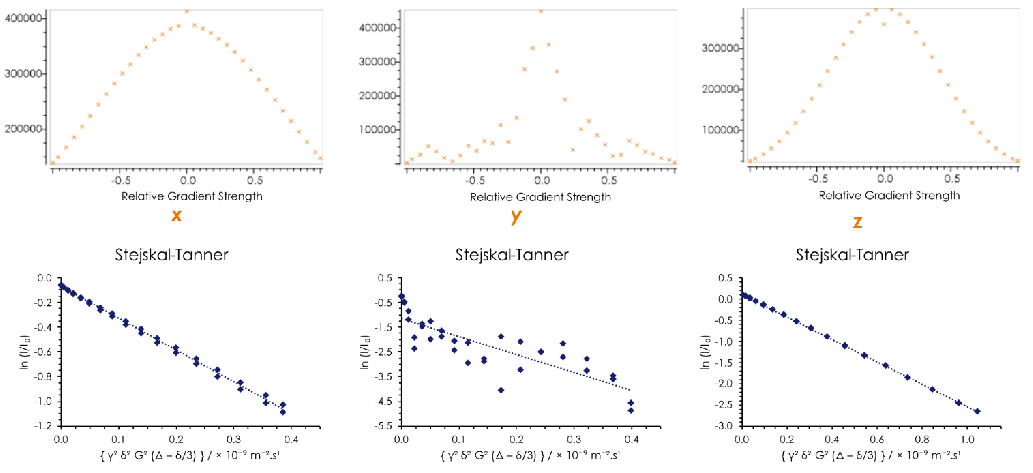
Fig. 5 — NMR Signals & Stejskal-Tanner plots at 1 mL/min.
RAFT Polymerisation
Here, in this study, the use of FlowNMR to monitor the reversible addition–fragmentation chain transfer (RAFT) polymerisation of methyl acrylate, a well-studied reaction, in real-time is demonstrated (Scheme 1), leveraging the capabilities discussed of the X-Pulse (Figure 2). RAFT polymerisation is a controlled radical polymerisation technique that allows control over molecular weight and polymer architecture, making it highly suitable for synthesising advanced polymeric materials. This example shows the importance of combining the X-Pulse's gradient configuration with DOSY to overcome challenges associated with diffusion measurements under flowing conditions. By applying these techniques, the aim is to illustrate how real-time monitoring can provide information into polymerisation kinetics and molecular weight evolution for more efficient and scalable chemical processes.
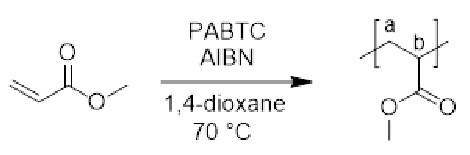
Scheme 1 — RAFT polymerisation of methyl acrylate.Here interleaved 1H NMR and PGSE experiments at 1 mL/min were performed. In this case the individual 1H NMR were stacked where the methyl acrylate and poly methyl acrylate peaks were integrated, from this the 1H NMR data provided direct information into the concentration changes of methyl acrylate over time. This allowed the tracking of monomer conversion throughout the reaction. Small changes such as the addition of RAFT agent at 60 minutes to increase the rate of reaction were also observed (see Figure 6).
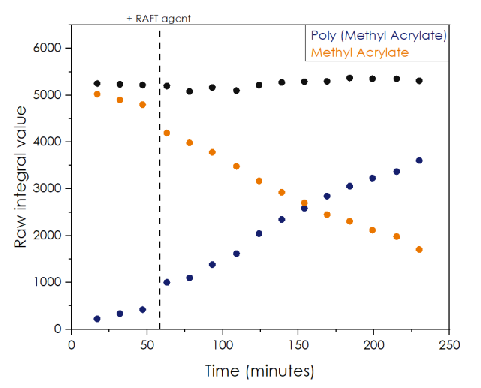
Fig. 6 — 1H NMR reaction progression of the RAFT polymerisation of methyl acrylate.The PGSE experiments involved systematically varying the gradient strengths; for each gradient strength used, raw signal integrals were plotted to assess the impact of relative gradient strength on signal attenuation (Figure 7). Analysis was first centred around Stejskal-Tanner plots, wherein the natural logarithm of integral ratios was plotted against the square of the gradient strength, defined by the equation:
S(g) = S(0) exp(−γ2g2δ2(Δ − δ/3)D)
Equation 1 — Stejskal-Tanner equation
Where S(g) is the signal amplitude with gradient, S(0) is the signal amplitude without gradient, γ is the gyromagnetic ratio, g is the gradient strength, δ is the duration of each gradient pulse, Δ is the time between the gradients, and D is the diffusion coefficient.
By plotting the natural logarithm of the ratio of the signal intensities, ln(S(g)/S(0)), against γ2g2δ2(Δ − δ/3), the slope of each linear plot corresponds to the negative of the diffusion constant, −D (Figure 8).
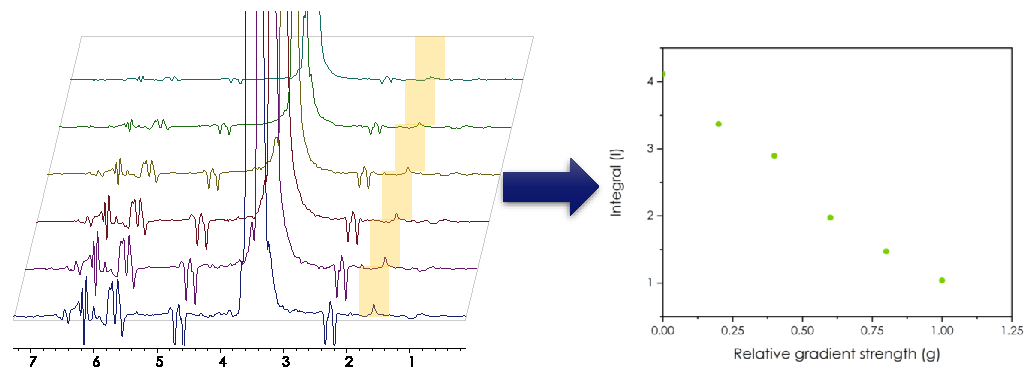
Fig. 7 — Plotting the relative field strength.
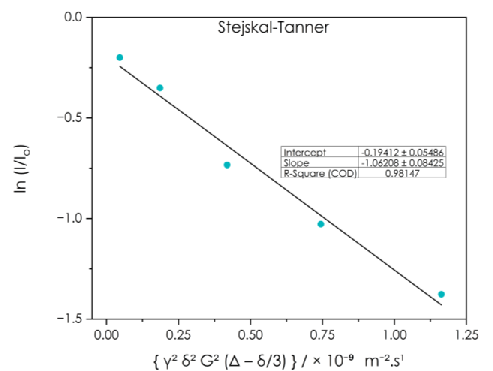
Fig. 8 — Stejskal-Tanner plot for the RAFT polymerisation of methyl acrylate showing linear fit used to extract the diffusion coefficient.
This processing was applied to every data point collected during the reaction; this enabled real-time monitoring of changes in diffusion coefficients and, by extension, molecular weight over time.
Figure 9 illustrates how the diffusion constant of poly methyl acrylate evolves over time, reflecting the growth of polymer chains during the polymerisation process. Importantly, as polymers are not monodisperse, the DOSY experiment provides an average diffusion constant, which correlates to an average molecular weight at each time point. The molecular weight profiles generated from this analysis offers useful information into polymer growth and reaction progress.
The approach of measuring molecular weight via DOSY uses the diffusion coefficient which is related to the hydrodynamic radius of the analyte through the Stokes-Einstein relationship (Equation 2), which is in turn related to the molecular weight through an adapted Rouse–Zimm model (Equation 3).
D = kBT / (6πηrh)
Equation 2 — The Stokes-Einstein Relation
Where D is the diffusion coefficient of the particle in the fluid (m2/s), kB is the Boltzmann constant (1.38×10⁻²³ J/K), T is the absolute temperature of the fluid (K), η is the dynamic viscosity of the fluid (Pa·s), and rh is the radius of the spherical particle (m).
rh ≈ bMDν
Equation 3 — Modified Rouse-Zimm Model
The mass obtained in this manner is the diffusion average mass, MDν.
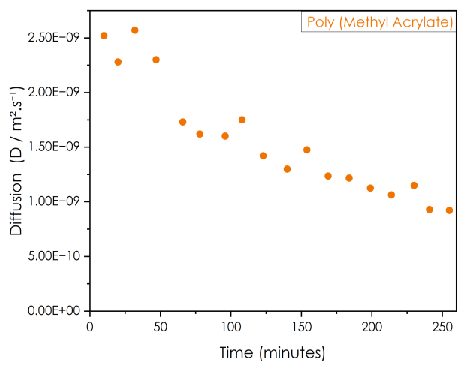
Fig. 9 — Diffusion constant of poly methyl acrylate over time.
The evolution of polymer molecular weight over time was shown to correlate well with theoretical expectations for the living RAFT polymerisation. The mass of the polymer continued to increase as the reaction progressed, reaching a maximum of ~700 Da through the termination of the reaction (Figure 10). Offline verification of the resulting mass of the polymer was conducted by GPC giving Mn = 700, and Mw = 910 g mol−1, based on a differential refractive index (DRI) detector and PMMA calibration with narrow molecular weight standards. This reaction shows the expected kinetics of a typical living radical process, with a first order rate constant of 8.78×10⁻⁵ s−1, in agreement with literature values.
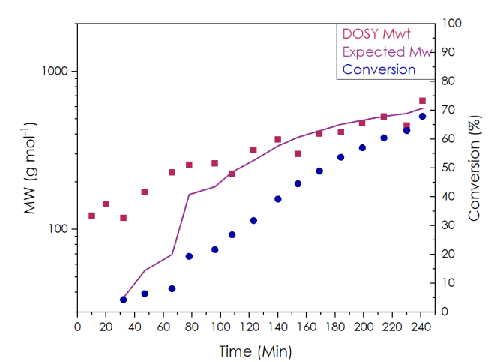
Fig. 10 — Polymerisation of MA via thermally initiated RAFT as measured by continuous flow DOSY.
For an example of a higher polymerisation system achieving 7000 Da, see Macromolecules
, 2025, 58, 10, 5201–5207, which shows a system with a more representative polymer weight and small section of polymers with different molecular weights.
The DOSY data has provided an average molecular weight at each time point and offered a comprehensive picture of the polymer growth kinetics. The advantage of this non-invasive approach utilising our gradients provided real-time monitoring of polymerisation reactions. Continuous flow analysis eliminates the need for stopping the flow or removing samples for offline analysis. The X-Pulse spectrometer ensures reliable diffusion measurements with minimal disruptions, even under flow conditions.
The X-Pulse spectrometer is also not limited to 1D diffusion experiments; the configuration supports a wider selection of shaped pulses allowing techniques such as solvent suppression, selective excitation and gradient selective two-dimensional spectroscopy to be performed in real-time.
Summary
This application note demonstrates the capabilities of the Oxford Instruments X-Pulse Benchtop NMR Spectrometer for performing DOSY under continuous flow conditions. By using its advanced three-axis gradient configuration and PGSE experiments, the X-Pulse enables accurate, reliable, and real-time diffusion measurements in polymerisation reactions. It eliminates the need to stop flow or remove samples for offline measurements, preserving the integrity of reaction conditions. The unique alignment of the z-axis gradient perpendicular to the sample ensures superior field homogeneity and signal-to-noise ratio, even under challenging flow conditions.
As shown in the RAFT polymerisation example, this methodology allows for simultaneous tracking of monomer conversion and polymer molecular weight evolution. The ability to extract diffusion coefficients and molecular weights in real-time without disrupting the reaction environment makes this approach a powerful tool for studying reaction kinetics, molecular interactions, and material properties.
Reference
W. Pointer, O. Tooley, A. Saib, R. Radmall, P. Wilson, D. Lester, J. Town, R. J. Blagg and D. Haddleton, Macromolecules
, 2025, 58, 10, 5201–5207. https://doi.org/10.1021/acs.macromol.4c03260