Polybutadiene (or rubber) is added during polymerisation of styrene to increase the flexibility of polystyrene
polymers. It is important to closely monitor the amount of polybutadiene added, so that the flexibility of the
polystyrene polymer may be regulated. NMR can provide an effective and rapid method for the regulation of
polybutadiene content in Impact Polystyrene.
Method
NMR has a number of advantages over other techniques:
- NMR is very stable over the long term and rarely needs calibration adjustment.
- The measurement time is short (typically 32 seconds), allowing rapid sample throughput.
- The NMR technique is non-destructive, so the same sample may be measured several times before being analysed by
other techniques.
- NMR is insensitive to air voids between polystyrene granules.
- Measurement precision is good compared to wet chemical methods.
- NMR does not require the use of hazardous solvents.
- Both weighing and non-weighing methods are available for this application.
Calibration and Results
12 samples of impact polystyrene were used for the calibration of polybutadiene content. Each sample was weighed into
a tared 26mm glass tube before measurement at room temperature in the MQC+. The resulting calibration graph is shown
in Figure 1.
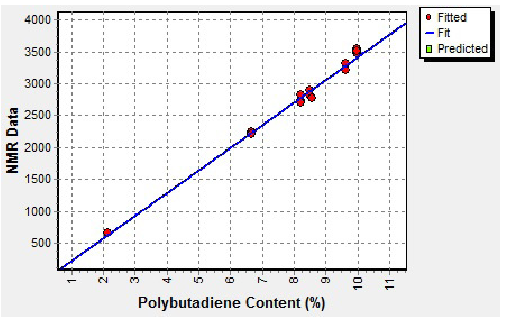
Fig. 1 — Calibration graph of NMR signal per unit mass against polybutadiene content obtained by a reference
method. Correlation Coefficient r = 1, Standard Deviation = 0.15.
Table 1 shows that the repeatability (or precision) of the NMR data is excellent.
| Repeat number |
Polybutadiene Content (%) |
| 1 |
6.79 |
| 2 |
6.81 |
| 3 |
6.80 |
| 4 |
6.81 |
| 5 |
6.79 |
| 6 |
6.78 |
| 7 |
6.81 |
| 8 |
6.79 |
| 9 |
6.79 |
| 10 |
6.80 |
| Average |
6.80 |
| Standard Deviation |
0.01 |
Table 1: NMR measurement repeatability.
Recommended Instrument
The MQC+ with a 0.55 Tesla (23 MHz hydrogen resonance) magnet, fitted with a 26mm diameter (14ml sample) probe is a
suitable instrument for this application. The Rubber in Impact Polystyrene package consists of:
- MQC+ with a built-in computer operating Microsoft® Windows® 10 (no separate PC is required).
- MultiQuant software including RI Calibration, RI Analysis, and
the EasyCal ‘Rubber in Polystyrene’ application.
- 26mm diameter glass tubes.
- User Manuals.
In addition to this package you may also require:
The instrument offers advantages over others on the market:
- High signal sensitivity.
- Small benchtop footprint.
- Low maintenance.
- Recyclable sample tubes, lowering consumable costs.
- Minimal sample preparation.
Note: Other instruments/packages are available for the analysis of larger or smaller quantities of
sample. Please contact Oxford Instruments for details.