Summary
- Fast, accurate and repeatable
- Minimal sample preparation
- Simple linear calibration
- Easiest, most reliable technique available; suitable for unskilled personnel
Application
Wax (paraffin) content is an important characteristic affecting the physical properties of petroleum products, in particular their viscosity and setting temperature. This not only affects their ability to be processed, but fuel and oils are often de-waxed to ensure they are suitable for their intended use. Thus measuring wax content, either directly or indirectly, has become a routine analytical requirement for product quality control.
Advantages of NMR
The UOP (Universal Oil Products LLC) solvent extraction method (UOP46) is commonly used to determine the wax content of oil by weight. However, this method requires dissolution of the product in acetone, large sample volumes (to guarantee good reproducibility), highly skilled analysts and long measurement times. Moreover, this technique is unsuitable for the detection of wax components less than 5% by mass.
Secondary methods for the determination of wax in oil include pour point (ASTM D97) and wax appearance either by cloud point (e.g. ASTM D2500, D5773) or polarisation microscopy. All these methods are cumbersome, time-consuming and subjective.
In some cases, the wax content can be indirectly calculated using differential scanning calorimetry (DSC) data. However, DSC can be inapplicable for low wax oils; furthermore, sample preparation and DSC measurements usually require a highly skilled operator.
In contrast to the standard wet chemistry methods and the DSC technique, low resolution Nuclear Magnetic Resonance (NMR) provides a fast, direct and user-friendly method for the determination of wax content in petroleum products.
The MQC+ benchtop Nuclear Magnetic Resonance (NMR) analyser provides an alternative method that is quick and easy to perform, simple to calibrate, and requires minimal sample preparation. As such, it is ideal for routine operation either in a laboratory or production environment, without any requirement for specialist operator training.
Method
This measurement is based on measuring the NMR response obtained from the solid wax component relative to that of the whole sample. The instrument is calibrated using petroleum distillate standards with known wax contents.
N.B. The same calibration may be used to measure crude oil however the result is only likely to give an indication estimate of the true value.
Calibration
Ultimately, only two well known standards are required to calibrate the instrument since the calibration is linear. However initially it is recommended that the instrument is calibrated by 3–6, preferably more, distillate standards with known wax contents evenly spread over the range of interest. NMR is a comparative technique and therefore cannot be more accurate than the reference technique against which it is being compared. However, it is more robust and reproducible than wet chemical methods and therefore error is reduced by analysing more reference samples.
Measurement
The sample (1.5ml) is melted then mixed with a small quantity of solvent in a 10 mm glass NMR tube. The sample tube is then placed in a temperature controlled conditioning block at -28°C for 20 minutes prior to analysis. Measurement time is just 4 seconds per sample.
Results
Figure 1 shows a calibration for distillates with wax concentrations ranging from 1 to 55 % by mass (w/w). An excellent linear correlation is obtained between the NMR response from the wax and the concentration in the products.
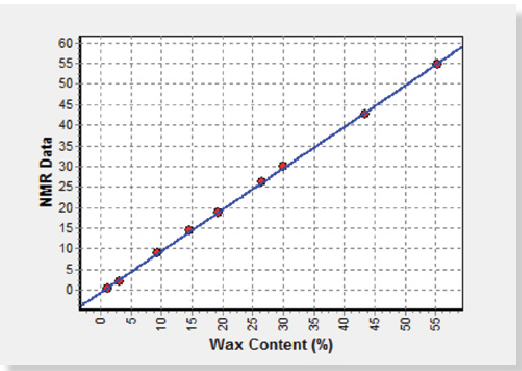
Fig. 1 — NMR calibration for wax in petroleum products at -28°C. The correlation coefficient and standard deviation are 1.000 and 0.353% respectively.
Table 1 shows that the MQC+ has good measurement repeatability by testing one sample ten times. After every test measurement the sample was transferred from the magnet back to the conditioning block at -28°C for 20 minutes prior to the next measurement.
| Repeat | Wax Content (% w/w) |
| 1 | 8.89 |
| 2 | 8.88 |
| 3 | 9.17 |
| 4 | 8.71 |
| 5 | 8.87 |
| 6 | 9.06 |
| 7 | 8.87 |
| 8 | 8.98 |
| 9 | 9.05 |
| 10 | 9.33 |
| Mean | 8.98 |
| Standard Deviation | 0.17 |
Table 1: Repeatability of wax content measurement by NMRConclusion
- NMR is very stable over the long term and rarely needs calibration adjustment
- Calibration maintenance samples, with a range of wax contents, may be used to check and maintain the original calibration
- Measurement precision is good compared to wet chemical methods
- The NMR technique is non-destructive so the same sample may be measured repeatedly
- Minimal sample preparation is required
Complete Package
Oxford Instruments offers a package especially tailored to the measurement of Wax Content in Petroleum Products.
- Oxford Instruments MQC+ NMR Analyser
- 0.55 Tesla (23 MHz) high homogeneity magnet
- Probe for 10 mm diameter sample tubes
- Integrated PC and large flat-screen display
- MultiQuant software including RI Calibration, RI Analysis, and the EasyCal ‘Wax Content in Petroleum Products’ application
- Tuning sample
- 10 mm glass tubes
- A set of three calibration maintenance samples
- User manuals
- Method sheet
Optional Items
- Refrigerated water bath capable of maintaining test samples at -28°C
- Aluminium block for 10mm tubes compatible with the above water bath
- A set of distillates samples with known wax contents (similar to those used in Figure 1)