Application
Various grades of polyethylene are defined by their density (LLDPE, LDPE and HDPE) which relates to the crystallinity of the polymer. As density and crystallinity increase, stiffness increases and impact resistance decreases. Measurement of density is therefore a critical Quality Control parameter.
Why use NMR?
Traditional methods including displacement, titration and liquid pycnometry (ASTM D792, ASTM D1505, ISO 1183) can be time consuming, require skilled operators and, in some instances, the use of hazardous solvents.
The MQC+ benchtop Nuclear Magnetic Resonance (NMR) analyser provides an alternative method which is quick and easy to perform, simple to calibrate, and requires minimal sample preparation. As such it is ideal for routine operation in either a laboratory or production environment without any requirement for additional chemicals or specialist operator training.
Summary
- Fast, accurate and repeatable
- No sample preparation
- Simple linear calibration
- Easiest, most reliable technique available; suitable for unskilled personnel
Method
The NMR technique monitors and distinguishes the rates (spin-spin relaxation times) characterising a decay of the NMR signal acquired from polymer samples. In a polymer sample with a higher density, the atoms (spins) are positioned closer to each other and, thus, the interaction processes in such a sample are more intense compared to those in polymer materials with a lower density. As a result, in samples with a higher density, the NMR signal decays faster than that for a sample with a lower density allowing them both to be quantified; density is proportional to the relative amount of the tightly packed component in the sample.
For optimal precision, it is essential to stabilise the temperature of the polymer prior to measurement; usually at 40°C, which is the same temperature as the magnet.
Calibration
Ultimately, only two well-known standards are required to calibrate the instrument as the calibration is linear within the typical range of industrial materials. However initially it is recommended that the instrument is calibrated by 3–6, preferably more, standards with known polyethylene densities evenly spread over the range of interest. NMR is a comparative technique therefore cannot be more accurate than the reference technique against which it is being compared; error is reduced by analysing more reference samples.
Measurements
Polyethylene samples are poured into 18 mm glass NMR tubes up to a predefined mark. The sample tubes are placed in a temperature controlled aluminium block at 40°C for 30 minutes prior to analysis. Measurement time is less than 20 seconds per sample.
Results
Figure 1 shows a calibration for polyethylene density. The reference values for the calibration samples need to be very accurate given that the range of densities is narrow (0.92–0.96 g/cm³). However, the NMR measurement is also very precise; Table 1 shows the repeatability of measuring the same sample seven times.
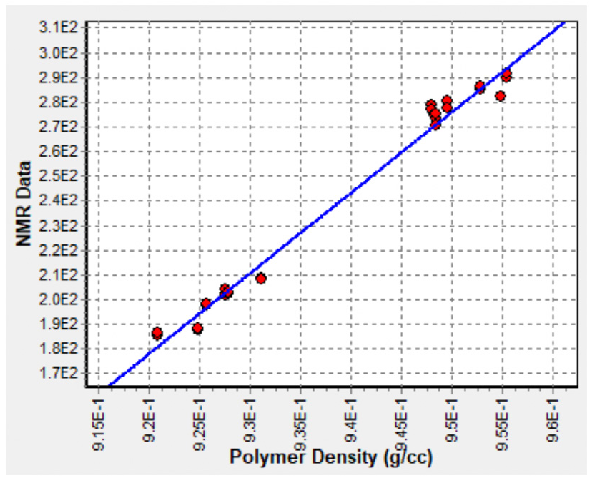
Fig. 1 — NMR calibration for polyethylene density. The correlation coefficient and standard deviation are 0.9930 and 0.0015 g/cc respectively.
| Reference value | Repeat Measurement 1 | Repeat Measurement 2 | Repeat Measurement 3 | Repeat Measurement 4 | Repeat Measurement 5 | Repeat Measurement 6 | Repeat Measurement 7 | Mean | Standard deviation |
| 0.9276 | 0.9276 | 0.9281 | 0.9284 | 0.9282 | 0.9285 | 0.9280 | 0.9282 | 0.9282 | 0.0003 |
Table 1 — Measurement repeatability test of polymer density (g/cc)
Conclusions
- NMR is very stable over the long term and rarely needs calibration adjustment.
- NMR is insensitive to the air voids between grains of powder or pellets.
- Measurement precision is good compared to wet chemical and other manual methods.
- Sample measurement time is rapid.
- The NMR technique is non-destructive so the same sample may be measured several times before being analysed by other techniques.