Application
Asphalt shingles are one of the most prevalent roof coverings used in North America. They are a composite product,
with a base layer of paper or fibreglass, which is impregnated or coated with an asphalt layer. This asphalt layer is
itself a composite of asphalt (bitumen in British English) and finely divided mineral (often limestone) fillers. The
performance and longevity of asphalt shingles is critically dependent on an accurate and consistent formulation of the
asphalt layer.
Advantages of NMR
Several methods are available to determine the filler content of asphalt. Perhaps the most commonly used is the
loss-on-ignition method which involves measuring the weight loss of a bituminous mixture during combustion in a
furnace. This test can take 40–60 minutes for ‘large’ samples, can be hazardous and costly, because of the
temperatures used, and produces hazardous fumes that must be directed out of the facility.
By contrast, NMR requires little sample preparation and the measurement is fast, repeatable and accurate. This
technique is a turn key solution and does not require special operator training.
Method
Benchtop NMR indirectly measures the filler content in asphalt by measuring the NMR signal (per unit mass) from the
asphalt and subtracting the asphalt content from the total mass, to give the filler content. (%Filler = 100% −
%Asphalt)
Calibration
The instrument is calibrated using a single sample of the asphalt thus can be easily recalibrated if the raw material
regularly changes. The notional mass of the calibration sample is varied to give a range of filler contents and pure
filler itself can be used as a 0% asphalt calibration point.
Measurement
A sample vial is tared then filled to a given height with the sample. Each sample is then weighed before placing in a
temperature conditioning block for 20 minutes. The conditioning temperature is usually 40°C, the same as the magnet,
for optimum precision.
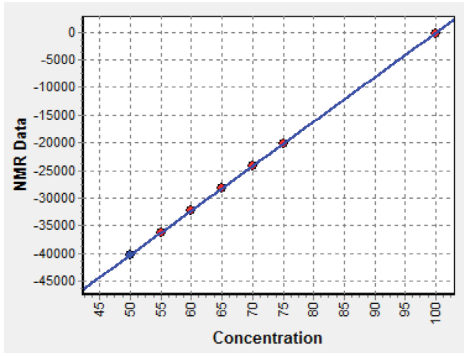
Filler in Asphalt calibration graph
Results
Table 1 shows the excellent reproducibility obtained for artificially-created (50% filled) and real (originally
unknown filler content) sub-samples.
| Sample |
%Filler |
| Sub-sample 1 |
Sub-sample 2 |
Sub-sample 3 |
Average |
Std Dev |
| 50% filled |
49.94 |
49.98 |
50.19 |
50.04 |
0.13 |
| Real (Unknown) |
65.27 |
65.08 |
65.46 |
65.27 |
0.19 |
Table 1. Measurement reproducibility of different unfilled and filled coating samples
Table 2 shows the excellent repeatability obtained from multiple measurements of the filled sample. This
reproducibility test on the same sample is only possible because NMR is a non-destructive technique, unlike the
loss-on-ignition method, in which the test destroys the sample.
| Repeat |
%Filler |
| 1 |
65.25 |
| 2 |
65.24 |
| 3 |
65.26 |
| 4 |
65.30 |
| 5 |
65.36 |
| 6 |
65.35 |
| 7 |
65.26 |
| 8 |
65.32 |
| 9 |
65.33 |
| 10 |
65.35 |
| Mean |
65.30 |
| SD |
0.05 |
Table 2. Measurement repeatability on the same filled coating sample
Conclusions
A primary calibration can be produced using a single sample of asphalt.
- NMR is very stable over the long term and rarely needs calibration adjustment
- Because NMR penetrates through the whole sample and is insensitive to air voids, it provides the most accurate
measurement of filler in a given volume of sample
- The measurement precision is typically better than 0.1% filler
- Sample measurement time is rapid (32 seconds)*
* For optimal precision samples should be conditioned at 40°C for 20 minutes in a dry block heater prior to analysis.
Summary
- Fast, accurate and repeatable
- Simple linear calibration
- Little sample preparation
- Easiest, most reliable technique available; suitable for unskilled operators – simple, intuitive visual software
- Non-destructive technique
Oxford Instruments Ready-to-run Application Package
The MQC+23 with a 0.55 Tesla (23 MHz) magnet, fitted with a 26 mm diameter (10 ml sample) probe is
ideal for this application. The MQC+23 uniquely has the largest gap between magnet poles for a 0.5
(actually 0.55) Tesla magnet. This results in the desirable combination of largest sample size with the highest
sensitivity. The Filler in Asphalt package comprises:
- MQC+23 which can be controlled using its own built-in computer operating Microsoft Windows or via
a stand-alone PC
- MultiQuant software including RI Calibration, RI Analysis, and
the EasyCal ‘Filler in Asphalt’ application
- Test/tuning sample
- 23 mm glass vials
- PTFE sample vial holders
- Installation manual
- Method sheet
In addition you may require:
- A dry block heater and aluminium block with holes for sample conditioning at 40°C
- A precision balance