Fragment-based drug design (FBDD) revolutionized drug discovery by providing a bottom-up approach to identifying and
evolving bioactive small molecules into drug candidates. FBDD resulted in 7 FDA-approved drugs and over 50 clinical
trials. NMR spectroscopy is the gold standard method for fragment screening, i.e. identifying the interaction of a
protein with small molecules of molecular mass below 300 g/mol. Until recently, NMR fragment screening required a
high-field NMR spectrometer, but recent developments by NexMR enable screening fragment libraries on a cryogen free
benchtop NMR spectrometer, such as the X-Pulse (Oxford Instruments).
NexMR's technology functions by illuminating samples to enhance the NMR signal of photoinducible fragments and
detect them within seconds to minutes of experiments. The sensitivity enhancement is achieved by spiking the sample
with a photosensitizer and an oxygen-quenching enzyme cocktail. Then, the sample is illuminated for a few seconds
while sitting in the magnet. Photo-induced signal enhancement is the fastest method to improve the sensitivity of NMR
instruments. Furthermore, it is performed at room temperature in an aqueous buffer, which is a preferred condition for
drug discovery.
For fragment screening purposes, the sample illumination must be compatible with an automated sample changer to
achieve sufficient throughput provided by the ultrafast measurement of NexMR's photoinducible fragment libraries.
Typical benchtop NMR setups are incompatible for illumination using automated sample changers as the light coupling
requests the physical connection of the light source and the sample through a waveguide, forcing the user's manual
intervention. A customised version of the Oxford Instruments X-Pulse with integrated light capability
alongside an automated setup enables a high screening rate of one sample every five minutes on a benchtop NMR
spectrometer, corresponding to a throughput of 288 samples daily.
X-Pulse is a modular broadband benchtop spectrometer that brings unmatched flexibility to any
analytical or research laboratory. In addition to a high throughput autosampler, it can be equipped with variable
temperature (0 to +65°C) or a flow cell.
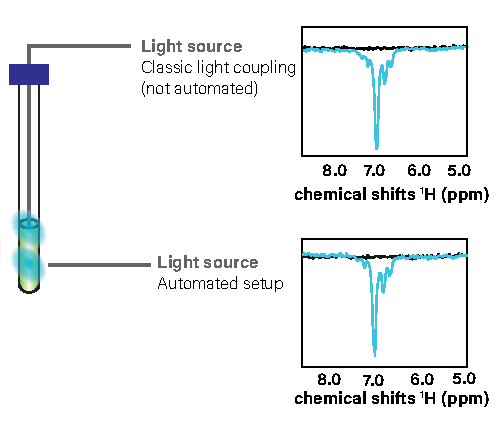
Fig. 1 — Automated X-Pulse with light and measurement of the signal-to-noise, comparing classic (non-automated)
and automated light coupling setups.
Performance of NexMR's fragment kits with X-Pulse
NexMR's fragment libraries (NMhare) contain different aromatic scaffolds observable with an
X-Pulse benchtop NMR spectrometer with integrated light capability. After illumination for a couple
of seconds, low concentrations of the fragments in an aqueous buffer (200 µmol/ℓ) are detected within 2 seconds, i.e.
in a single scan (Figure 2).
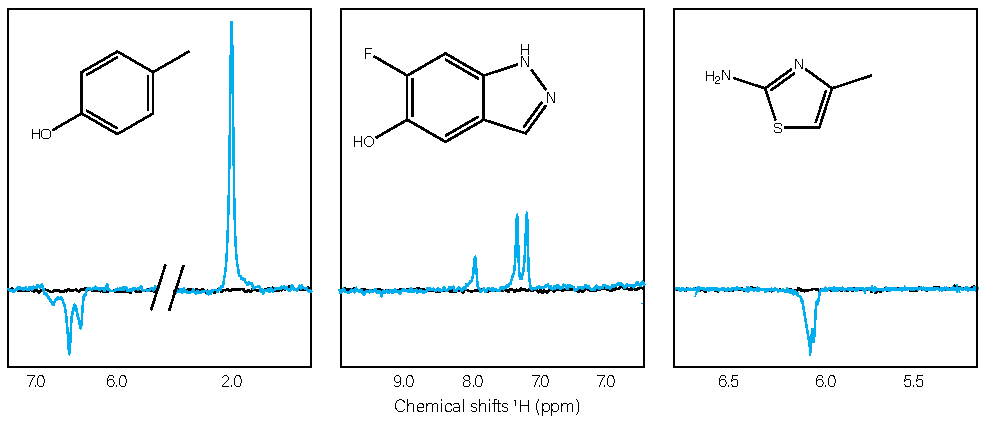
Fig. 2 — Photo-boosted NMR spectra (blue) of three fragments with diverse aromatic scaffolds after 2 seconds of
illumination, and the same experiment without illumination (black).
Sixteen of the eighteen fragments tested yielded an appreciable signal-to-noise ratio (SNR) following a single scan
at 200 µmol/ℓ. The median SNR was 7 (with an average of 20), the maximum SNR observed with a single scan was 112, and
the minimum was 2. An accumulation of sixteen scans yields a minimum SNR of 10, enabling quantitative peak analysis.
The maximum SNR was 450; with a median of 30, and an average of 82. This level of performance enables fragment
screening within 2 min; without photo-boosted NMR, such experiments would require >100 hours.
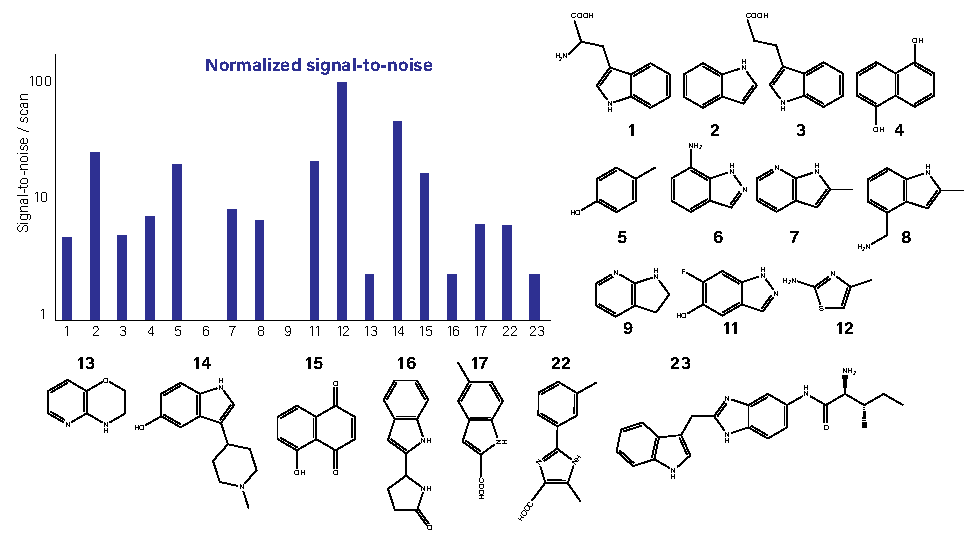
Fig. 3 — Signal-to-noise ratio (SNR) per molecule and scan. Each molecule was measured at a concentration of 200
µmol/ℓ.
Low micromolar measurements
As a rule of thumb, a SNR of 10 is required for quantitative peak analysis. At high magnetic fields, ligand-observed
NMR screening is carried out at 50–200 µmol/ℓ ligand concentrations. We evaluated the SNR at different concentrations
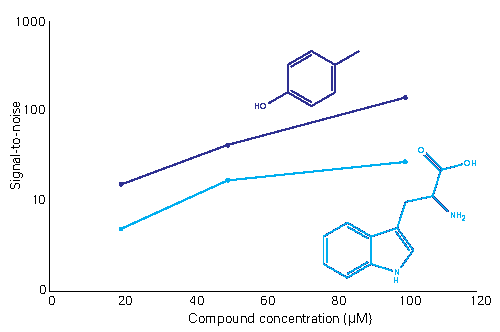
for two emblematic molecules yielding photo-boosted NMR: tryptophan and cresol. Within sixteen scans (2 min),
observing down to 20 µmol/ℓ for both molecules is possible (Figure 4). For quantitative analysis, we recommend using
64 (8 min) scans for 20 µmol/ℓ screening and 16 for 50 µmol/ℓ screening.
Fragment-screening with X-Pulse benchtop NMR spectrometer and NMhare photo-inducible libraries
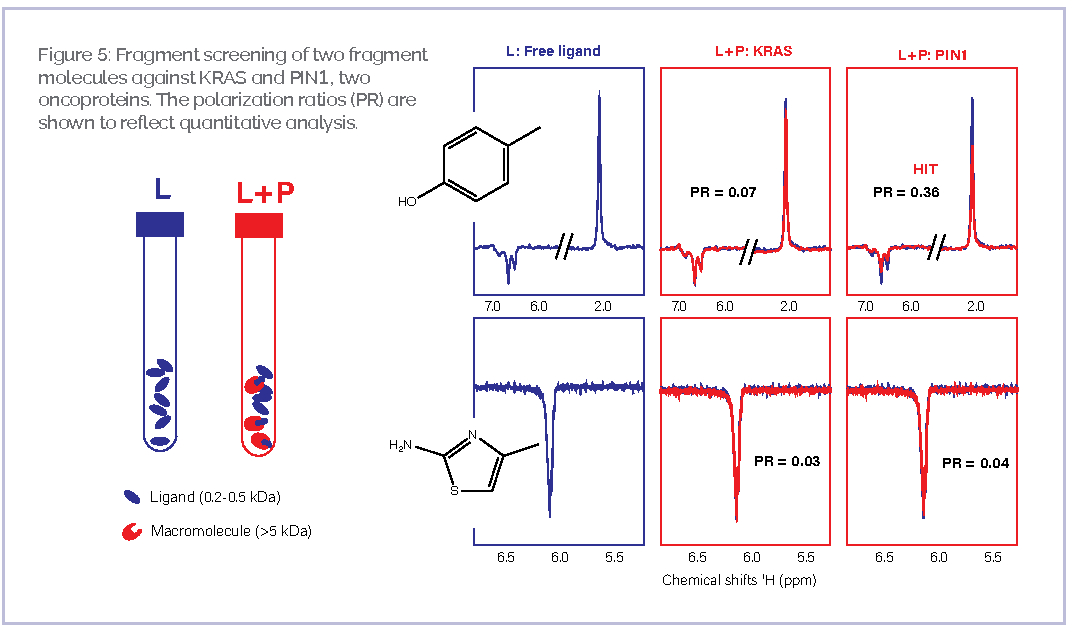
Small molecules can interact with larger macromolecules to form a complex in slow rotational motion. When this
happens, the small molecule polarization is transferred to the protein through the nuclear Overhauser effect (NOE),
causing a reduction in signal intensity. Identifying a protein-fragment binding event is possible by tracking the
signal reduction following addition of a protein of interest. This fragment screening technology was previously
described by NexMR and the Riek Lab (ETH Zürich).1
The signal reduction is quantified with the polarization ratio (PR
) defined as:PR
= 1 − (I
PL / I
L)I
PL and I
L refer to the integral of the hyperpolarized ligand peak with and without protein, respectively.
We tested the molecules against known protein targets to observe the signal reduction upon binding on all molecules
that exhibited photo-boosted signals. One fragment showed a particularly significant reduction in the signal, which
was deemed a 'hit'. The hit was only observed for the PIN1 protein and not for the KRAS protein, where the
characteristic decrease in signal was observed. If PIN1 were a druggable target protein, medicinal chemists could
start to base their drug design around this fragment as it has been proven to bind with the protein.1 F.
Torres et al., J. Am. Chem. Soc.
, 2023, 145, 12066–12080.
Summary
In summary, automated high throughput fragment screening has been demonstrated using NexMR's fragment library and
Oxford Instruments X-Pulse with autosampler. By making use of photo-induced signal boosting, the
experiment time was reduced from >100 hours to 2 minutes. This reduction in experiment time allowed for testing of
fragments for their photo response and then subsequent screening of protein molecules for any binding, all within just
one working day. This high throughput, high reliability screening approach should enable academia and industrial
pharma researchers to accelerate drug development in their laboratories using small footprint, cryogen free benchtop
NMR.
About NexMR
NexMR is a technology company developing and commercializing fragment libraries tuned for photo-hyperpolarization and
an experimental protocol for fragment screening and affinity determination. NexMR's technology enables ultrafast
detection of micromolar amounts of small molecules, even at low magnetic fields. For more detailed information: https://www.nexmr.com