Cocoa beans are processed to extract cocoa liquor and cocoa butter, both major ingredients of dark and milk
chocolate. Cocoa beans are roasted, separated from their shell and cracked into nib. Nib is then ground to produce
cocoa liquor or cocoa butter plus cocoa powder. As the quality of the beans can vary depending on the environmental
conditions in the region where they were grown, it is important to quantify the fat content of the raw and
intermediate materials to ensure consistency of the final product.
Advantages of Benchtop NMR
The International Office of Cocoa, Chocolate and Sugar Confectionery Industries (IOCCC) 14-1972 and AOAC 963.15
methods involve acid digestion to release the bound lipids followed by extraction using petroleum ether. However,
these methods are time consuming, require skilled operators and the use of hazardous solvents.
The MQC+ benchtop Nuclear Magnetic Resonance (NMR) analyser provides an alternative method to wet
chemistry; it is quick and easy to perform, simple to calibrate, and requires minimal sample preparation. As such it
is ideal for routine operation without any requirement for hazardous chemicals or specialist operator training.
Summary
- Fast, accurate and repeatable
- Minimal sample preparation
- Simple calibration using cocoa butter or a range of standards
- Most reliable technique available; suitable for non-specialised personnel
Method
The analytical technique is based on direct measurements of the NMR response obtained from the fat in chocolate
products normalised by the sample mass. The fat content is quantified by calibrating the NMR signal per gram of sample
against concentration determined by a suitable reference technique.
Calibration
Ultimately, only two well known standards are required to calibrate the instrument as the calibration is linear.
However initially it is recommended that the instrument is calibrated by 3–6, preferably more, standards with known
fat contents evenly spread over the range of interest.
NMR is a comparative technique therefore cannot be more accurate than the reference technique against which it is
being compared. However, it is more robust and reproducible than extraction methods and therefore calibration error is
reduced by analysing more reference samples.
Measurement
The melted chocolate is poured into a pre-tared vial and weighed. The vial is then placed in a temperature controlled
conditioning block at 50°C for 20 minutes prior to analysis. Inserting the sample into the instrument automatically
starts the NMR analysis after which it displays the fat content after 8 seconds.
Results
Calibrations were obtained by measuring various samples of dark and milk chocolate (Figure 1) and chocolate crumb
(Figure 2), a mixture of milk, sugar and cocoa liquor, and plotting the NMR data against the fat contents obtained by
the International Office of Cocoa Chocolate and Sugar Confectionery (IOCCC) reference method.
The results for both chocolate and crumb show excellent correlations with R values of 0.999 and 0.997 respectively.
The reference values are compared against those calculated from the NMR calibration in Tables 1 and 2.
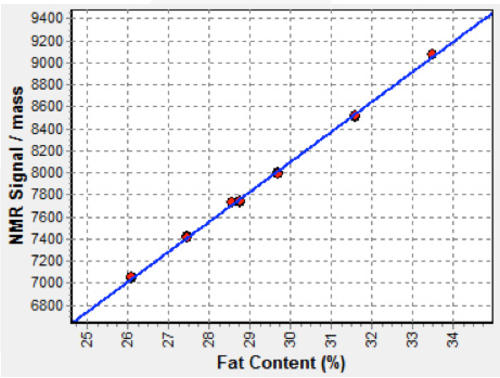
Fig. 1 — NMR calibration for Total Fat Content of dark and milk chocolate referenced against the IOCCC method.
The correlation coefficient (R) and standard deviation (σ) are 0.999 and 0.07 respectively.
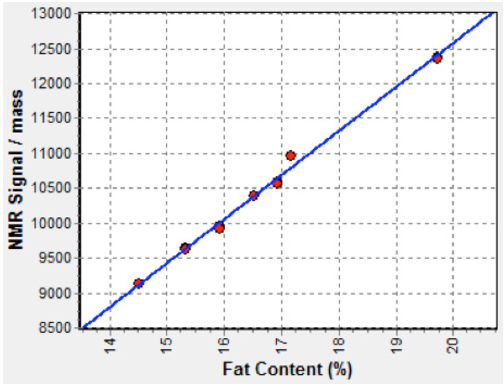
Fig. 2 — NMR calibration for Total Fat Content of chocolate crumb referenced against the IOCCC method. The
correlation coefficient (R) and standard deviation (σ) are 0.997 and 0.12 respectively.
| Sample |
Ref. Value (%) |
NMR Value (%)* |
Diff. (%) |
| 1 |
29.7 |
29.7 |
0.0 |
| 2 |
28.6 |
28.7 |
0.1 |
| 3 |
33.5 |
33.6 |
-0.1 |
| 4 |
27.5 |
27.5 |
0.0 |
| 5 |
26.1 |
26.1 |
0.0 |
| 6 |
31.6 |
31.5 |
-0.1 |
| 7 |
28.8 |
28.6 |
-0.2 |
Table 1. A comparison of the fat contents of various samples of dark and milk chocolate obtained from the
reference technique against those calculated from the NMR calibration in Figure 1. *Average of two subsamples.
| Sample |
Ref. Value (%) |
NMR Value (%)* |
Diff. (%) |
| 1 |
14.5 |
14.5 |
0.0 |
| 2 |
15.3 |
15.3 |
0.0 |
| 3 |
15.9 |
15.8 |
-0.1 |
| 4 |
16.9 |
16.9 |
0.0 |
| 5 |
16.5 |
16.6 |
0.1 |
| 6 |
17.2 |
17.4 |
0.2 |
| 7 |
19.7 |
19.7 |
0.1 |
Table 2. A comparison of the fat contents of various samples of chocolate crumb obtained from the reference
technique against those calculated from the NMR calibration in Figure 2. *Average of two subsamples.
Conclusions
- A primary calibration can be produced using multiple reference samples that span the concentrations of interest.
Alternatively, a single cocoa butter sample can be used to cover concentrations ranging from 0.5 to 100%.
- NMR is very stable over the long term and rarely needs calibration adjustment.
- NMR penetrates through the whole sample and is insensitive to air voids, which means it provides the most accurate
measurement of the total amount of fat in a given volume of sample.
- Measurement precision is good compared to wet chemical methods, typically <0.1%.
- Sample measurement time is rapid (typically 8 seconds).
- The NMR technique is non-destructive so the same sample may be measured repeatedly before being analysed by other
techniques.
Complete Package
Oxford Instruments offers a package especially tailored to the measurement of Total Fat Content in Chocolate and
other Cocoa Derivatives:
- Oxford Instruments MQC+23 NMR Analyser
- 0.55 Tesla (23 MHz) high homogeneity magnet
- Probe for 23 mm diameter sample vials (10 ml sample volume)
- Integrated system controller (no external PC required)
- Integrated flat-screen display
- MultiQuant software including RI Calibration, RI Analysis, and
the EasyCal ‘Total Fat Content in Chocolate’ application
- Test/tuning sample
- 23mm diameter vials
- PTFE vial holders
- A set of three Calibration Maintenance Standards (CMSs)
- User manuals
- Method sheet
In addition to the above, the following are also required:
- A precision balance (3 decimal places)
- A dry heater and aluminium block with holes for sample conditioning at 50°C