Summary
- Fast, accurate and repeatable
- Minimal sample preparation
- Simple linear calibration, no chemometrics
- Easiest, most reliable technique available; suitable for non-technical personnel
The MQC+ benchtop Nuclear Magnetic Resonance (NMR) analyser provides an alternative method to wet
chemistry and NIR; it is quick and easy to perform, simple to calibrate, and requires minimal sample preparation. As
such it is ideal for routine operation without any requirement for additional chemicals, complicated calibrations or
specialist operator training.
Application
Measurement of oil (and water) in oilseed residues after crushing and solvent extraction is important to ensure
maximum process efficiency. Likewise the oil content of the oilseed and grain by-products is also important for their
end use, mainly animal feed and other speciality uses.
Advantages of NMR
Solvent extraction techniques are commonly used for determination of oil content. However, these methods can be time
consuming, require skilled operators and the use of hazardous solvents.
NIR is rapid but measures only the surface layer, so sample grinding may be required for improved reproducibility. In
addition, NIR requires calibration using a large number of reference samples that represent a variety of factors
including oil and water content, seed or grain type, particle size or colour. Therefore, the results may unknowingly
be inaccurate if the sample is outside the range/scope of the calibration.
In contrast:
- NMR does not require solvents which are hazardous to use and in its disposal.
- NMR is a bulk measurement technique and so measures all the oil in the sample regardless of the particle size.
- NMR is the method of choice for sunflower seeds since it is unaffected by colour.
- Oil and water calibrations may be obtained using just three samples.
- NMR provides a rapid measurement for a variety of sample sizes.
Method
The oil and water measurement involves differentiating the two analytes on the basis of their NMR relaxation times.
The NMR signal from solids within a sample decay rapidly, leaving signals originating only from oil and bound water.
Subsequently the signal from the bound water decays leaving that from the oil only. The water signal is determined by
taking the difference between the oil and combined oil + bound water signal.
Calibration
Since NMR calibrations are always linear, theoretically only two well known standards are required to calibrate the
instrument. However it is recommended that the instrument is calibrated using 3–6 standards with known oil contents
evenly spread over the range of interest. The instrument may be calibrated by measuring the NMR value against:
- Solvent-only Soxhlet extraction for 'crude' oil, OR
- Soxhlet extraction preceded by acid hydrolysis for 'total' oil content.
NMR is a comparative technique and therefore cannot be more accurate than the reference technique against which it is
being compared. However, it is more reproducible than wet chemical methods, which have more manual steps, therefore
errors are reduced by analysing more reference samples.
Conditioning and Measurement
Samples are poured into glass NMR tubes up to a predefined mark and weighed. Large samples (80 or 40ml) are normally
conditioned at room temperature in a stable environment. For small sample volumes (≤14ml) conditioning using a dry
heating block is recommended for best repeatability. The NMR measurement time is typically 16 seconds per sample.
Results
Figure 1 shows that a good linear calibration can be generated for oil content across a wide concentration range
(approx. 10–50%) for both canola (seed, cake and meal) and corn (germ and meal) products using an MQC+5 analyser with
a 51mm diameter (80ml volume) probe.
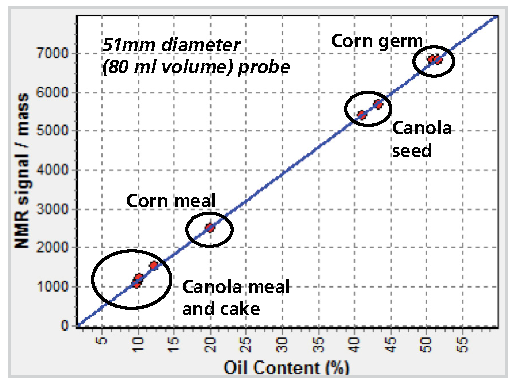
Fig. 1 — NMR calibration generated from acid hydrolysis followed by Soxhlet data for oil in various canola and
corn products without drying (moisture < 10%) at room temperature. The correlation coefficient and standard
deviation are 1.00 and 0.33% respectively.
Furthermore, Figure 2 shows that a good linear calibration can be generated for oil content in soya beans (whole),
wheat (ground) and maize by-product (ground) for concentrations ranging from 1 to 22% using an MQC+5 analyser with
40mm diameter (40ml volume) probe.
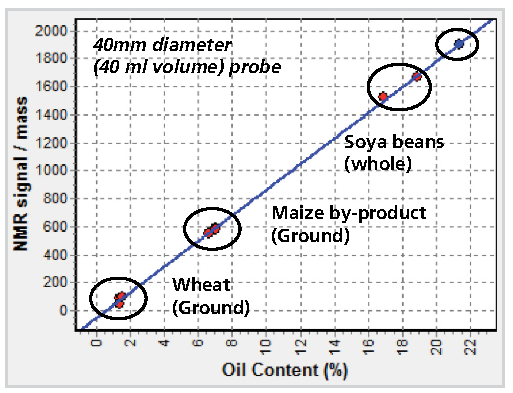
Fig. 2 — NMR calibration generated from Soxhlet data for oil in soya bean (whole), maize (ground) and wheat
(ground) samples at room temperature. The correlation coefficient and standard deviation are 1.00 and 0.16%
respectively.
Sampling Error vs. Sensitivity
The choice of NMR probe is dependent on the sample size or sensitivity required. The 51mm probe offers double the
sample volume of the 40mm probe and therefore has reduced sampling errors, i.e. better reproducibility; the 51mm probe
is preferred for sunflower seeds. However the 40mm probe is more suited to measurement of very low concentrations,
e.g. after the solvent extraction processing step.
Repeatability
Table 1 shows that the measurement repeatability of both canola seed and cake is good at room temperature (using 51mm
probe). Each sample was left to equilibrate at room temperature for 20 minutes prior to each measurement.
| Sample |
Repeat Measurements |
Mean (%) |
SD (%) |
| Canola seed |
43.04 |
43.09 |
43.1 |
43.09 |
43.11 |
43.09 |
43.15 |
44.16 |
43.14 |
43.11 |
43.11 |
0.033 |
| Canola cake |
9.4 |
9.37 |
9.4 |
9.4 |
9.42 |
9.37 |
9.37 |
9.43 |
9.4 |
9.43 |
9.4 |
0.022 |
Table 1: Repeatability of oil content measurement of samples at room temperature
Measurement Error
Both examples indicate that it is possible to use one calibration for several different types of oil, provided they
have similar composition, related to the degree of unsaturation of the fatty acids. The deviations from the
calibration line are less than the errors associated with the reference techniques used. The deviations are typically
caused by unextracted oil which is bound to the matrix. Therefore NMR tends to correlate better with the total oil
content measured by extraction after acid hydrolysis.
Conclusion
- NMR is very stable over the long term and rarely needs calibration adjustment.
- NMR is insensitive to the air voids between the grains or powder.
- Measurement precision is good compared to wet chemical methods.
- Sample measurement time is rapid (typically 16 seconds).
- The NMR technique is non-destructive so the same sample may be measured repeatedly before being analysed by other
techniques.
Complete Package
Oxford Instruments offers various packages tailored to the measurement of oil and water in oilseeds, their residues
(pressed cake or meals) and various other grains (maize, wheat, corn):
- Oxford Instruments MQC+5 NMR Analyser*
- 0.11 Tesla (5 MHz) high homogeneity magnet
- Probe for 51 or 40 mm diameter sample tubes (80 and 40 ml sample volumes)
- Integrated system controller (no external PC required)
- Flat-screen display
- MultiQuant software including RI Calibration, RI Analysis, and
the EasyCal 'Oil and Water in Seeds' application
- Test/tuning sample
- Glass tubes
- Oil and Water Calibration Maintenance Standards
- User manuals
- Method sheet
In addition you may also wish to purchase:
- A precision balance (2 decimal places for 80 ml and 40 ml samples)
*Packages based on the MQC+23 are available where oil content of smaller volumes or single seeds is
required (up to 14ml sample volume). A 10mm (2ml sample volume) diameter probe is required to measure Solid Fat
Content (SFC) on the same instrument.
Oxford Instruments MQC+ NMR Analyser — shown with electronics with integral PC