Introduction
When the first commercial NMR instruments were introduced in the early 1950s, they could analyse a single nucleus:
hydrogen-1 (1H, proton). Only many years later would commercial multinuclear spectrometers be introduced.
They soon became a mainstay of analysis in both academia and industry, fuelling discoveries in fields ranging from
chemistry to biotechnology, pharmaceuticals, polymers, and energy, among many others.
Benchtop NMR instruments, which offer NMR capabilities in a more compact, low-maintenance form factor, have followed
a similar, if faster, development path. Since the introduction of the first, single-nucleus spectrometers in 2009,
two- and three-nucleus versions quickly became available. Just a decade later, 2019 saw the debut of the
X-Pulse 60, the first broadband multinuclear benchtop NMR spectrometer, expanding the reach of
benchtop instruments into areas previously reserved for traditional high-field spectrometers. The 2025 launch of the
X-Pulse 90 further extended broadband benchtop NMR spectroscopy to a higher frequency, with increased
sensitivity and improved signal dispersion.
As broadband capabilities became available in compact benchtop systems, X-nuclei NMR spectroscopy is accessible to a
wider range of users across new academic and industrial fields. However, before starting, it is important to
understand which nuclei can be observed, which factors influence their detectability, and how instrument configuration
and setup affect measurement feasibility and data quality.
The following sections introduce the fundamentals to X-nuclei spectrometry and explain how to tune the NMR
spectrometer to the nuclei of interest to achieve best possible results.
X-Nuclei NMR spectroscopy Basics
Many elements are observable by NMR but not every atom of each element is. Chemical elements differ by the number of
protons in their nucleus, indicated by their atomic number. Each atom of an element has the same number of protons.
However, atoms of the same element can have different numbers of neutrons in the nucleus, producing multiple isotopes
each with a unique atomic mass. This varying composition of atomic nuclei alters their physical properties, affecting
their suitability for NMR spectroscopy.
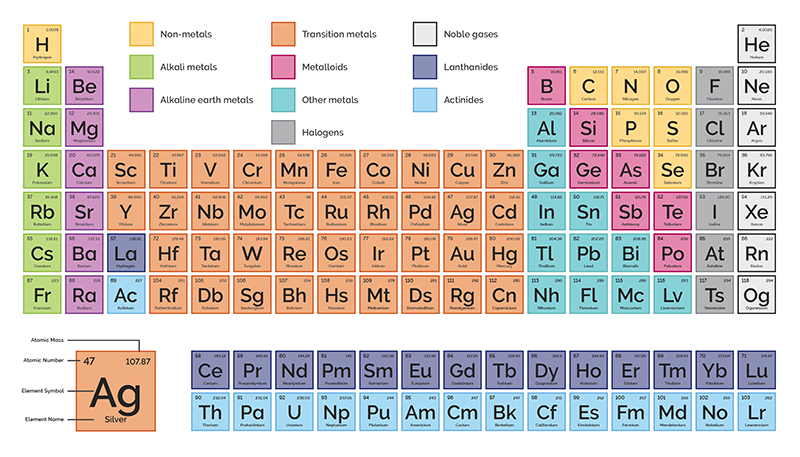
Figure 1 Periodic Table of the Elements
What are the nuclei properties relevant to NMR spectroscopy?
Some of the properties relevant to NMR spectroscopy of selected isotopes are summarised in Table 1.
Table 1 NMR properties of selected isotopes
| Isotope |
Nuclear Spin, I |
Natural Abuncance (%) |
Larmor Frequency @1.4 T (MHz) |
Larmor Frequency @2.1 T (MHz) |
Relative Receptivity versus 13C |
| Hydrogen-1 (proton) |
1/2 |
99.99 |
59.70 |
90.45 |
5870 |
| Hydrogen-2 (deuterium) |
1 |
0.0115 |
9.16 |
13.88 |
< 0.01 |
| Lithium-7 |
3/2 |
92.41 |
23.20 |
35.15 |
1590 |
| Boron-10 |
3 |
19.90 |
6.41 |
9.72 |
23.2 |
| Boron-11 |
3/2 |
80.10 |
19.15 |
29.02 |
777 |
| Carbon-13 |
1/2 |
1.07 |
15.01 |
22.74 |
1 |
| Nitrogen-14 |
1 |
99.63 |
4.31 |
6.54 |
5.9 |
| Nitrogen-15 |
1/2 |
0.37 |
6.05 |
9.17 |
0.02 |
| Fluorine-19 |
1/2 |
100 |
56.17 |
85.11 |
4900 |
| Silicon-29 |
1/2 |
4.68 |
11.86 |
17.97 |
2.16 |
| Phosphorus-31 |
1/2 |
100 |
24.17 |
36.61 |
391 |
| Cobalt-59 |
7/2 |
100 |
14.17 |
21.46 |
1640 |
| Platinum-195 |
1/2 |
33.83 |
12.83 |
19.44 |
20.7 |
Nuclear Spin
Nuclear spin is one physical property relevant for NMR. In principle, all nuclei with a non-zero nuclear spin may be
observed by NMR spectroscopy. In practice, other considerations, such as the abundance of the isotope, its
sensitivity, and its typical linewidth, make some nuclei easier to analyse than others.
Isotopic abundance
In nature, most chemical elements are found as a mixture of isotopes. The NMR signal is directly proportional to the
number of nuclei in the sample producing that signal, therefore the abundance of an NMR active isotope greatly
influences the ease of analysis.
For isotopes with low natural abundance, isotopic enrichment can increase sensitivity; doubling the percentage of a
low abundance isotope in the sample would double the signal. One everyday example is the use of deuterated solvents,
in which the percentage of deuterium (2H) is routinely increased from its natural abundance of 0.0115% to
99% or higher to provide a strong deuterium lock signal.
Larmor Frequency
Another consideration is that each NMR active isotope has a different level of sensitivity, which is related to the
frequency of the signal it produces. In a fixed magnetic field, each isotope resonates at a characteristic frequency
(called the Larmor frequency).
Although the term "Larmor frequency" may be unfamiliar to casual NMR users, they probably use it every day,
as magnet strengths are commonly expressed as the 1H Larmor frequency (for example, 90 MHz for the X-Pulse
90's 2.1 tesla permanent magnet). All other considerations being equal, in a fixed magnetic field, an isotope that
produces a signal at a higher frequency will be more sensitive. Other than the extremely low-abundance, radioactive,
tritium (3H) isotope; the high-abundance proton (1H) has the highest Larmor frequency, which is
a major reason for its popularity in NMR.
Receptivity
The receptivity of an isotope quantifies the overall ease of observation by NMR spectroscopy, accounting for both its
natural abundance and physical properties. Receptivity is usually reported either relative to proton or to carbon-13
(as done in Table 1). Comparing values of the different isotopes shows that observation of 1H is
almost six thousand times "easier" than that of 13C.
Low receptivity in NMR spectroscopy can be overcome by increasing sample concentration, running longer experiments
(increasing the number of scans), and choosing specific experiments designed to enhance sensitivity.
What NMR spectrometer capabilities are required for X-nuclei analysis?
In addition to the properties of a nucleus, the capabilities of the NMR spectrometer are a critical consideration for
X-nuclei NMR spectroscopy. To analyse a nucleus, the NMR spectrometer hardware must be designed to operate at its
Larmor frequency.
Different nuclei have different Larmor frequencies. A proton, for example, will resonate at 90 MHz on a 2.1 tesla
magnet, but 13C will resonate at just 22.7 MHz. As an example of the scope of an NMR spectrometer, the
broadband X-channel of an X-Pulse 60 or 90 fitted with a standard broadband probe and preamplifier can analyse nuclei
with Larmor frequencies between 41% and 19% that of the proton. A few of the nuclei in this range include
13C, 31P, 7Li, 11B, 23Na, 27Al, and 29Si.
Observing nuclei outside that range would require the probe and/or preamplifier to be exchanged for ones optimised
for the frequence range of interest. For example, the low-frequence probe/preamplifier available for the X-Pulse 60
which will allow for the observation of nuclei with Larmor frequencies between 14% and 7% that of the proton
(including: 2H, 15N & 14N).
Tuning & Matching an NMR Spectrometer
To get the best performance out of an NMR spectrometer, it is important for the electrical circuit used to transmit
and receive the radio-frequency (RF) signals to be tuned to the Larmor frequency of the nuclei, through a process
known as tuning & matching (commonly referred to just as tuning).
Tuning & matching is performed by adjusting two capacitors within the probe. The first is used to tune
the RF to the relevant nuclei and is analogous to tuning to a radio station; the second is used to match the
impedance of the sample to the circuit. This ensures that the maximum possible RF energy is absorbed by the sample,
and hence the strongest possible NMR signal is obtained.
Due to the wide frequency range of the broadband X-channel on the X-Pulse, it is also necessary to swap between
various fixed capacitors to tune between the complete range of nuclei. While on high-field NMR spectrometers, these
adjustments would usually be made on the bottom of the probe, so underneath the magnet; on an X-Pulse the various
capacitors are easily accessible on the top of the magnet, next to the sample load position.
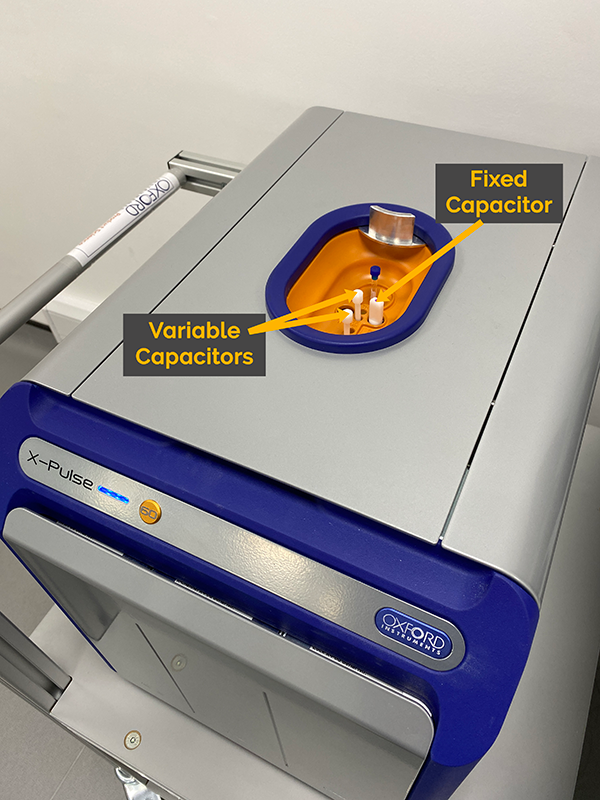
Figure 2 Oxford Instruments X-Pulse Broadband Benchtop NMR Spectrometer showing the
variable and fixed capacitors for Tuning & Matching the X-channel.
Why is it important to tune an NMR spectrometer correctly?
An NMR spectrometer needs to be tuned correctly for a number of reasons. Not only will it maximise the sensitivity of
the measurement; it ensures that the RF pulses are as short as possible and minimises the power required for
decoupling. Most importantly it ensures that previously calibrated pulse widths (and powers) are reproducible, which
is essential when performing advanced multi-pulse NMR experiments.
How to tune and match an NMR spectrometer?
To tune & match an NMR spectrometer the frequency is swept over a narrow region centred on the target frequency,
with the response compared with a reference, this gives a curve showing reflected energy. By aligning the minima of
the curve with the target frequency and ensuring that the minima is as close to zero intensity as possible, the
spectrometer can easily be tuned.
Watch this video for a demonstration of tuning and matching in the X-Pulse: Measuring 7 nuclei in 37 minutes
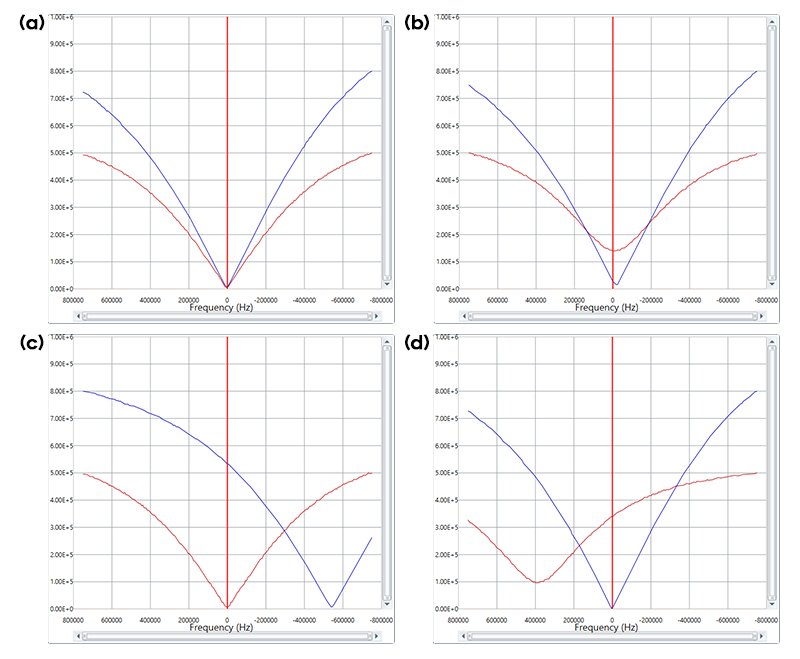
Figure 3 Tuning & Matching in Oxford Instruments SpinFlow software, with the
1H/19F channel in red and the X-channel in blue: (a) both channels well-tuned & matched; (b)
1H/19F channel well-tuned but poorly matched; (c) X-channel poorly tuned but well matched; (d)
1H/19F channel poorly tuned & matched.
Since the electrical properties of samples vary, optimal tuning & matching of an NMR spectrometer varies between
samples. These differences arise mostly from the solvent, and the degree of ionic character of the sample. The most
significant changes are observed when changing between ionic aqueous solutions and low-polarity organic solvents.
Therefore, it is important to tune & match on individual samples, and not just on the individual nuclei.
Summary
While the vast majority of elements have at least one NMR active nuclei and in principle can be observed by NMR
Spectroscopy, there is a number of considerations related to acquiring spectra in practice. This includes the
NMR-active nuclei's abundance and sensitivity, and if it is possible to tune the NMR spectrometer to the
appropriate frequency. To obtain spectra of different nuclei it's important to be able to tune the NMR
spectrometer not only to the individual nuclei, but for the specific sample.
The Oxford Instruments X-Pulse 90/60 Broadband Benchtop NMR Spectrometers are fully tuneable
systems, capable of observing a wide range on nuclei including 1H, 19F, 13C,
31P, 7Li, 11B, 23Na, 27Al, 29Si and many more.