How can you get the Most Information from Expanded Samples?
Traditional light microscopy is limited by the diffraction of light. Consequently, features less than 200 nm apart cannot be resolved. For a significant time microscopy technique development was focused towards improving imaging techniques to allow individual molecules to be resolved. Super-resolution microscopy was developed at the beginning of the 21st century to allow imaging at a resolution beyond the 200 nm barrier (Schermelleh, Heintzmann et al. 2010, Schermelleh, Ferrand et al. 2019). However, super-resolution techniques have limitations, such as limited field of view, limited imaging depth, incompatibility with multicolour experiments, slow acquisition time and high energy illumination intensity requirements. To overcome these hurdles, a few creative research groups went in a different direction and explored what could be done to allow standardised and straightforward nanoscale imaging. Expansion Microscopy (ExM) is an imaging protocol which allows conventional light microscopes to see sub-diffraction limited (<200 nm) or densely packed details which previously could not be distinguished. The development of this new modality of magnification was reported in 2015 by Edward Boyden's team at MIT. While attempting to overcome the difficulties in mapping molecules across the large scales of neural circuits in the brain, Boyden's research group developed a way to magnify the specimen itself, instead of magnifying the emitted signal from the specimen. (Chen, Tillberg et al. 2015).
Table 1- Glossary.
| Glossary: |
| AcX |
acryoyl-X, SE, 6 - (acryoyl amino hexanoïc) ester succinimidylique (crosslinking agent that reacts with amines of proteins and be copolymerized in polyacrylamide matrices) |
| DiExM |
differential expansion microscopy |
| DMAA |
N,N dimethylacrilamide acid - (nonionic acrylic monomer that can make swellable polymeric particles) |
| ExFish |
expansion microscopy fluorescence in situ hybridization |
| ExM |
expansion microscopy |
| FP |
fluorescent protein |
| GA |
glutharaldehyde (crosslinking fixative, penetrate membran more slowly than PFA) |
| HCR |
hybridization chain reaction |
| iExM |
iterative expansion microscopy |
| IF |
immunofluorophore |
| MA NHS |
methacrylic acid N-hydroxysuccinimide ester (crosslinking agent that reacts with amines of proteins and can be copolymerized in polyacrylamide matrices) |
| MAP |
maximum analysis of the proteome |
| MBAA or BA |
N’N Methylenebis (acrylamide) /(bisacrylamide) crosslinking agent that polymerize with acrylamide and creates crosslinks within the polyacrylamide gel) |
| PFA |
paraformaldehyde (crosslinking fixative, preserves the secondary/tertiary structures of proteins) |
| ProExM |
protein-retention expansion microscopy |
| SDS |
sodium dodecylsulfate (anionic surfactant useful to denature and dissociate proteins) |
| SRRF |
super resolution radial fluctuations |
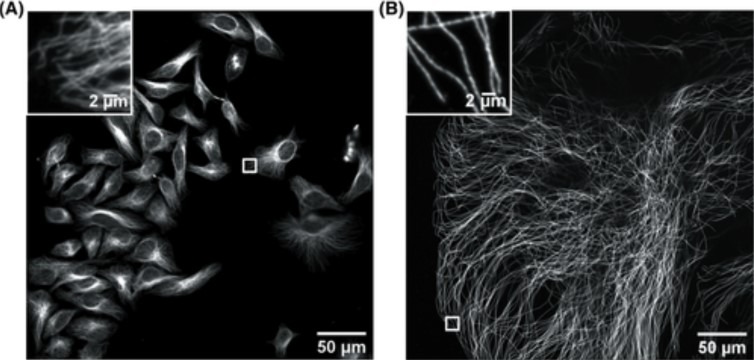
Figure 1. Confocal image of HeLa cells non expanded microtubules (right) and 4.5x linearly expanded microtubules (left). Imaging was performed on an Andor spinning-disk confocal microscope (Dragonfly) with a 40×, numerical aperture (NA) 1.15 water- immersion objective. (A) Confocal image of HeLa cells with immunostained microtubules, imaged at a single xy plane at the bottom of the cells. The inset in the upper left zooms in on the small box at the middle right. (B) Confocal image of a ∼4.5× linearly expanded HeLa cell with immunostained microtubules, imaged at a single xy plane at the bottom of the cell. The inset in the upper left zooms in on the small box at the bottom left. Scale bars in (B) indicate post-expansion scales. Only a fraction of an expanded cell fills the entire field of view. The respective insets display a zoom of the respective small boxes of the full field of view. (Zhang, C., et al, Current Protocols in Neuroscience ,2020).
ExM is a cost-effective sample preparation method which consists of synthesising a dense interconnected web of swellable polymer within a biological specimen. The tissue, within the polymer matrix is expanded and labelled. Once immersed in water, the expansion pulls apart the cellular structures isotropically to create large gaps between each biomolecule. The specimen is isotropically magnified, as a result an effective higher resolution is achievable with a standard microscope. A 4x linear expansion is reported in pure water which means a 64x volumetric expansion. Using Andor spinning disk confocal (Dragonfly) on an expended microtubule Hela cells sample shown in Figure 1 reveals how using expansion microscopy protocols, researchers can see previously unseen details in their samples. Nevertheless, care must be taken when preparing expanded samples; successful implementation of the expansion microscopy protocols relies on:
- Embedding safely: the polymer needs to be inserted into cells using a non-invasive methodology. Carefully inserting the small monomers into the cells and tissues. These monomers are building blocks of the hydrogel that will then expand. The trick is to trigger the monomer polymerisation once they are inside the preserved cells and tissues.
- Expanding without de-structuring: the key is expanding the sample whilst keeping the structural organisation of cells intact. To ensure the expansion does not distort the sample, the specimen is treated with heat/detergent or an enzymatic digestion to mechanically homogenize the specimen which ensures that the organisation remains intact.
Table 2- Comparison of Expansion microscopy protocols. See the glossary above for the abbreviations
| Protocol name |
ExM (Boyden Lab) |
ExM (Vaughan Lab) |
ProExM (Boyden Lab) |
MAP (Chung Lab) |
ExFiSH (Boyden Lab) |
| Hydrogel |
acrylamide + sodium acrylate +++ MBAA |
acrylamide + sodium acrylate +++ |
acrylamide + sodium acrylate +++ |
acrylamide +++ sodium acrylate + BA |
acrylamide sodium acrylate MBAA |
| Linking agent |
acrydite |
MA-NHS GA |
acryloyle-X (AcX) |
paraformaldehyde acrylamide |
LabelX (AcX + Label-IT amine) |
| Disruption agent |
proteinase K |
proteinase K |
proteinase K |
SDS |
proteinase K |
| Disruption type |
digestion |
digestion |
digestion or gentle disruption |
denaturation dissociation |
digestion |
| Expansion factor (linear) |
4.5 |
4.0-4.2 |
4 |
4 |
3.3 |
| Resolution |
70 nm |
65 nm |
70 nm |
60 nm |
/ |
| FP preservation |
no |
yes |
yes (50% intensity) |
no |
no |
| IF staining |
no |
yes |
yes |
yes |
no |
| Sample |
cells, brain tissue |
cells, brain tissue |
cells, brain, pancreas, lung, spleen tissues |
cells, brain, spinal cord, lung, heart, liver, kidney, intestine tissues |
cells, brain tissue |
| Target |
proteins |
proteins & DNA |
proteins |
proteins & saccharides |
RNA & DNA |
| Pros comments |
first method reported |
conventional fluorophores organelle level |
conventional fluorophores post-expansion labelling |
post-expansion labelling whole organ level multiplexed staining |
3D imaging post-expansion FISH multiplexing & HCR amplification |
| Cons comments |
complex protocol no standard fluorophores |
pre-expansion labeling only fluorescence loss |
incomplete homogeneization fluorescence loss |
incompatibility w/ FPs preparation lost after 3 days |
/ |
| Reference |
Chen et al., 2015 Science |
Chozonski et al. 2016 Nature Methods |
Tillberg et al., 2016 Nature Biotech |
Ku et al., 2016 Nature Biotch |
Chen et al., 2016 Nature Methods |
| Variant |
iExM |
x10 |
x10; DiExM |
uExM |
|
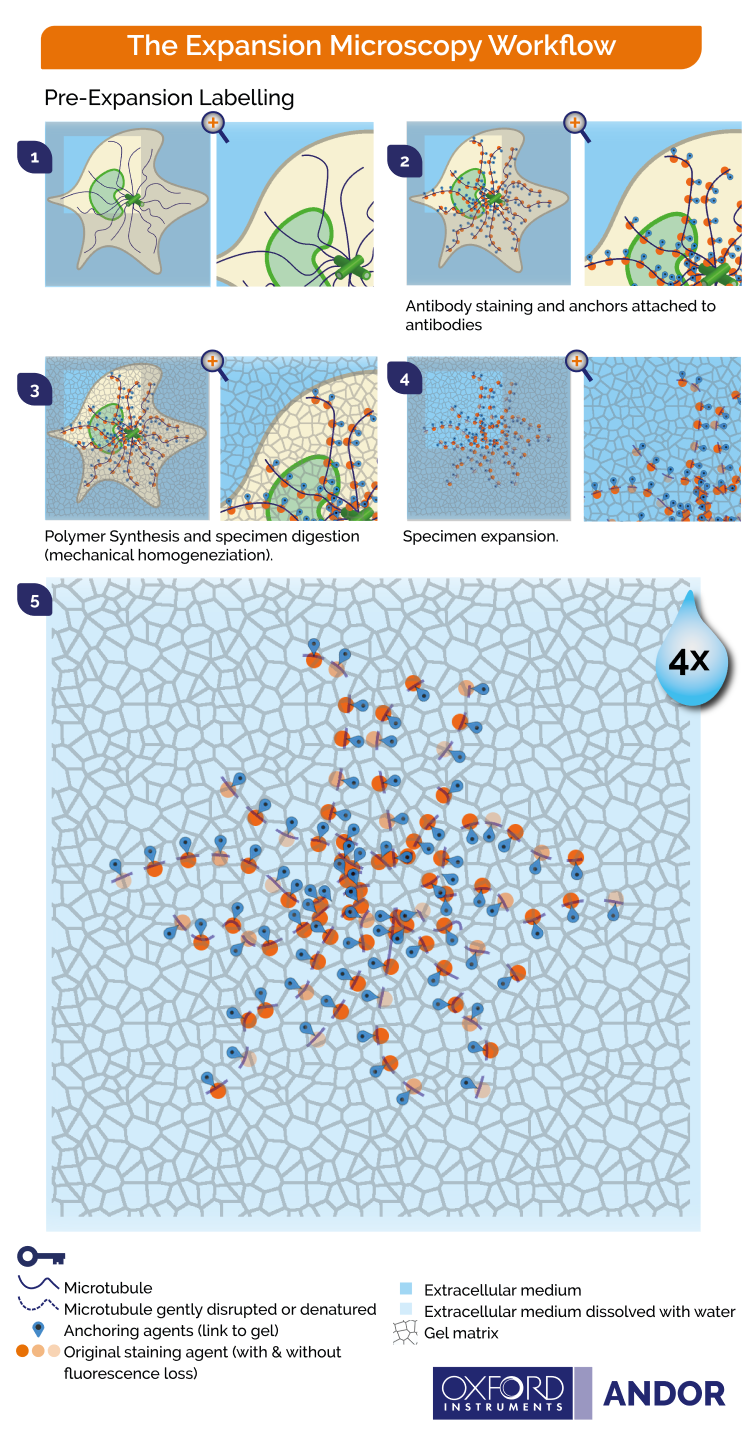
Figure 2- Principles of pre-expansion microscopy. 1) Cells are fixed 2) Labelling by immunostaining is performed on the samples and biomolecules are covalently anchored to the gel 3) During gelation the specimen is immersed in a monomer solution and the chemical network is formed. 4) During homogenization, the specimen structures are chopped by enzymatic digestion to ensure that the organization is kept intact. 5) Upon water immersion, spontaneous expansion occurs. A 4-fold linear expansion is reported in pure water (64 volumetric expansion).
There are 2 main approaches for expansion microscopy:
- Stain the biomolecules and then expand the tissue (Figure 2)
- Expand and then stain the biomolecules of the tissue (Figure 3)
The graphics shown in Figure 2 and Figure 3 represent the protocols in which cells and tissues are expanded up to 4x. The 200 nm diffraction limit of light sets a boundary on what can be distinguished as separated by light microscopes. Since the linear expansion achieved is a factor of 4, using these protocols, biomolecules that are separated up to 50 nm will be visible under the light microscope.
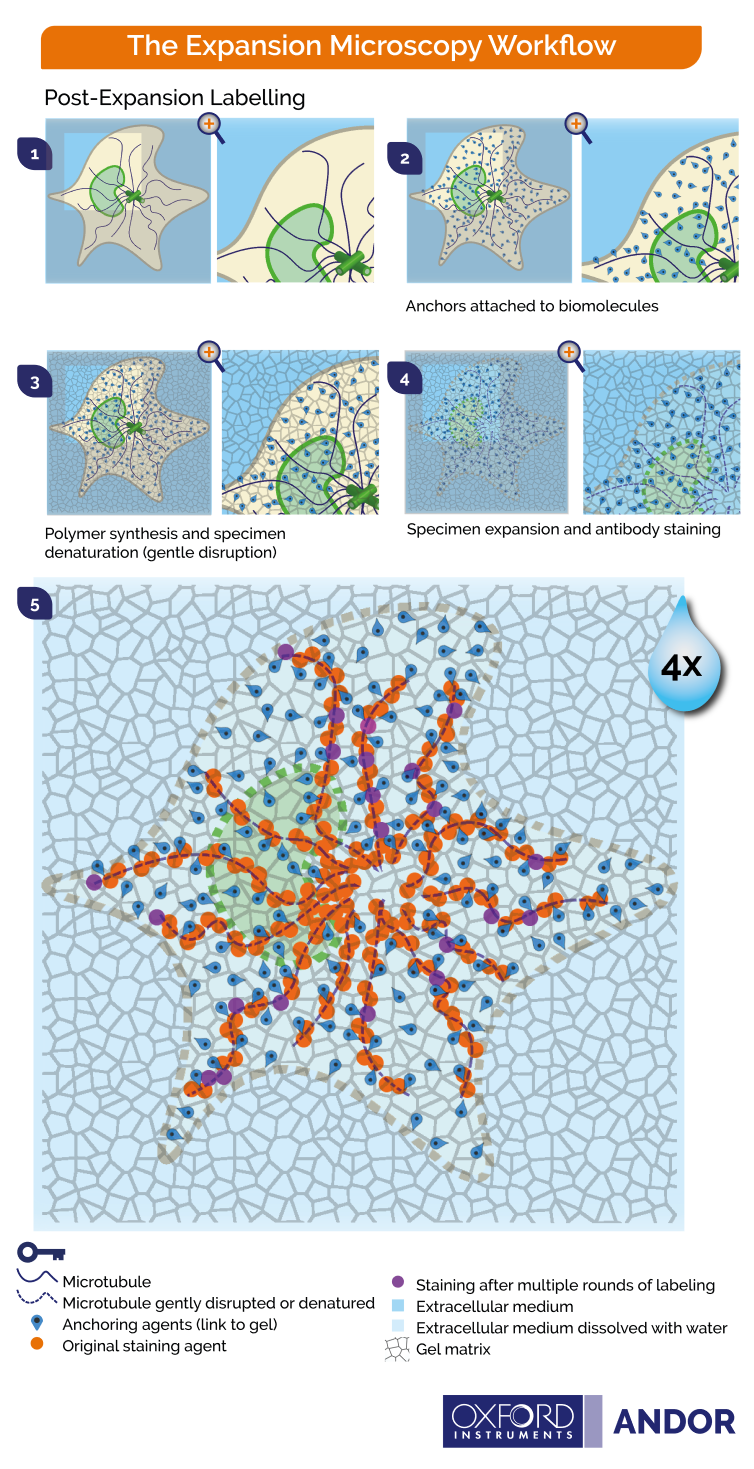
Figure 3- Principles of post-expansion microscopy 1) Fixation of cells 2) Covalent anchoring of endogenous proteins to the gel 3) Hydrogel embedding with high polyacrylamide concentration 4) Denaturation and dissociation of non-crosslinked proteins 5) Expansion upon water immersion 6) Post-expansion immunostaining possible in multiple rounds.
Fundamental steps of expansion microscopy
Through expansion, the fluorescent signal is also isotropically expanded. As a result, an effective higher resolution is achieved. The key steps for expansion microscopy protocols are:
(see also Figure 2 and Figure 3):
- Labelling: biomolecules are tagged with fluorophores (in post-expansion labelling method this step is performed at the end, after the expansion).
- Anchoring: biomolecules and/or labels are covalently equipped with molecular handles. Those cross-linkers will allow the polymer matrix to exercise their force on the biomolecules.
- Gelation: To avoid damaging the cells, the polymer chain is broken down into its constituent parts (its building blocks). The specimen is immersed in a monomer solution (sodium acrylate) and a highly penetrating hydrogel (sodium polyacrylate). Once inside the cells, a chemical reaction is triggered, the monomers will bind to form a network of the desired polymer.
- Homogenization: the aim is to avoid sample distortion and ensure that the specimen organization is kept intact. The sample is chemically disrupted either by enzymatic digestion or by a heat and detergent treatment (denaturation/dissociation). The choice of homogenization treatment depends on the nature of the specimen and the molecules to be visualized.
- Expansion: the specimen is immersed in water, which diffuses into the polyelectrolyte hydrogel through osmotic force. The water will promote the expansion of the polymer. The expansion pulls apart anchored biomolecules in an isotropic way and creates huge gaps between each biomolecule. The spatial organization of the expanded specimen is preserved, allowing nanoscale imaging with standard fluorescent microscopes.
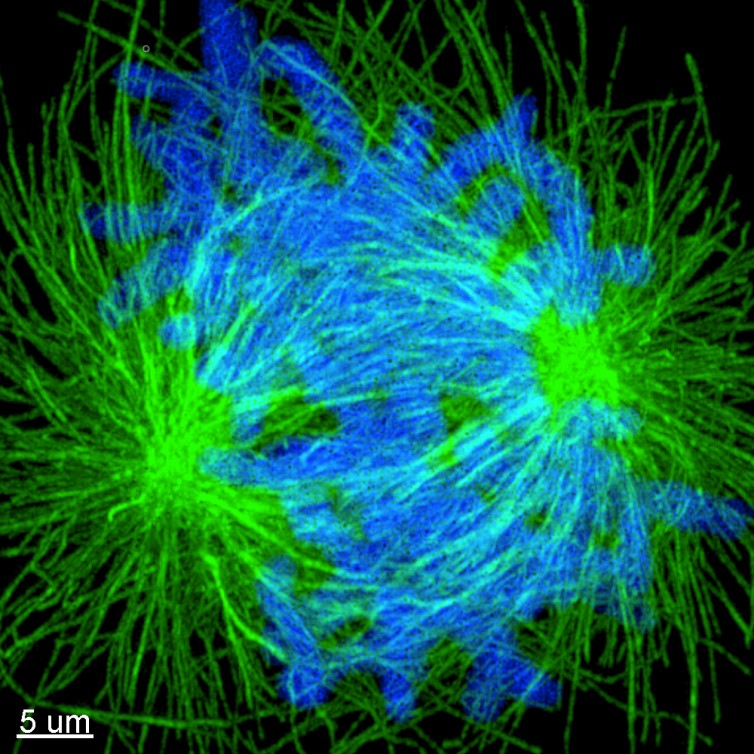
Figure 4. Image of expanded mitotic cell. Maximum projection images of dividing cells stained for tubulin (green) and DNA (Blue). Cells where labelled using the post-expansion protocol, and image with Andor Dragonfly. Sample courtesy of Joshua C Vaughan (University of Washington).
Most popular protocols of expansion microscopy
Since its development, several different Expansion Microscopy protocols have been published. Currently, there are variations and improvements which cover a wide range of applications. Below we present a table summarizing the main protocols for expansion microscopy.
In summary, two main strategies of expansion microscopy co-exist: the pre and the post-expansion labelling strategies (figures 2 and 3), and the different protocols are adapted to specific cellular structures. When starting on expansion microscopy imaging, care must be taken to choose the correct protocol to visualize the desired subcellular structure. It might be necessary to optimize a protocol to better suit the experimental conditions; researchers should not forget to design the proper experimental controls to demonstrate the isotropic expansion of the structure to be analysed.
Learn more about Andor’s product solutions for Expansion Microscopy in our solution note - Dragonfly the ideal multimodal imaging platform for Expansion Microscopy.
Bibliography:
- Chang, J.-B., et al. (2017). " Iterative expansion microscopy." Nature Methods 14(6): 593-599.
- Chen, F., et al. (2015). "Expansion microscopy." Science 347(6221): 543-548.
- Chen, F., et al. (2016). "Nanoscale imaging of RNA with expansion microscopy." Nature Methods 13(8): 679-684
- Chozinski, T. J., et al. (2016). "Expansion microscopy with conventional antibodies and fluorescent proteins." Nature Methods 13(6): 485-488
- Gambarotto, D., et al. (2019). "Imaging cellular ultrastructures using expansion microscopy (U-ExM)." Nature Methods 16(1): 71-74
- Ku T, Swaney J, Park JY, et al. (2016 ) “Multiplexed and scalable super-resolution imaging of three-dimensional protein localization in size-adjustable tissues.” Nat Biotechnol. 34 (9):973-981. doi:10.1038/nbt.3641
- Schermelleh, L., et al. (2019). "Super-resolution microscopy demystified." Nature Cell Biology 21(1): 72-84.
- Schermelleh, L., et al. (2010). "A guide to super-resolution fluorescence microscopy." Journal of Cell Biology 190(2): 165-175. Pernal, S. P., et al. (2019). "Differential expansion microscopy." bioRxiv: 699579.
- Truckenbrodt, S., et al. (2018). "X10 expansion microscopy enables 25-nm resolution on conventional microscopes." EMBO reports 19(9): e45836.
- Truckenbrodt, S., et al. (2019). "A practical guide to optimization in X10 expansion microscopy." Nature Protocols 14(3): 832-863.
- Tillberg PW, Chen F, Piatkevich KD, et al. (2016) " Protein-retention expansion microscopy of cells and tissues labeled using standard fluorescent proteins and antibodies. " Nat Biotechnol. 34 (9):987-992.
- Wassie, A. T., et al. (2019). "Expansion microscopy: principles and uses in biological research." Nature Methods 16(1): 33-41
- Zhang, C., Kang, J. S., Asano, S. M., Gao, R., & Boyden, E. S. (2020) “Expansion microscopy for beginners: Visualizing microtubules in expanded cultured HeLa cells.” Current Protocols in Neuroscience,