Introduction
Nuclear Magnetic Resonance (NMR) spectroscopy is a powerful analytical technique that provides detailed information on molecular structure, dynamics, and intermolecular interactions. Conventional NMR experiments are typically performed at ambient temperature; however, many chemical and physical processes are inherently temperature dependent. Variable Temperature (VT) NMR extends the capabilities of standard NMR by enabling precise control of sample temperature during acquisition, allowing the investigation of dynamic molecular behaviour.
By systematically varying temperature, VT NMR can be used to study a wide range of phenomena including reaction kinetics, conformational equilibria, phase transitions, and solvation effects. Temperature-dependent studies enable the determination of rate constants, activation parameters, and mechanistic pathways, whilst also providing insights into processes such as ring flipping, hindered rotation, tautomerism, crystallisation, and polymorphic transformations.
The X-Pulse VT accessory provides a practical solution for temperature-dependent NMR investigations. The modular VT system integrates directly with the compact and user-friendly X-Pulse platform, enabling controlled sample heating and cooling over a temperature range of 0 °C to 60 °C with minimal additional infrastructure. Uniquely amongst commercially available benchtop NMR spectrometers, the X-Pulse enables both sub-ambient and moderately elevated-temperature studies, allowing applications ranging from low-temperature conformational and exchange processes to elevated-temperature reaction kinetics and solubility investigations. The streamlined design maintains excellent temperature stability and experimental reproducibility whilst simplifying installation and operation.
Temperature control is achieved using a gas-based heating and cooling system, enabling rapid temperature adjustments within minutes and typical equilibration times of less than 30 minutes. Furthermore, the system operates without liquid cryogens, simplifying operation and maintenance whilst maintaining precise and reproducible temperature control.
As a broadband benchtop NMR spectrometer, the X-Pulse additionally supports a wide range of nuclei beyond conventional 1H measurements, extending the applicability of VT studies to multinuclear investigations. This combination of accessibility, efficiency and versatility makes the X-Pulse a practical platform for both routine and advanced temperature-dependent studies.
This application note demonstrates the VT capabilities of the X-Pulse Broadband Benchtop Spectrometer through the investigation of temperature-dependent exchange phenomena in 3-dimethylaminoacrolein. By monitoring spectral changes and peak coalescence in both 1H and 13C NMR spectra over a temperature range of 0–60 °C, the ability of the X-Pulse VT system to investigate dynamic molecular processes is demonstrated.
Temperature-Dependent NMR Analysis of 3-Dimethylaminoacrolein
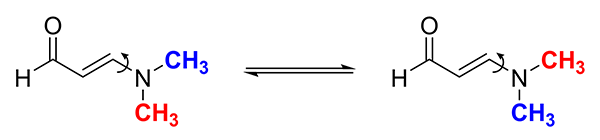
The VT capabilities of the X-Pulse system were demonstrated using 3-dimethylaminoacrolein, a molecule that exhibits dynamic NMR behaviour arising from exchange processes involving the N-methyl groups. Prior to all measurements, sample temperatures were verified using the ethylene glycol chemical shift thermometer method to ensure accurate and reproducible temperature control throughout the study.[1]
Initially, a 1H NMR spectrum was acquired at 30 °C in CDCl3. Under these conditions, the exchange process occurs in the intermediate exchange regime on the NMR timescale, resulting in partial averaging of the N-methyl resonances. Consequently, the two methyl environments are not fully resolved and instead appear as a broad doublet resonance centred at approximately 2.83 ppm with noticeable peak asymmetry (Figure 1).
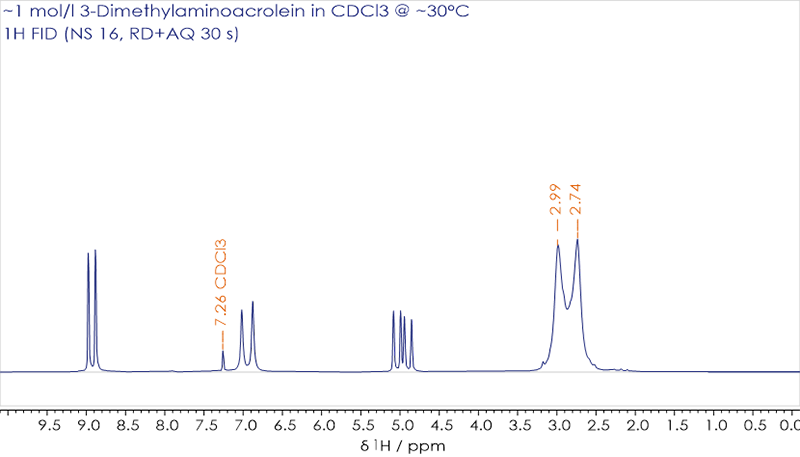
Fig. 1 — 1H spectrum of 3-dimethylaminoacrolein acquired at 30 °C in CDCl3 using the X-Pulse 90 MHz
To investigate the temperature dependence of this exchange process, the sample was first cooled from 30 °C to 0 °C before being heated to 60 °C. The sample was allowed to fully equilibrate at each temperature prior to acquisition, and the ethylene glycol reference sample was used throughout to verify the achieved sample temperature.
Cooling the sample slows the rate of exchange between the two N-methyl environments. At 0 °C, the exchange becomes sufficiently slow on the NMR timescale for two distinct resonances to be observed at 2.74 ppm and 2.99 ppm, corresponding to the inequivalent methyl groups (Figure 2).
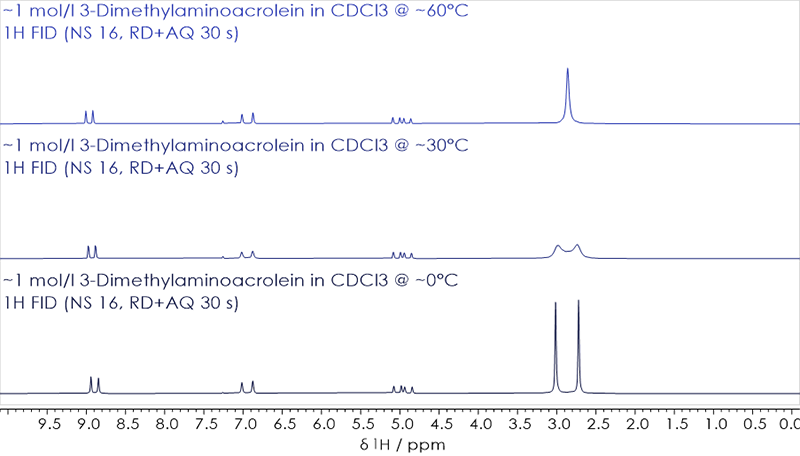
Fig. 2 — Stacked 1H spectra of 3-dimethylaminoacrolein acquired between 0 °C and 60 °C showing temperature-dependent peak coalescence using the X-Pulse 90 MHz
Increasing the temperature has the opposite effect. At 60 °C, the exchange rate increases such that the two environments rapidly interconvert during the NMR experiment. As a result, the individual resonances coalesce into a single sharp resonance centred at approximately 2.9 ppm, characteristic of fast exchange on the NMR timescale.
The corresponding 13C spectra show similar temperature-dependent exchange behaviour. At 0 °C, two well-resolved resonances are observed at 37 ppm and 46 ppm, reflecting the two distinct N-methyl carbon environments. As the temperature increases, exchange broadening becomes increasingly significant, resulting in progressive attenuation and loss of spectral resolution. At 60 °C, the N-methyl carbon resonances remain severely broadened and are no longer clearly distinguishable from the baseline.
The different behaviour observed for 1H and 13C at 60 °C arises from the different frequency separations between the exchanging sites for the two nuclei. The N-methyl environments have a substantially larger chemical-shift separation in the 13C spectrum than in the 1H spectrum. Consequently, the 1H resonances reach the fast-exchange regime and form a sharp averaged signal at 60 °C, while the 13C resonances remain exchange broadened.
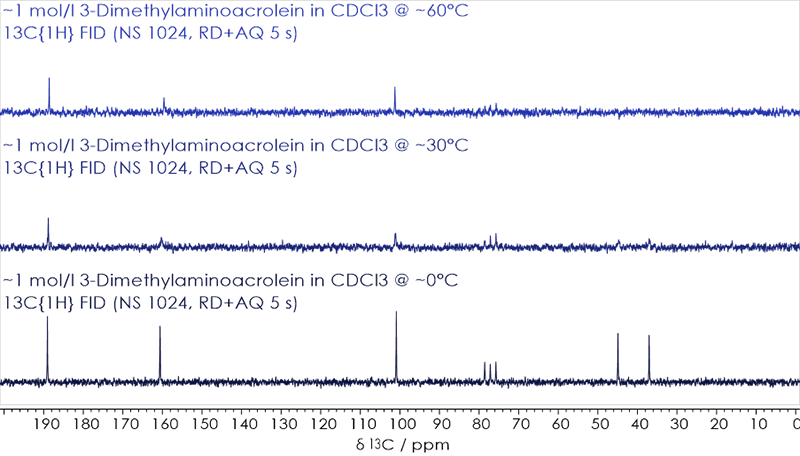
Fig. 3 — Stacked 13C NMR spectra of 3-dimethylaminoacrolein acquired between 0 °C and 60 °C using the X-Pulse 90 MHz, showing temperature-dependent exchange broadening of the N-methyl carbon resonances
The X-Pulse VT system can also be used with two-dimensional NMR experiments, extending temperature-dependent investigations beyond conventional 1D measurements. Gradient-selective 1H–1H COSY and 1H–13C HSQC spectra of 3-dimethylaminoacrolein were readily acquired at both 0 °C and 60 °C, demonstrating that routine 2D experiments can be performed across the VT range.
At 0 °C, the slower exchange allows the two N-methyl environments to be distinguished, with the HSQC spectrum showing separate 1H–13C correlations for the two environments. At 60 °C, rapid exchange results in averaging of the N-methyl proton environments, consistent with the corresponding 1D 1H spectra, and a single averaged HSQC correlation is observed.
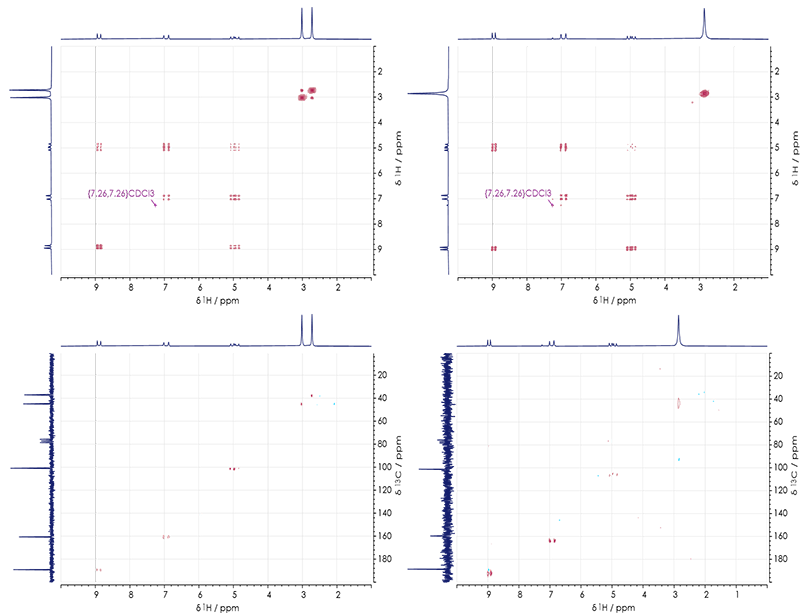
Fig. 4 — Gradient-selective 1H–1H COSY and 1H–13C HSQC spectra of 3-dimethylaminoacrolein acquired at 0 °C and 60 °C using the X-Pulse 90 MHz Broadband Benchtop NMR Spectrometer, demonstrating temperature-dependent changes in the N-methyl environments
Together, the 1D and 2D measurements demonstrate that the X-Pulse VT system can be used to investigate temperature-dependent molecular dynamics using a range of NMR experiments, providing complementary structural information under controlled temperature conditions.
Conclusion
This work demonstrates the Variable Temperature capabilities of the X-Pulse Broadband Benchtop NMR Spectrometer. Accurate temperature control was verified using an external ethylene glycol calibration method, confirming reliable and reproducible sample temperature regulation across the investigated temperature range.
Using 3-dimethylaminoacrolein as a model system, temperature-dependent exchange phenomena were successfully characterised using both 1D 1H and 13C NMR and 2D COSY and HSQC experiments. The observation of peak broadening, coalescence and the separation of distinct N-methyl environments at lower temperatures demonstrates the ability of the system to investigate dynamic molecular processes under controlled temperature conditions.
These results demonstrate that the X-Pulse VT system provides a practical and accessible platform for temperature-dependent 1D and 2D NMR investigations, significantly expanding the capabilities of benchtop NMR spectroscopy.
References
[1] D. S. Raiford, C. L. Fisk and E. D. Becker, Anal. Chem., 1979, 51, 2050–2051.