Introduction
One of the big advances in NMR since its inception has been the introduction of two-dimensional (2D) NMR experiments. Their introduction greatly increased the power of NMR for structural elucidation and broadened the range and complexity of problems that could be tackled. These experiments are a series of one-dimensional (1D) experiments that differ only through a time increment which is introduced through the pulse sequences, resulting in a two-dimensional array with two separate time evolutions — the direct measurement (t2) and the indirect (t1). A 2D discrete Fourier transform of the data generates a 2D spectrum with frequency axes f1 and f2 (in NMR spectroscopy these are usually shown as chemical shift, δ values). At high-field, the use of 2D NMR experiments has become routine and within the limits of practicality this is the same on the X-Pulse Benchtop NMR Spectrometer.
Experimental Set-Up
An important family of 2D experiments are the heteronuclear correlations experiments. These experiments provide correlations between hydrogen and carbon signals and are crucial for determining the structure of an unknown molecule. Here, we show two such experiments, HSQC-ME and HMBC. These experiments are often described as inverse experiments because the signals from the hydrogen nuclei are measured directly to maximise the sensitivity of the experiments. This allows heteronuclear correlations to be performed much faster than with a traditional HETCOR experiment, reducing the time required from multiple hours to tens of minutes. We illustrate these experiments using a 1 mol/ℓ sample of the molecule gemfibrozil (figure 1), a medication used to treat abnormal blood lipid levels.
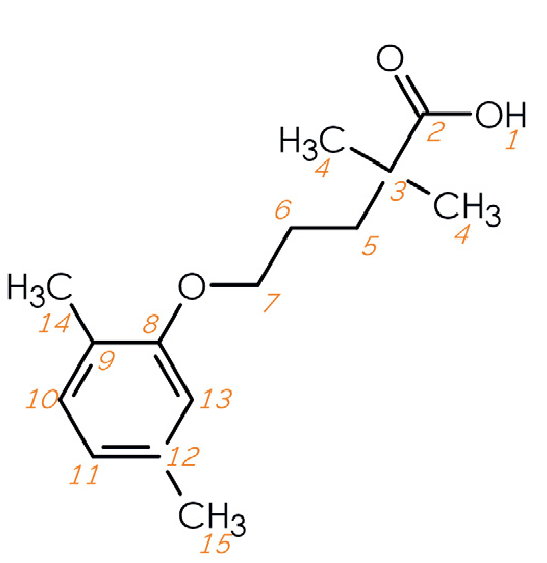
Fig. 1 — Chemical structure of gemfibrozil.
HSQC-ME (Heteronuclear Single Quantum Coherence with Multiplicity Editing) Experiment
HSQC: This experiment provides a method to directly link hydrogen and carbon spectra. The signal from a hydrogen nucleus can be correlated to the signal from a carbon that it is directly bound to. In the HSQC spectrum this is exhibited as cross peaks (peaks that appear in both the carbon and hydrogen spectra). Signals in the one-dimensional carbon spectrum with no cross peak are identified quickly as quaternary carbons.
Multiplicity Editing: A popular extension to the basic HSQC experiment is the multiplicity edited experiment (also known as DEPT-edited). As with the HSQC experiment, the signals from carbon and hydrogen nuclei that are directly bound are connected through a cross peak in the HSQC-ME spectrum. In addition, the multiplicity of the hydrocarbon group, i.e., CH3, CH2, CH, can be directly determined by the phase of the peak. The CH3 and CH peaks are positive (red in figure 2) and the CH2 peaks are negative (blue in figure 2). The ability to quickly identify the multiplicity is important for structural elucidation. The carbon spectrum in figure 2 shows only amplitude and not phase which is why the CH2 peaks still appear positive. The full HSQC-ME spectrum for gemfibrozil is shown in figure 2.
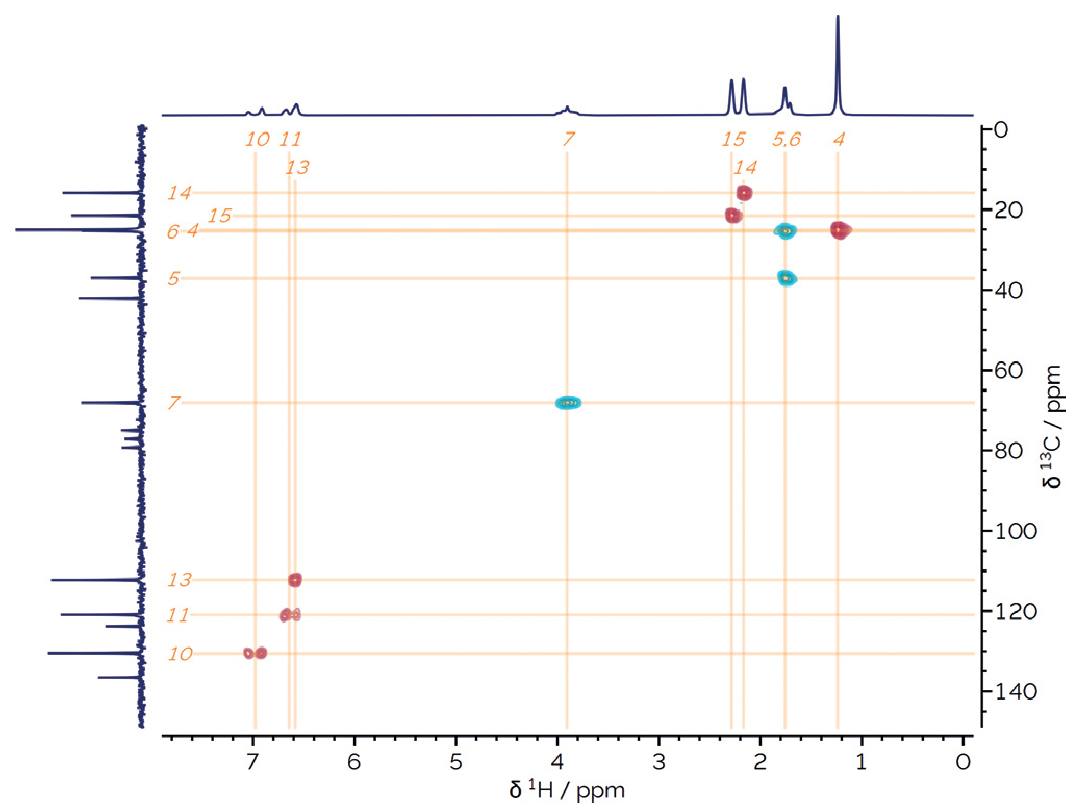
Fig. 2 — Gradient-selective HSQC-ME for 1 mol/ℓ gemfibrozil. 16 scans with total experimental time 1 ¾ hours; the numbers on the cross peaks correlate to the numbered carbon positions in figure 1.
HMBC (Heteronuclear Multiple Bond Correlation) Experiments
HMBC: The HSQC experiment provides valuable information about the hydrocarbon functional groups, which is usually enough for verifying a known structure. However, it is not enough for the structural elucidation of an unknown. In general, structural elucidation requires more information about the connectivity along the carbon backbone of the molecule. The HMBC experiment provides this information.
In this experiment, the signals from hydrogen nuclei are correlated with signals from carbon nuclei separated by two or three bonds. If we consider part of a hydrocarbon chain: C1Ha3–C2Hb2–C3Hc=, the HSQC-ME would show cross peaks between C1 & Ha, C2 & Hb, and C3 & Hc (of these only the cross peak for the C2 & Hb correlation would have a negative phase).
In the HMBC spectrum, the HSQC cross peaks would be suppressed and instead cross peaks of C1 with Hb & Hc, C2 with Ha & Hc, and C3 with Ha & Hb would be observed. The combination of the two spectra allow the NMR user to build up a picture of the carbon backbone structure and the associated hydrocarbon groups. The full HMBC spectrum of gemfibrozil is shown in figure 3.
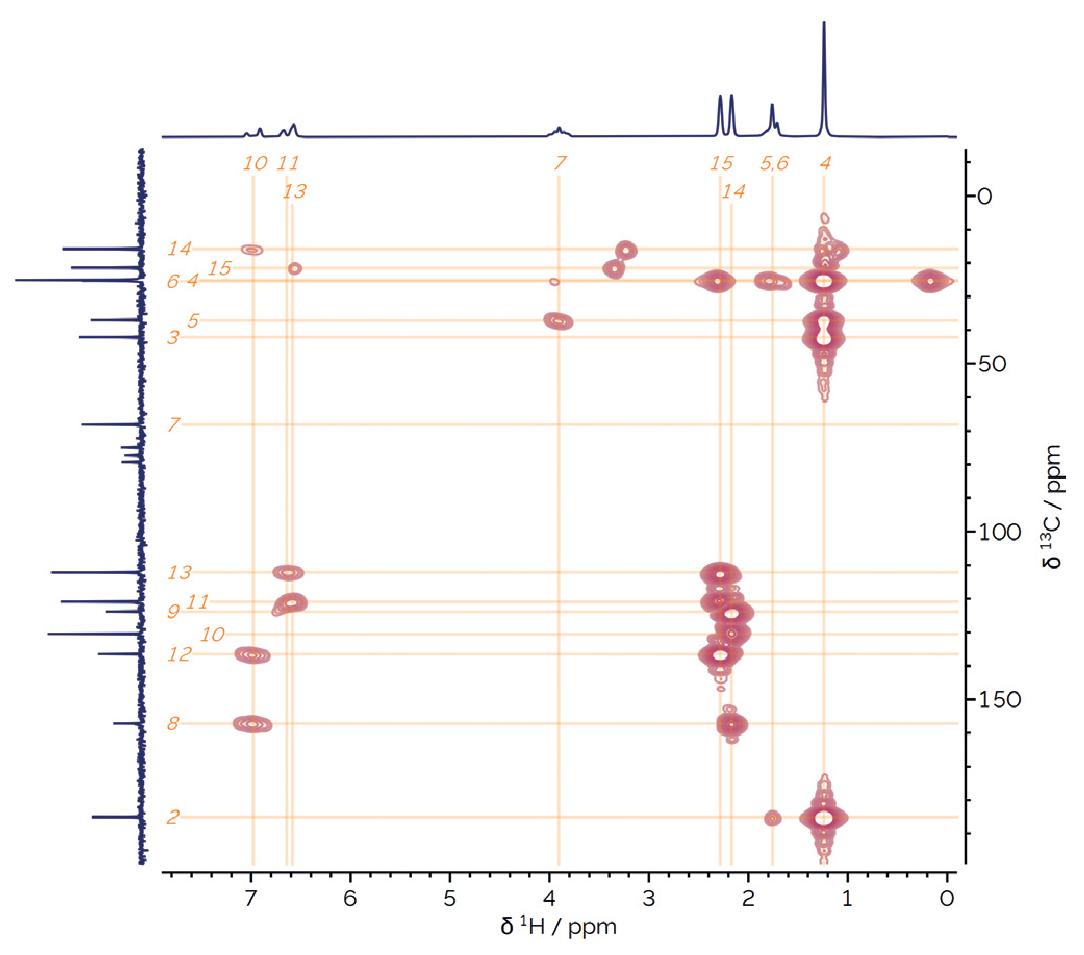
Fig. 3 — Gradient-selective HMBC for 1 mol/ℓ gemfibrozil, 16 scans with total experimental time 1 ¾ hours; the numbers on the cross peaks correlate to the numbered carbon positions in figure 1.
Summary
Heteronuclear correlation experiments allow users to determine the structure of completely unknown molecules by correlating hydrogen atoms with the carbons they are bound to (HSQC-ME), and with carbons two and three bonds away (HMBC). Inverse experiments such as HSQC and HMBC use the greater sensitivity of proton measurements to help elucidate the structure of an unknown compound in under 3 hours.