In Raman spectroscopy, the choice of diffraction grating is far more than a technical detail, it’s a critical factor in achieving meaningful results. To unlock the full potential of your Raman spectrometer or microscope, you need gratings that are tailored to your application, ensuring compatibility with the wavelength and desired spectral resolution.
The Role of Diffraction Gratings in Raman Spectroscopy
Diffraction gratings are at the heart of Raman spectroscopy, influencing spectral resolution, sensitivity, and efficiency. For systems with multiple excitation wavelengths or diverse applications, having several carefully selected gratings is essential. Without proper optimisation, you risk losing valuable spectral data by missing key Raman shifts, or by failing to utilise the CCD detector’s full potential that results in a reduced spectral resolution. An unsuitable grating can also cause artifacts, such as polarisation effects, that compromise the accuracy of your analysis.
Key factors to consider when selecting spectral gratings
The blazing wavelength
Each grating is designed with a specific blazing wavelength, where its efficiency peaks. When measurements deviate from this optimal wavelength, efficiency drops off-gradually toward longer wavelengths but much more steeply toward shorter ones (see graph below). This decline reduces reflectivity, which in turn affects the system’s sensitivity and reliability.
Additionally, polarisation-dependent effects become more pronounced as you move further from the blazing wavelength. The reflectivity curves for s- and p-polarised light start to diverge, introducing artifacts that can distort data interpretation. These effects can lead to artificially enhanced or suppressed spectral features, especially in materials with significant polarisation-dependent Raman signals.
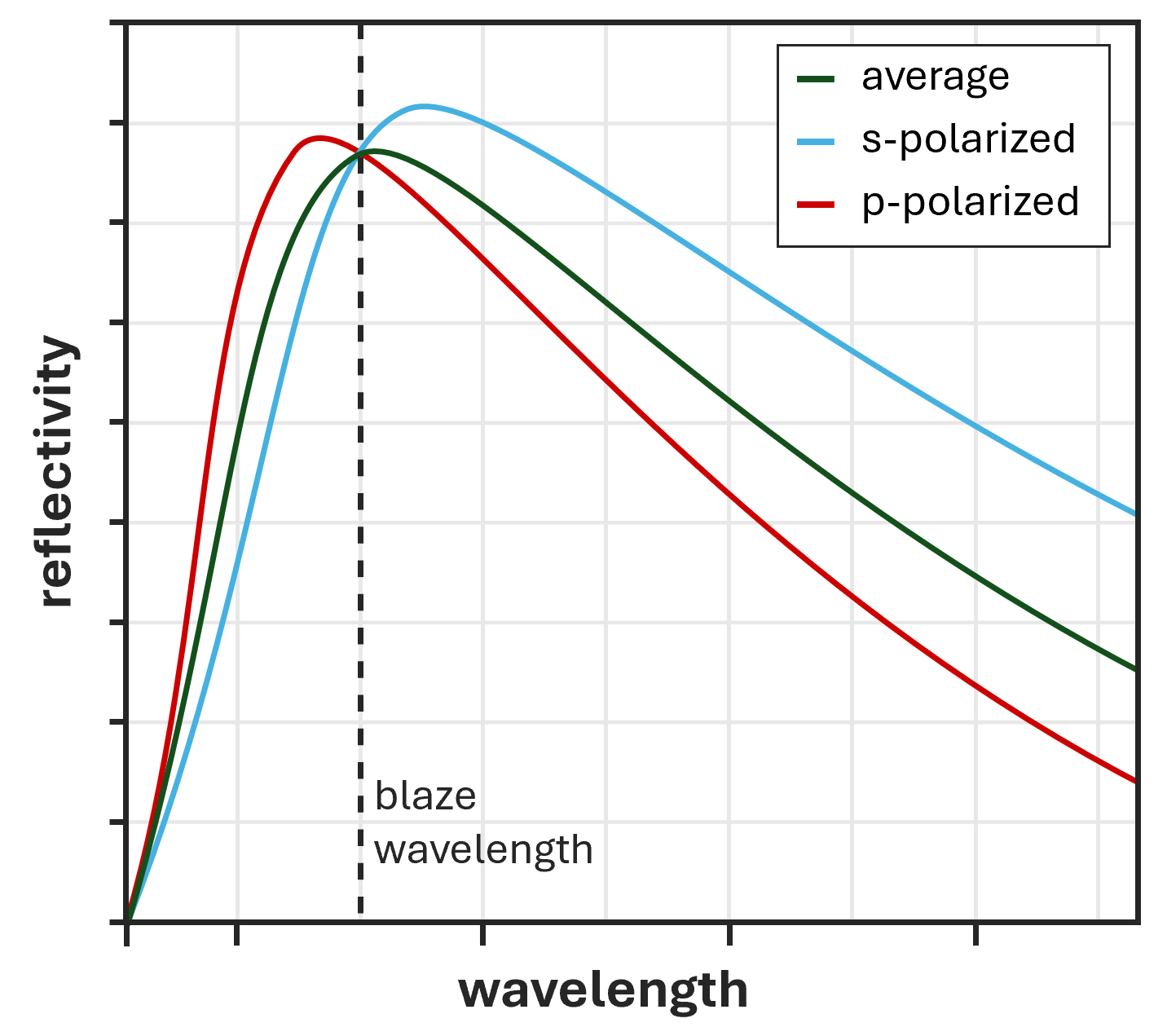 Schematic representation of the wavelength and polarisation-dependent reflectivity of a typical diffraction grating. It shows the efficiency drop-off as the measurement wavelength moves away from the blazing point, as well as the divergence in s- and p-polarisation reflectivity curves.
The Groove Density
Selecting the appropriate groove density is just as critical as the blazing wavelength, as it directly influences the balance between spectral range and resolution.
- Low groove density gratings are ideal for capturing wide spectral ranges in a single measurement, making them particularly useful for broad material characterisation.
- High groove density gratings can resolve closely spaced peaks and are indispensable for detecting subtle spectral shifts caused by phenomena like strain, stress, or phase transitions.
Both types of gratings play important roles in Raman analysis, and the ability to seamlessly switch between them is essential for comprehensive Raman material characterisation. The same principles apply to other spectroscopic techniques, such as photoluminescence, where balancing spectral resolution and range is equally critical.
Utilising the full width of the CCD detector and minimising wasted spectral space is essential for achieving high-resolution results, especially when recording full Raman spectra. This makes it crucial to use different diffraction gratings for excitation lasers that are spectrally significantly apart, such as 457, 532, and 785 nm. Each laser wavelength requires a grating with a properly matched blazing angle and groove density to ensure the relevant Raman shift range is optimally projected onto the CCD.
The Case for Multiple Gratings
For advanced spectroscopic systems, using multiple gratings isn’t just advantageous, it’s often a necessity. By integrating multiple gratings optimised for specific excitation wavelengths and spectral regions, you can achieve:
- Enhanced Efficiency: Maintain high sensitivity across a broad spectral range.
- Improved Data Fidelity: Minimise polarisation-induced artifacts and other distortions.
- Future-Ready Capability: Equip your system for evolving analytical needs, ensuring long-term flexibility.
Eliminating the Risks of Manual Grating Changes
Gratings are highly sensitive optical components, easily damaged by dust, moisture, or fingerprints. Once contaminated, they often require costly replacement, as they cannot be cleaned or restored by the user. Manual grating changes not only increase the risk of contamination but can also lead to misalignment, severely impacting system performance.
To avoid these issues, several spectroscopic systems incorporate automated grating exchange mechanisms. These systems not only protect the gratings but also enhance operational efficiency by enabling seamless transitions between different configurations.
Conclusion
Finding the ideal grating for your Raman spectrometer is rarely as simple as relying on a one-size-fits-all solution. Each application has unique demands, requiring gratings optimised for specific wavelengths and spectral ranges. By integrating multiple tailored gratings, you ensure your instrument delivers peak efficiency, adaptability, and reliable performance, not only meeting the demands of today’s applications but also preparing for future challenges. With the right grating setup, your Raman system becomes a trusted and lasting tool for advancing your research.