Andor's camera portfolio includes sCMOS models that offer Rolling Shutter (e.g. Sona, Marana, ZL41 4.2) and
Global Shutter operation (CB2 series). The ZL41 5.5 models have a 5T (5 transistor) pixel architecture that enables a
choice of both Rolling and Global Shutter modes (also called Rolling and Global Exposure modes). This
provides superior application and synchronization flexibility and the ability, through global shutter, to closely
emulate the familiar 'Snapshot' exposure mechanism of interline CCDs.
Rolling and Global Shutter modes describe two distinct sequences through which the image may be read
off an sCMOS sensor. In rolling shutter mode, different lines of the array are exposed at different times as the read
out 'wave' sweeps through the sensor, whereas in global shutter mode each pixel in the sensor begins and ends
the exposure simultaneously, analogous to the exposure mechanism of an interline CCD. However, absolute lowest noise
and fastest non-synchronized frame rates are achieved from rolling shutter mode.
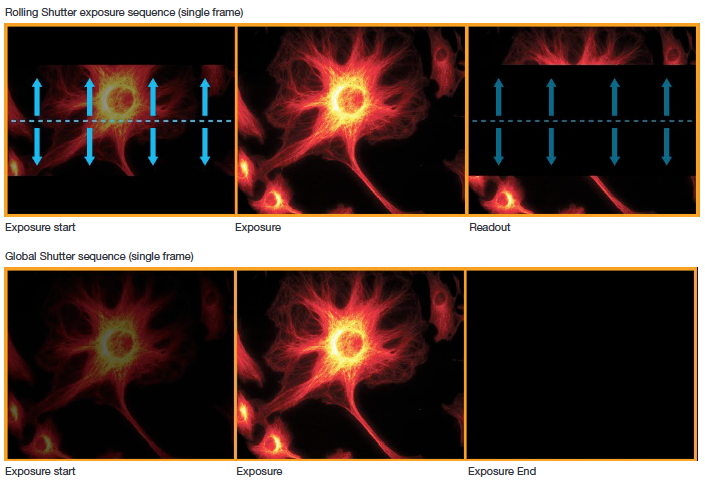
Figure 1 - Simplified illustration showing sequence of events in rolling and global shutter modes
for the ZL41 5.5. Note that while a single image acquisition is represented, each mode is also compatible with
'overlap' readout, whereby the next exposure begins simultaneous with image readout.
Most CMOS sensors offer either one mode or the other, but the ZL41 5.5 sCMOS cameras offer the choice of both rolling
and global shutter mode. Therefore the user benefits from the capability to select (via software selection) either
readout mode from the same sensor, such that the most appropriate mode can be chosen dependent on specific application
requirements.
Rolling Shutter Mode
In the following, Rolling Shutter mode will be explained based on the Neo and Zyla sCMOS cameras. Rolling
Shutter mode essentially means that adjacent rows of the array are exposed at slightly different times as
the readout 'waves' sweep through each half of the sensor. That is to say, each row will start and end its
exposure slightly offset in time from its neighbor. At the maximum readout rate of 560 MHz (Zyla 5.5 and Neo 5.5),
this offset between adjacent row exposures is 10 μs. The rolling shutter readout mechanism is illustrated in Figure 1.
From a point of view of readout, the sensor is split in half horizontally, and each column is read in parallel from
the center outwards simultaneously, row after row. At the start of an exposure, the wave sweeps through each half of
the sensor, switching each row in turn from a 'keep clean state', in which all charge is drained from the
pixels in the anti-bloom structure, to an 'exposing state' in which light induced charge is collected in each
pixel. At the end of the exposure, the readout wave again sweeps through the sensor, transferring the charge from each
row into the readout node of each pixel. The important point is that each row will have been subject to exactly the
same exposure time, but the row at the top or bottom of each sensor half would have started and ended its exposure 10
ms (1000 rows x 10 μs/row) after the rows at the center of the sensor.

Rolling Shutter can be operated in a continuous 'overlap' mode when capturing a kinetic
series of images, whereby after each row has been read out, it immediately enters its next exposure. This ensures a
100% duty cycle, meaning that no time is wasted between exposures and, perhaps more importantly, no photons are
wasted. At the maximum frame rate for a given readout speed (e.g. 100 fps at 560 MHz for for ZL41 5.5) the sensor is
continuously reading out in overlap mode, i.e. as soon as the readout fronts reach the top and bottom of the sensor,
they immediately return to the centre to readout the next exposure.
Rolling Shutter Mode - disadvantages
A potential downside of rolling shutter mode is spatial distortion, resulting from the above described exposure
mechanism. Distortion would be more apparent in cases where larger objects are moving at a rate that the image readout
could not match. However, distortion is less likely when relatively small objects are moving at a rate that is being
temporally oversampled by the frame rate.
A further downside is that different regions of the exposed image will not be precisely correlated in time to other
regions, which can be essential for some usages. A final, and very important, factor is that synchronizing (e.g. light
source activation or peripheral device movement) to rolling shutter readouts can be complex and also
can result in slower cycle times and frame rates, relative to those achievable in global shutter.
Global Shutter - 'interline CCD mode'
Global Shutter mode, which can also be thought of as a 'Snapshot' exposure mode, means that
all pixels of the array are exposed simultaneously, thus enabling 'freeze frame' capture of fast moving or
fast changing events and in this respect, global shutter can be thought of as behaving like an interline CCD sensor.
Before the exposure begins, all pixels in the array will be held in a 'keep clean state', during which charge
is drained into the anti-bloom structure of each pixel. At the start of the exposure, each pixel simultaneously begins
to collect charge and is allowed to do so for the duration of the exposure time. At the end of exposure, each pixel
transfers charge simultaneously to its readout node.
Global shutter can be configured to operate in a continuous 'overlap' mode (analogous to
interline CCD), whereby an exposure can proceed while the previous exposure is being readout out from the readout
nodes of each pixel. In this mode, the sensor has a 100% duty cycle, again resulting in optimal time resolution and
photon collection efficiency. During this entire cycle, there is no period of ‘transient’ readout as found in rolling
shutter.
Importantly, Global Shutter mode is very simple to synchronize to and often yields faster frame rates than efforts to
synchronize with Rolling Shutter with the same exposure time. Global shutter can also be regarded as essential when
exact time correlation is required between different regions of the sensor area.
However, the mechanism of global shutter mode demands that a reference readout is performed 'behind the
scenes', in addition to the actual readout of charge from each pixel. This additional digitized readout is
required to eliminate reset noise from the global shutter image. Due to this additional reference
readout, global shutter mode carries the trade-off of halving the maximum unsynchronized frame rate that would
otherwise have been achieved in rolling shutter mode.
| Mode |
Rolling Shutter |
Global Shutter |
| Snapshot exposure |
No |
Yes |
| Interline similarity |
No - very different 'transient' exposure sequence |
Yes - extremely similar exposure sequence |
| Temporal correlation between different regions of image area |
No - up to 10ms (@ 560MHz) difference between center and top or bottom of image for ZL41 5.5 |
Yes - all pixels represent exact same time of exposure. |
| Synchronization capability |
Complex to synchronize. Requires strobe light source. Longer cycle times. |
Simple to synchronize. Any light source. Shorter cycle times. |
| Fast double exposure capability |
No |
Yes |
| Maximum Frame Rate |
Maximum available (non- synchronized). |
Maximum frame rates are halved. |
| Read Noise |
Lowest possible (1 to 1.3 e- for ZL41 5.5) |
Slightly higher (2.3 e- to 2.6e- for ZL41 5.5) |
| Spatial Distortion |
Possible if not temporally oversampling object dynamics |
None |
| Duty Cycle Efficiency |
Reduced, e.g. if require to shutter illumination off during ‘transient’ readout phases |
Typically much larger since no ‘transient’ readout phase to avoid. |
Table 1 - Comparing the pros and cons of Rolling vs Global Shutter
Rolling Shutter or Global Shutter mode?
Whether rolling shutter or global shutter mode is right for you will depend very much on the
experiment. Global shutter has a 'non-transient' exposure mechanism that is entirely
analogous to that of interline CCDs, and for many will provide the reassurance of 'freeze frame' capturing of
moving objects or transient events during a kinetic acquisition series with zero spatial distortion, as well as
offering simpler and faster synchronization performance. For particular applications, for example where it is required
that different regions of the image maintain temporal correlation or where it is required to accurately synchronize to
relatively short lived events, global shutter will be viewed as a necessity.
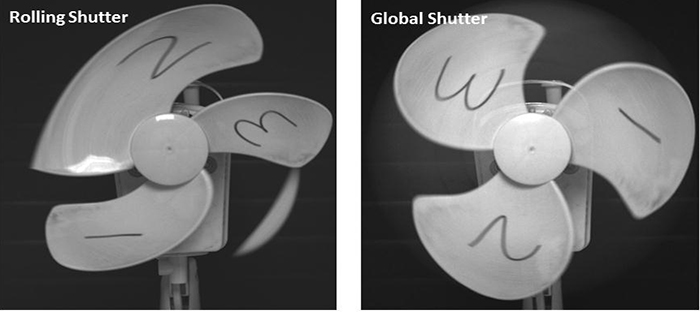
Figure 2 - Images of a moving fan, acquired with ZL41 5.5 sCMOS camera with rolling
and global shutter exposure modes, same exposure time. The spatial distortion associated with the ‘rolling shutter
effect’ is apparent in the left image. Global shutter is a ‘snapshot’ acquisition mode and avoids spatial distortion.
Figure 2 shows images of a moving fan, imaged with both rolling and global shutter exposure modes of the ZL41
5.5 sCMOS, identical exposure time. Significant spatial distortion (beyond motion blur) of the fan blades
is apparent in the image captured with rolling shutter. The reason for this is that the blades are moving fast
relative to the time taken for the ‘transient’ exposure activation /readout fronts of rolling shutter to transverse
the blade width. This spatial distortion is often referred to as the ‘rolling shutter effect’.
However, Rolling Shutter mode, with the enhanced non-synchronized maximum frame rate
possibility and lower read noise, is still likely to suit many scientific applications, e.g. where one simply needs to
track relatively small objects in 2D as a function of time. As long as the frame rate is such that the camera is
temporally oversampling object dynamics within the image area, negligible spatial distortion will be observed in
rolling shutter mode. Such oversampling is good imaging practice, since it is generally undesirable to have an object
travel a significant distance during a single exposure. However, it must always be born in mind that, even if
distortion is not manifest, an object at the top of bottom of the image will be captured up to 10 ms apart from an
object at the center of the image: if this is a factor for your experiment, then rolling shutter should not be used.
Short Charge Transfer Time Between 2 Consecutive Exposures with Global Shutter
The global shutter mode of ZL41 5.5 sCMOS camera can be used to effect electronic gating, similar to
that possible with interline CCDs. Before the exposure, all pixels in the array will be held in a 'keep clean
state', during which charge is drained into the anti-bloom structure of each pixel, thus acting as an
'electronic shutter'. The exposure 'switch on' is electronic and extremely fast (sub-µs). At the end
of exposure, each pixel transfers charge simultaneously to its readout node, again acting as an electronic shutter
close mechanism. The transfer time specification for this step is only 2 µs and has been optical measured to be less
than 1 µs.
The short transfer time between 2 consecutive images in global shutter mode lends the ZL41
5.5 sCMOS to fast 'double exposure' applications, such as Particle Imaging Velocimetry (PIV).
Synchronizing to Rolling and Global shutter
Flexibility to offer both rolling shutter and true global shutter can be
considered highly advantageous. Rolling shutter delivers absolute lowest read noise and is best used for very fast
streaming of data (> 50 fps full frame) without synchronization to light source or peripheral device. However, it
carries risk of spatial distortion, especially when imaging relatively large, fast moving objects. There is no risk of
spatial distortion when using true global shutter. To avoid spatial distortion in rolling shutter a simulated global
exposure synchronization approach must be used, which requires a pulsed light source and also significantly reduces
the duty cycle of photon collection (i.e. reduces photons collected per cycle). By contrast, a 100% duty cycle can be
maintained in global shutter.
When synchronizing to fast switching peripheral devices, true Global Shutter mode is
relatively simple and can result in faster frame rates. While the read noise in global shutter mode (~2.5
e-) is approximately double that of rolling shutter (~ 1.2 e-), this can often be offset against
the higher duty cycles (therefore increased photon collection per cycle) and higher synchronized frame rates possible
in true global shutter mode.
'Gen I' vs 'Gen II' sCMOS?
It has been noted that another prominent camera manufacturer has opted to apply the term ‘Gen II’ to a 4T (4
transistor) variant of the low noise pixel architecture used in ZL41 5.5 sCMOS cameras. While a 4T
design - also used by the ZL41 4.2 can be considered beneficial in affording a slightly improved
Quantum Efficiency response, it does so at the expense of global shutter capability, thus limiting application
flexibility and synchronization performance.
In the author's opinion, it is a considerable stretch to apply a ‘Gen II’ marketing label to such a sensor
variant, when both 4T (rolling shutter) and 5T (global shutter) CMOS concepts have been around for some time and are
extremely well documented.
In fact, it is the architecture of the CIS2051 sCMOS sensor used in the ZL41 5.5 that, if anything,
can be considered more innovative, in that it has been uniquely designed to offer global shutter whilst maintaining
rolling shutter capability. Other cameras within the Andor cameras portfolio such as the CB2 High Res
offer a Global Shutter only architecture, while Sona and Marana offer Rolling Shutter only. At the design stages of
the ZL41 5.5, Andor and partners had a choice of 4T rolling shutter or the design we opted for – the
decision was taken based on solid application reasoning. The ZL41 5.5 therefore offers excellent
application flexibility.
Discover more about Andor's sCMOS cameras below...