Introduction
Lithium, the lightest metal in the periodic table, is ubiquitously used across diverse sectors, including glass and ceramics, aerospace, medicine, and nuclear energy. The expanding demand for lithium, propelled by the rapid growth in lithium-ion batteries for electric vehicles and portable electronic devices, has made the effectiveness of its extraction increasingly critical.
Lithium reserves found in salt lake brines account for ~60% of global lithium resources (Figure 1). However, the challenge lies in the efficient separation of lithium ions from co-existing ions like magnesium, sodium and chloride in these brines. This has prompted the exploration of new extraction techniques, beyond conventional methods such as adsorption and membrane technologies, which often fall short in their selectivity and sustainability, necessitating resource-intensive subsequent treatments.
Among the innovative approaches, adsorption-coupled electrochemical (ACEC) technology has shown promise in extracting lithium from high-sodium brine with greater efficiency and minimal environmental impact. Moreover, recent advances have led to the exploration of lithium-containing brines from deep geological deposits. Initiatives such as those by Cornish Lithium in the UK and Vulcan Energy in Germany represent a significant shift towards tapping into geothermal waters and deep-sea brines. These methods not only expand the potential sources of lithium but also propose a more environmentally benign approach by leveraging the geothermal energy for extraction processes, thereby reducing the carbon footprint associated with lithium mining.

Fig. 1 — Aerial view of turquoise-coloured pools at Silver Peak Lithium Mine, Nevada, USA
FlowNMR spectroscopy
Nuclear magnetic resonance (NMR) spectroscopy is an analytical tool for monitoring chemical processes involved in lithium extraction. The technique's inherent specificity, rich information content, and non-invasive nature make it particularly suitable for real-time monitoring of complex extraction processes. FlowNMR takes this a step further by enabling continuous monitoring by quantitative, non-invasive analysis under realistic conditions. The reaction mixture from an external reaction vessel is pumped through a flow cell within the NMR spectrometer. This facilitates continuous, representative sampling, allowing high-density data acquisition and real-time multi-nuclear experiments to track dynamic changes occurring during lithium extraction. This is crucial in lithium mining processes, where changes in the concentration of lithium, sodium and chloride ions can significantly impact the efficiency and sustainability of the extraction methods.
This application note demonstrates the use of FlowNMR spectroscopy for the real-time monitoring and quantification of 7Li (lithium chloride) and 23Na (sodium chloride) nuclei simultaneously using a Broadband (X-) probe with an external deuterium lock, as well as 35Cl (lithium chloride) nuclei using a dedicated low-frequency probe. These measurements provide instantaneous feedback on extraction efficiency — in particular, lithium extraction from brines. All measurements here were performed on an Oxford Instruments X-Pulse Benchtop NMR Spectrometer.
FlowNMR setup
The FlowNMR system comprises three main components: the reaction vessel, the flow path, and the NMR flow cell situated within the spectrometer probe (Figure 2). PTFE tubing provides a flow loop from the reaction vessel through the pump to the flow cell and back out into the vessel. Connections to the reaction vessel were secured using rubber septa to ensure a closed system conducive to continuous flow analysis with all connections using HPLC fittings.
For the monitoring of lithium and sodium ions, a round-bottom flask, equipped with a rubber septum, was prepared with a solution of 0.5 mol/ℓ LiCl and 0.5 mol/ℓ NaCl in water, totalling 40 mℓ. This mixture was circulated through the FlowNMR setup by a peristaltic pump at 2 mℓ/min.
For the monitoring of chloride ions, a solution of 5 mol/ℓ LiCl in water, totalling 40 mℓ was prepared and circulated through the FlowNMR apparatus at 2 mℓ/min.
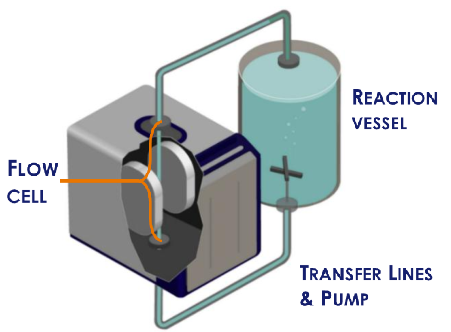
Fig. 2 — FlowNMR apparatus consisting of a reaction vessel, transfer lines, pump, and Flow Cell (inserted in the probe)
Quantification of Lithium, Sodium and Chloride
Given the varying relaxation properties of different nuclei, quantification of lithium, sodium and chloride is particularly important here to ensure the measurement of precise concentrations. Lithium is known for its long relaxation times; therefore too short a relaxation time would result in not observing a representable concentration of Li, whereas too long would limit the time points that can be observed. This becomes particularly important when sharp changes in concentrations occur. To address this, it is essential to consider that the relaxation delay (RD) should ideally be 5–7 times the T1 relaxation time to achieve accurate quantification without compromising the frequency of observation. To enable quantitative analysis, this study focused on first measuring the relaxation times (T1) of 7Li and 23Na nuclei under flowing conditions (2–4 mℓ/min) and compared to static relaxation times for a 0.5 mol/ℓ LiCl & NaCl solution in water (Figure 3).
Sodium ions exhibited rapid T1 relaxation times, ensuring swift data acquisition: at 2 mℓ/min the effective T1 time was 49 ms, whereas at 4 mℓ/min it was 63 ms.
Conversely, lithium was characterised by longer T1 times, posing a challenge for rapid acquisition. Our investigations revealed a significant reduction in the effective T1 relaxation time of lithium, from approximately 22 seconds under static conditions to 1.14 seconds at a flow rate of 2 mℓ/min, which further decreased to 0.63 seconds at 4 mℓ/min. This shortening of T1 in flow conditions is useful, as it allows for more frequent data collection and makes quantitative 7Li NMR easier to perform compared to static measurements, where the longer T1 would require extended delay times between scans.
These measurements therefore allowed for the optimisation of delay times to approximately 0.5 seconds for 23Na and 6 seconds for 7Li at a flow rate of 2 mℓ/min. This ensured quantitative 7Li, 23Na and 1H NMR spectra can be collected every eight minutes, which facilitates accurate monitoring of the dynamic changes in ion concentrations during the extraction process. Similarly, T1 relaxation times were determined for 35Cl, resulting in optimised delays of approximately 0.3 seconds. Consequently, quantitative 35Cl and 1H NMR spectra could be collected every 5 minutes.
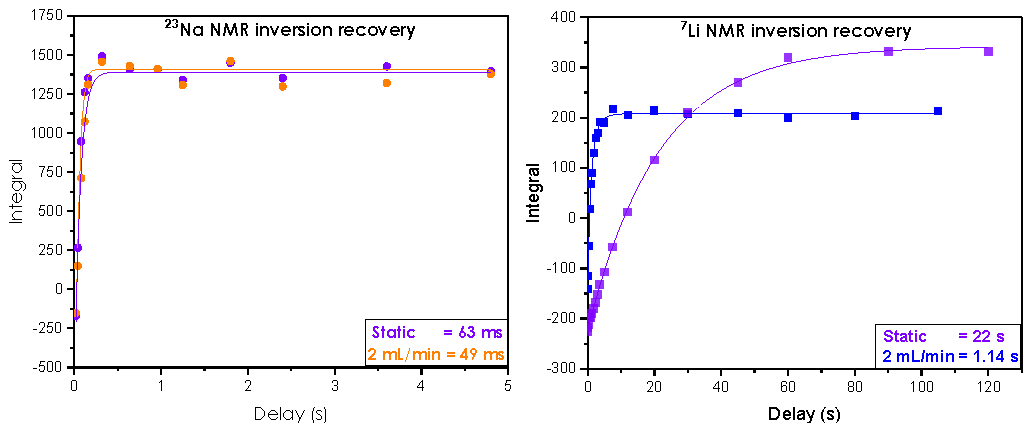
Fig. 3 — ²³Na NMR and ⁷Li NMR inversion recovery profiles of NaCl (left) and LiCl (right), recorded static and at 2 mℓ/min
Reaction monitoring and data acquisition
Here we show four reactions, each carried over 6 to 11 hours, monitoring the concentration changes when making additions and dilutions of LiCl and NaCl in H2O. Utilising the T1 data obtained from inversion recovery experiments, we interleave 7Li, 23Na, and 1H NMR experiments effectively, with one complete cycle executed every eight minutes for the first three reactions and interleaved 35Cl and 1H NMR every 5 minutes for the fourth reaction. This allowed for good quality spectra to be obtained (Figure 4).
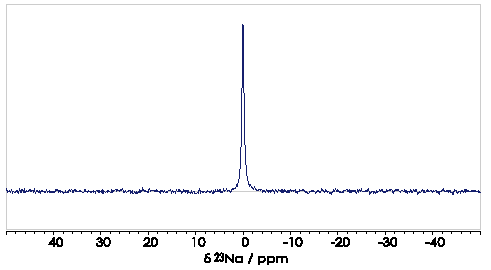
Fig. 4 — Exemplary ²³Na spectrum of NaCl at 2 mℓ/min
Processing
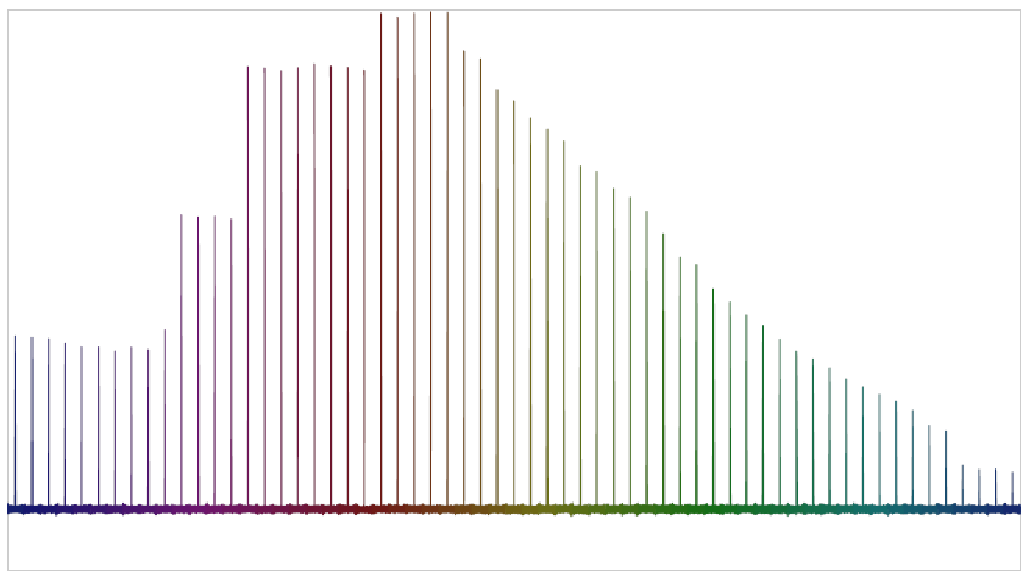
To effectively correlate NMR spectral data with concentration profiles of the lithium, sodium and chloride ions, the NMR data for each nucleus are stacked and aligned, as depicted in Figure 5. This alignment ensures accurate integration of the peaks of interest within the spectra. Following this step, the integration of these aligned peaks yields raw integral values for each spectrum. To account for the flow conditions' impact on these values, a correction factor is applied. This factor is derived by comparing the integrals from static (no flow) spectra to those obtained under flow conditions at corresponding time points. The ratio of static to flow integrals adjusts the raw data, ensuring the measured concentrations accurately reflect the system.
Using these corrected integrals, the concentrations of lithium, sodium and chloride ions are calculated. Given the known initial concentrations of LiCl and NaCl, these corrected integral values allow determination of the concentration changes over time. This method enables the generation of detailed concentration profiles, plotting the dynamic variations of lithium, sodium and chloride levels throughout the extraction process.
Results and discussion
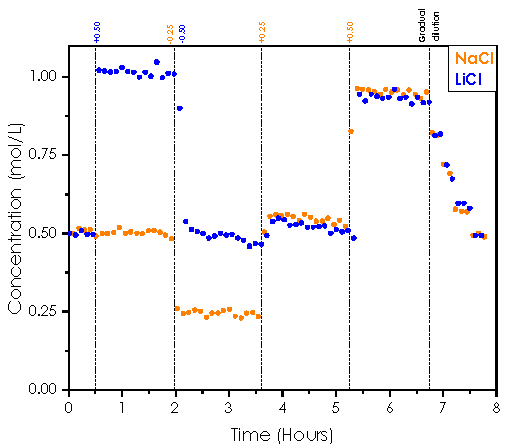
In the first experiment (see Figure 6), we observed the behaviour of a system initially balanced at 0.5 mol/ℓ concentrations of both LiCl and NaCl. The concentration of LiCl was then increased to 1 mol/ℓ, creating a disparity in the Li:Na ratio. This adjustment was maintained for 70 minutes, after which the system was diluted, halving the concentrations of both ions. Subsequent adjustments were made to equalise the concentrations of LiCl and NaCl, followed by a simultaneous increase to 1 mol/ℓ at 320 minutes and a gradual decrease back to 0.5 mol/ℓ over the last hour. These manipulations demonstrated the versatility of FlowNMR in tracking concentration changes in real-time, providing valuable data on the kinetics of ion exchange and solubility under varying conditions.
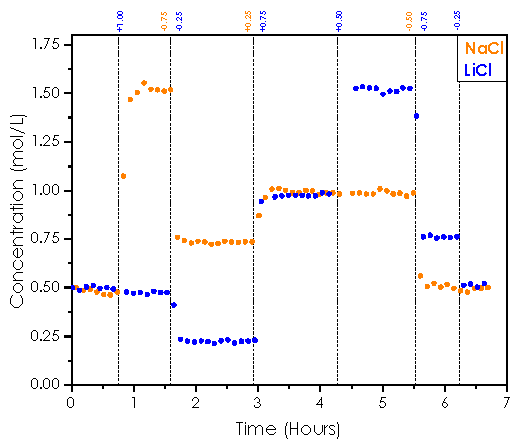
The second experiment (see Figure 7) further explored the system's response to more pronounced changes in ion concentrations, with a swift increase of LiCl to 1.5 mol/ℓ and subsequent dilution and equilibration steps involving both LiCl and NaCl. This experiment highlighted the sensitivity of FlowNMR in detecting subtle shifts in ion concentrations, which is an important aspect for optimising the lithium extraction processes.
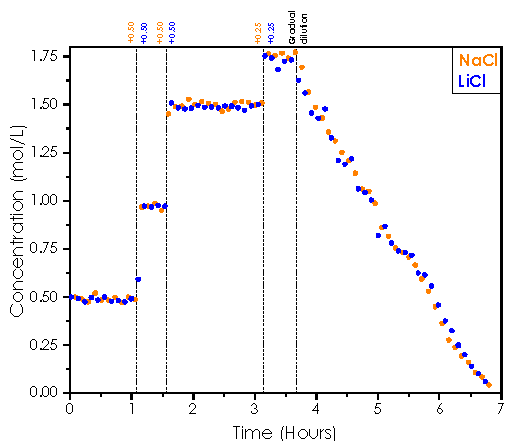
In the third experiment (see Figure 8), a more aggressive modulation of ion concentrations was undertaken, with both LiCl and NaCl concentrations being ramped up incrementally to 1.5 mol/ℓ. To highlight the power of FlowNMR, concentration time plots were able to identify at 180 minutes that the concentration was indeed at 1.5 mol/ℓ; we then used this information to increase the concentration of both LiCl and NaCl to 1.75 mol/ℓ. The reaction system was then methodically decreased over 4 hours to 0 mol/ℓ. This scenario provided a detailed view of the system's behaviour across a wide concentration range, showing the ability of FlowNMR to monitor the incremental decrease of complex reactions and ion interactions effectively.
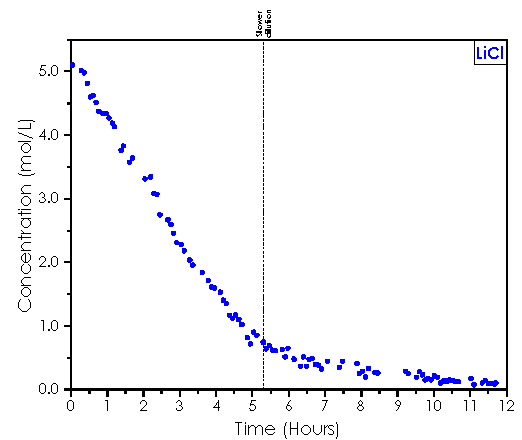
In the final experiment (see Figure 9), a constant dilution of LiCl was performed initially over the first 5 hours, which reduced the concentration from 5 mol/ℓ to 0.75 mol/ℓ. Following this, a slower dilution continued from 5 to 12 hours, ultimately reaching a concentration of 0.08 mol/ℓ. This clearly demonstrates the ability of FlowNMR on the X-Pulse to accurately quantify chloride concentration by 35Cl NMR over an extensive concentration range for an extended period of time without any need to shim, showing its effectiveness for precise monitoring and optimisation of extraction processes.
The ability of FlowNMR to detect small changes in concentration, particularly in the millimolar range, makes it a practical tool for monitoring and optimising lithium extraction processes. This level of sensitivity is important when aiming to produce high-purity, battery-grade lithium. By providing regular, quantitative data, the technique can support more efficient extraction methods and help reduce impurities early in the process. This not only improves current approaches but also opens the door for developing new techniques that better meet the demands of lithium-ion battery production. In this way, FlowNMR has relevance beyond just measurement — it can play a role in improving supply chain reliability and supporting the transition to cleaner energy technologies.
Summary
These experiments using FlowNMR spectroscopy have highlighted its significant potential in the realm of lithium extraction. The technique's ability to provide continuous, real-time data on concentration changes of lithium, sodium and chloride ions offers substantial benefits in studying reaction kinetics, concentration changes, and process optimisation. These experiments performed on the Oxford Instruments X-Pulse Benchtop NMR Spectrometer not only show the versatility and sensitivity of multinuclear FlowNMR spectroscopy, but also show its applicability in addressing key challenges in lithium extraction processes effectively.