Pharmaceutical research and process development require analytical techniques that deliver reliable chemical information quickly and non-destructively. The witec360 platform combines confocal Raman microscopy with efficient imaging and data analysis workflows to support informed decisions from early R&D to process development.
Introduction
From early formulation studies through process development and scale-up activities, researchers need robust and reproducible analytical methods that help generate actionable chemical insights. The chemical identity, spatial distribution, and solid-state form of active pharmaceutical ingredients (APIs) directly influence product performance, stability, and manufacturability. Even minor variations in polymorphic form or blend homogeneity can affect formulation behaviour and development outcomes.
Confocal Raman microscopy combines molecular specificity with high spatial resolution and non-destructive analysis. The microscope and software provide features that support structured laboratory workflows and data handling practices. Functions such as multi-user role management, internal calibration routines, and reproducibility features help maintain consistent procedures and clear documentation. These capabilities can support laboratories working within regulated environments and implementing requirements such as 21 CFR Part 11. The witec360 platform further extends these capabilities by enabling fast confocal Raman imaging, spectral acquisition, and guided evaluation to support efficient research and process development workflows.
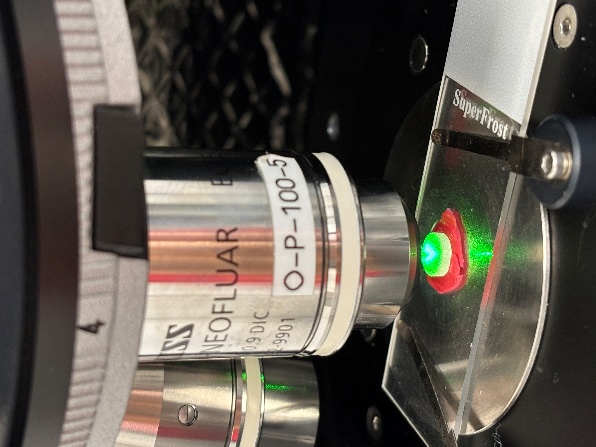
Raman setup in a pharmaceutical environment.
Technology Overview
Raman spectroscopy is based on the inelastic scattering of light. During this process, a small fraction of the incident photons exchanges energy with molecular vibrations, producing a shift in the light’s frequency. Each molecule generates a characteristic Raman spectrum that acts as a chemical fingerprint.
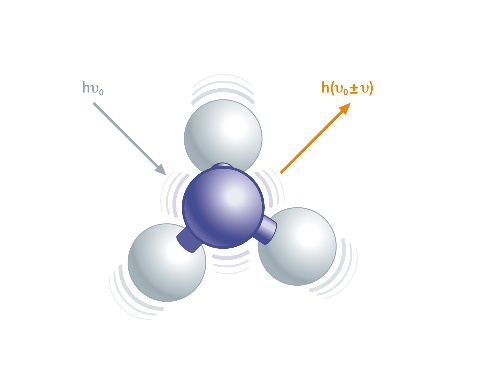
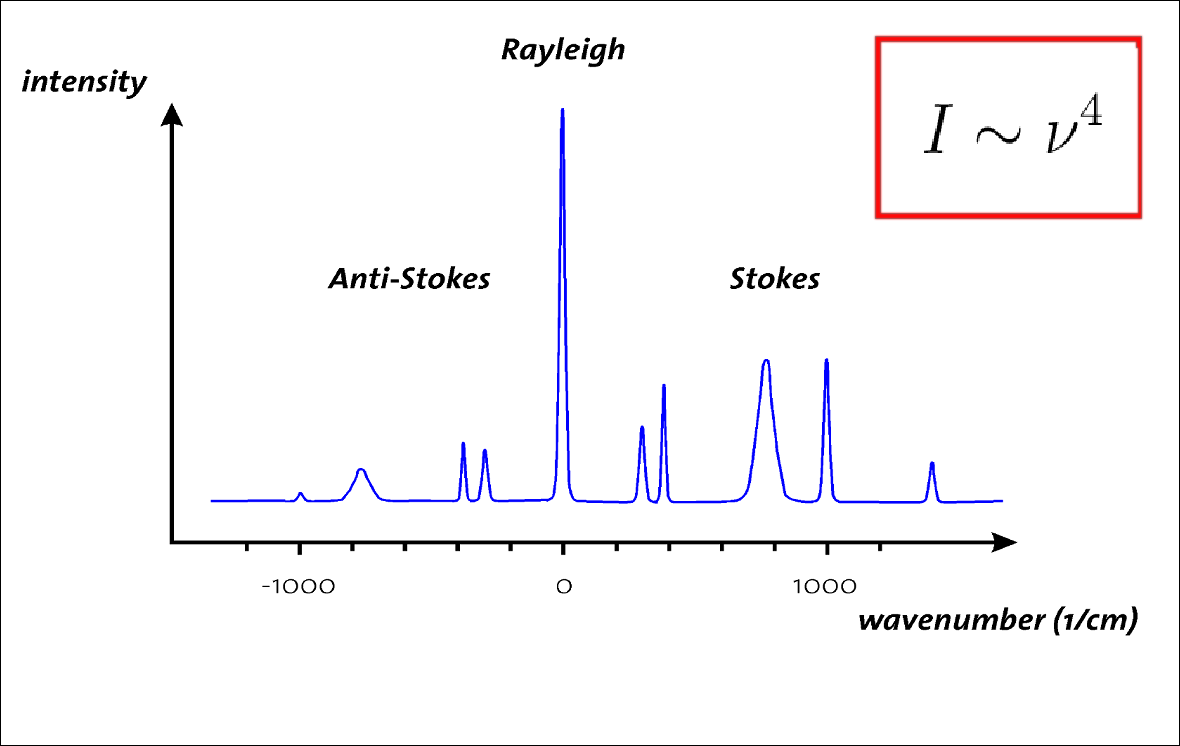
Compared to other analytical methods, Raman microscopy offers several advantages: no sample preparation is required, the method is non-destructive, label-free and contact-free, and it provides high chemical specificity combined with submicron spatial resolution.
When combined with confocal microscopy, Raman spectroscopy enables spatially resolved chemical imaging in two and three dimensions. This allows both identification and localization of compounds within complex pharmaceutical formulations.
Advantages over other methods
- No sample preparation required.
- Non-destructive and contact-free.
- Label-free.
- High chemical specificity and spatial resolution.
Key features of witec360 systems
- True confocal Raman imaging for 3D chemical mapping.
- Rapid data acquisition through highly sensitive detectors.
- Possibility to combine with AFM or further correlative technologies for multimodal analysis.
The witec360 platform is built on a true confocal optical design, ensuring high lateral and axial resolution while minimizing background signals such as fluorescence. This architecture is particularly advantageous for heterogeneous samples such as coated tablets, granulates, or multilayer systems.
Hexalight is the innovative spectrometer at the heart of the witec360 Raman microscopes. Its pioneering lens-based design eliminates mirrors and sets new benchmarks for throughput and spectral versatility, offering exceptional broadband performance. Hexalight's outstanding sensitivity helps accelerate workflows and significantly reduce integration times, enabling large-area mapping and screening applications commonly encountered in pharmaceutical research and process development.
TrueSurface technology allows Raman measurements on uneven or curved sample surfaces without refocusing artifacts. Automated z-scanning enables volumetric chemical imaging and depth profiling without destructive cross-sectioning. The integrated software supports automated spectral clustering, chemical segmentation, and advanced visualization options, while standardized data export supports transparent and traceable laboratory workflows.
Applications in Pharmaceutical R&D and Process Development
Raman microscopy addresses critical analytical questions throughout pharmaceutical research, formulation development, and process development. From understanding material properties to evaluating formulation performance, analytical reproducibility is essential for generating reliable results.
Polymorphism analysis enables reliable differentiation of crystalline forms of APIs, supporting solid-state characterization and stability studies. API distribution mapping provides insight into blend homogeneity and dose uniformity during formulation development. Contamination analysis enables rapid identification of foreign particles and supports root-cause investigations. In addition, Raman spectroscopy can contribute valuable information for Process Analytical Technology (PAT) approaches and process understanding activities. Standardized measurement routines help reduce operator dependency and improve reproducibility across development studies.
Typical Pharmaceutical Applications and Workflow Integration
| Analytical Task | Development Relevance | witec360 Workflow Integration |
| Polymorphism analysis | Solid-state characterization and stability studies | High spectral resolution, automated phase differentiation |
| API distribution in tablets | Formulation development and blend homogeneity assessment | Automated 2D/3D mapping, cluster-based segmentation |
| Contamination analysis | Automated 2D/3D mapping, cluster-based segmentation | Automated particle analysis routines, spectral library matching |
| Coating homogeneity | Process development and controlled release evaluation | TrueSurface, depth profiling, volumetric imaging |
Example Measurements
API Distribution in a Pharmaceutical Tablet
A tablet containing one API and multiple excipients was analyzed using confocal Raman imaging on the witec360 platform. Surface mapping was performed with a lateral resolution of approximately 300 nm. Subsequent depth profiling achieved an axial resolution of approximately 900 nm. Automated cluster analysis enabled objective segmentation of chemically distinct regions.
The resulting chemical maps visualize the spatial distribution of API and excipients and provide insight into blend homogeneity. Such information can support formulation optimization and process development activities.
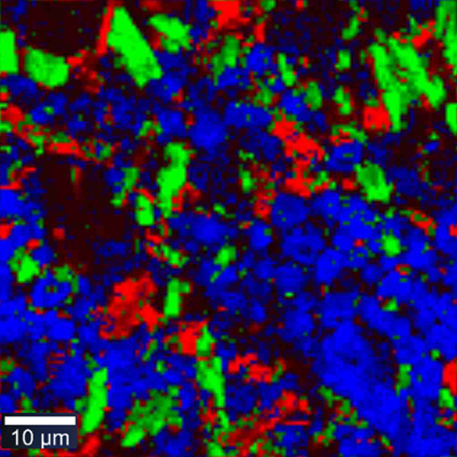
Raman map showing API and excipient distribution in a tablet.
Polymorphic Distribution of Acetylsalicylic Acid (ASA)
Using high spectral resolution and confocal imaging, different polymorphic forms of ASA were identified and spatially localized within a single tablet. The Hexalight spectrometer design ensures sufficient sensitivity and spectral resolution to resolve subtle spectral differences between crystalline phases.
Automated spectral classification supports rapid polymorph differentiation, strengthening solid-state characterization and stability assessment workflows.
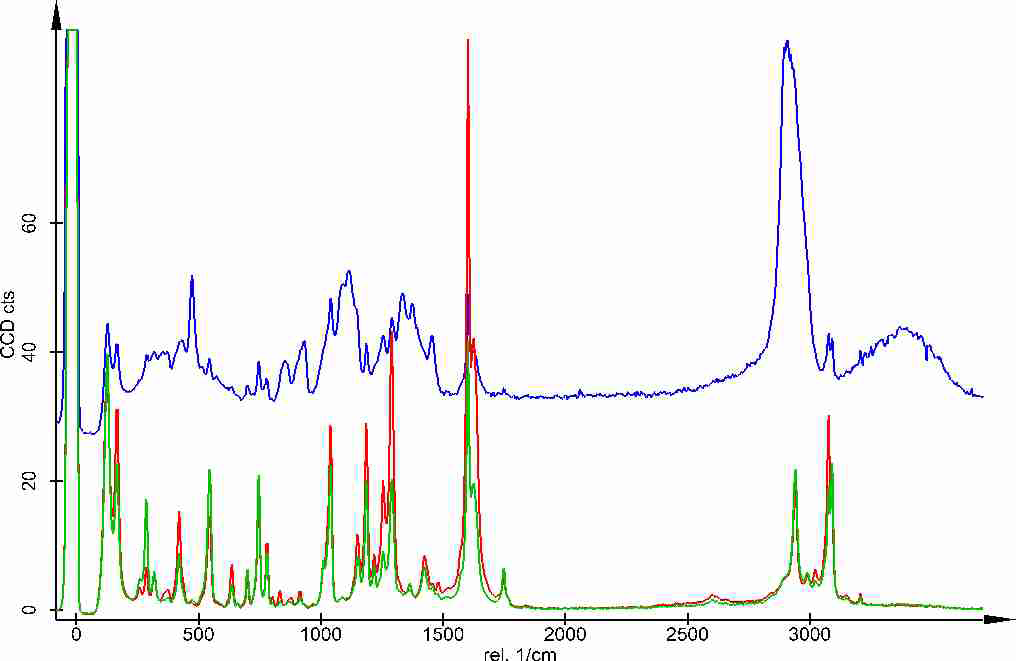
Raman polymorph spectra of ASA (green and red) within tablet.
3D Coating Analysis and Depth Profiling
Three-dimensional Raman imaging enables non-destructive analysis of coated tablets. Z-stack acquisition combined with automated focus control (TrueSurface) allows accurate determination of coating thickness, surface morphology, and internal API distribution.
This volumetric approach provides detailed insight into multilayer systems and supports formulation optimization and process development without destructive cross-sectioning.
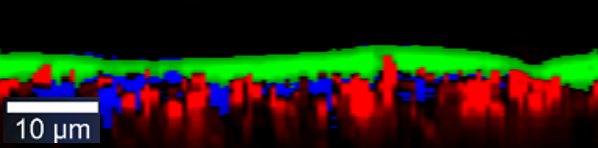
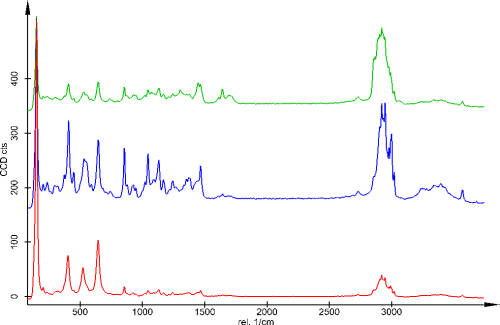
Raman depth profile showing API distribution within the coating.
Advantages for Pharmaceutical R&D and Process Development
The witec360 systems support both fundamental research and development-focused analytical workflows through robust optical architecture, high-throughput spectroscopy, and automated measurement protocols.
The combination of high chemical specificity, submicron spatial resolution, and workflow-supporting software features spanning hardware, software, and application expertise makes Raman microscopy an effective tool for pharmaceutical laboratories working across research, formulation development, and process development stages.
Conclusion
The witec360 Raman imaging platform provides a comprehensive analytical solution for pharmaceutical material characterization in research and process development environments. From polymorph identification to automated API mapping and three-dimensional coating analysis, the system delivers high-resolution chemical imaging that supports structured laboratory workflows.
By combining analytical performance with workflow support, reproducibility, and automation, Raman microscopy becomes a valuable technology for pharmaceutical scientists seeking deeper material understanding, accelerated development, and improved process knowledge.