Background
Fluorine is an important element in industrial chemistry and has applications in a wide range of industries, such as pharmaceuticals, agrochemicals, polymers, surfactants and solvents. It is estimated that more than 20% of all pharmaceutical compounds contain fluorine. This includes some of the commercially important drugs such as Prozac (fluoxetine) and Paxil (paroxetine). Nuclear Magnetic Resonance (NMR) spectroscopy is a valuable technique for the measurement of compounds containing fluorine especially organo-fluorine compounds. After the proton (1H) and carbon-13 (13C) NMR, fluorine-19 (19F) is the most common nucleus studied by this technique. 19F nuclei have a nuclear spin of ½, have a high gyromagnetic ratio, and have 100% natural abundance, ensuring they have a high receptivity for NMR measurements. The 19F resonance frequency in a 1.4 T magnetic field, such as X–Pulse, is 56.2 MHz which is sufficiently close to the resonance frequency of 1H, that proton and fluorine-19 spectra can be measured using the same probe.
Measuring 19F Spectra on X–Pulse
X–Pulse is a high performance broadband benchtop NMR spectrometer that does not require external services, such as liquid cryogens or compressed air, and can be placed in the laboratory rather than in a specialised NMR facility. Spectra can be collected within a couple of minutes using standard 5 mm NMR tubes.
A series of spectra have been collected to demonstrate the 19F and 1H capability and performance of the instrument using the same probe.
ɑ,ɑ,ɑ-Trifluorotoluene is a useful reference material for 19F NMR spectroscopy and can be used as an internal standard in a similar way to tetramethylsilane (TMS) is for 1H and 13C measurements. The 1H and 19F spectra of ɑ,ɑ,ɑ-trifluorotoluene are shown in Figure 1.
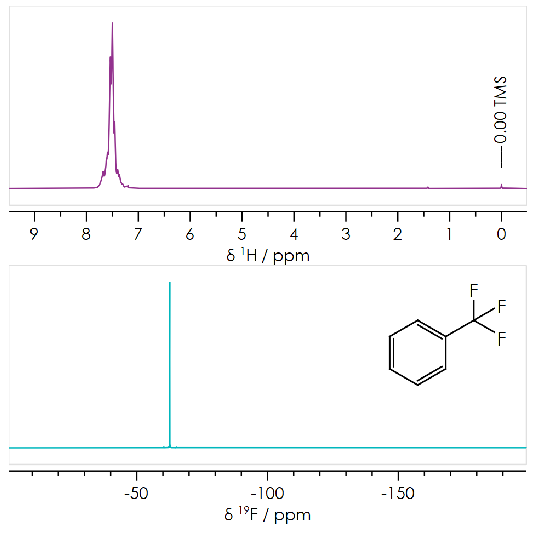
Figure 1 —
1
H (top, purple) and
19
F (bottom, sea green) spectra of ɑ,ɑ,ɑ-trifluorotoluene
The 19F spectrum, shown in Figure 1, consists of a single peak since the three fluorine nuclei are chemically and magnetically equivalent, and are not in close proximity to any of the protons in the molecule. The 1H spectrum is more complex since the hydrogen nuclei on the aromatic ring are not equivalent and the resulting homonuclear couplings give rise to multiple overlapping signals, appearing as a single multiplet.
The spectrum shown in Figure 2 is a mixture of two fluorine containing chemicals; ɑ,ɑ,ɑ-trifluorotoluene (TFT) and 2,2,2-trifluoroethanol. TFT is often used as a reference material for 19F spectra; since it appears as a strong, single peak with a chemical shift of −62.6 ppm relative to the standard 19F NMR chemical shift reference compound, CFCl3, at 0 ppm. (Angew. Chem. Int. Ed.
, 2018, 57, 9528–9533) It is a single peak as the structure consists of three equivalent fluorine nuclei isolated from any other nuclei that would couple to it. By comparison the peak in the spectrum due to trifluoroethanol, at −77.1 ppm, is split into a triplet. This is due to the fact that the 19F nuclei couples with the two equivalent 1H nuclei on the adjacent carbon atom in the molecule, just as 1H nuclei would couple with other neighbouring 1H nuclei in the molecule.
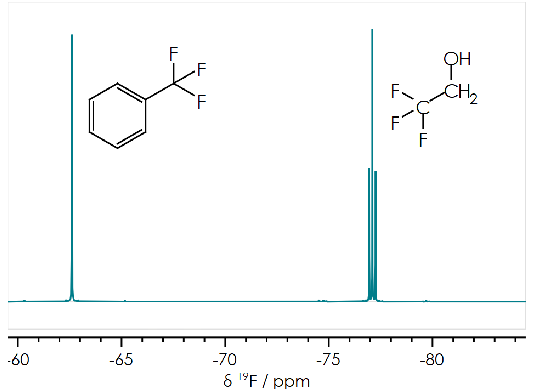
Figure 2 —
19
F spectrum of a mixture of ɑ,ɑ,ɑ-trifluorotoluene and 2,2,2-trifluoroethanol
Figure 3 shows the 1H and 19F spectra of the compound 5-bromo-1,2,3-trifluorobenzene. The 1H spectrum consists of a single multiplet of peaks resulting from the two equivalent 1H nuclei and their couplings with the chemically and magnetically inequivalent 19F nuclei within the molecule. The 19F spectrum consists of two resonances, each of which are multiplets due to the two different chemical environments of the 19F nuclei. The resonance at −132 ppm arises from the fluorines in the meta
positions of the molecule while the resonance at −161 ppm arises from the fluorine in the para
position.
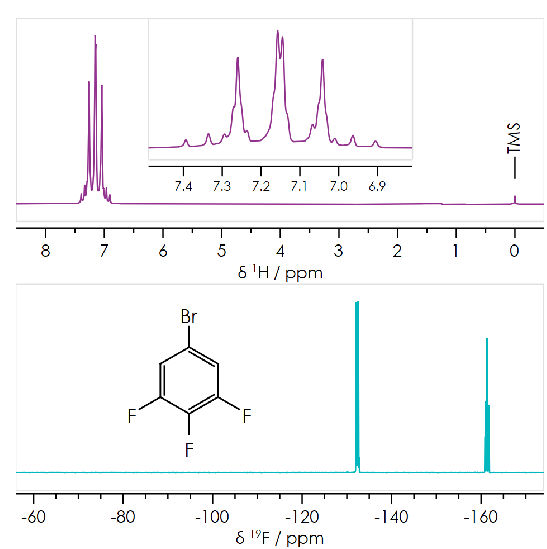
Figure 3 —
1
H (top, purple) and
19
F (bottom, sea green) spectra of 5-bromo-1,2,3-trifluorobenzene
Each of these resonances shows a complex coupling pattern due to the other nuclei on the aromatic ring. Most easily recognisable is the triplet of triplet pattern at −162 ppm, arising because the fluorine in the para
position is coupled to two equivalent fluorines in the meta
positions and two equivalent hydrogens in the ortho
positions.
Finally, a comparison has been made of the 19F spectra of two different positional isomers of bromotrifluorobenzene. Figure 4 shows the 19F spectra of 5-bromo-1,2,3-trifluorobenzene and 1-bromo-2,4,5-trifluorobenzene.
In contrast to the spectrum of 5-bromo-1,2,3-trifluorobenzene, the spectrum of 1-bromo-2,4,5-trifluorobenzene shows three 19F resonances because each of the fluorines on the ring are in different chemical environments. They all appear as a doublet of doublets of doublets of doublets, since each is coupled to two inequivalent fluorines and two inequivalent hydrogens.
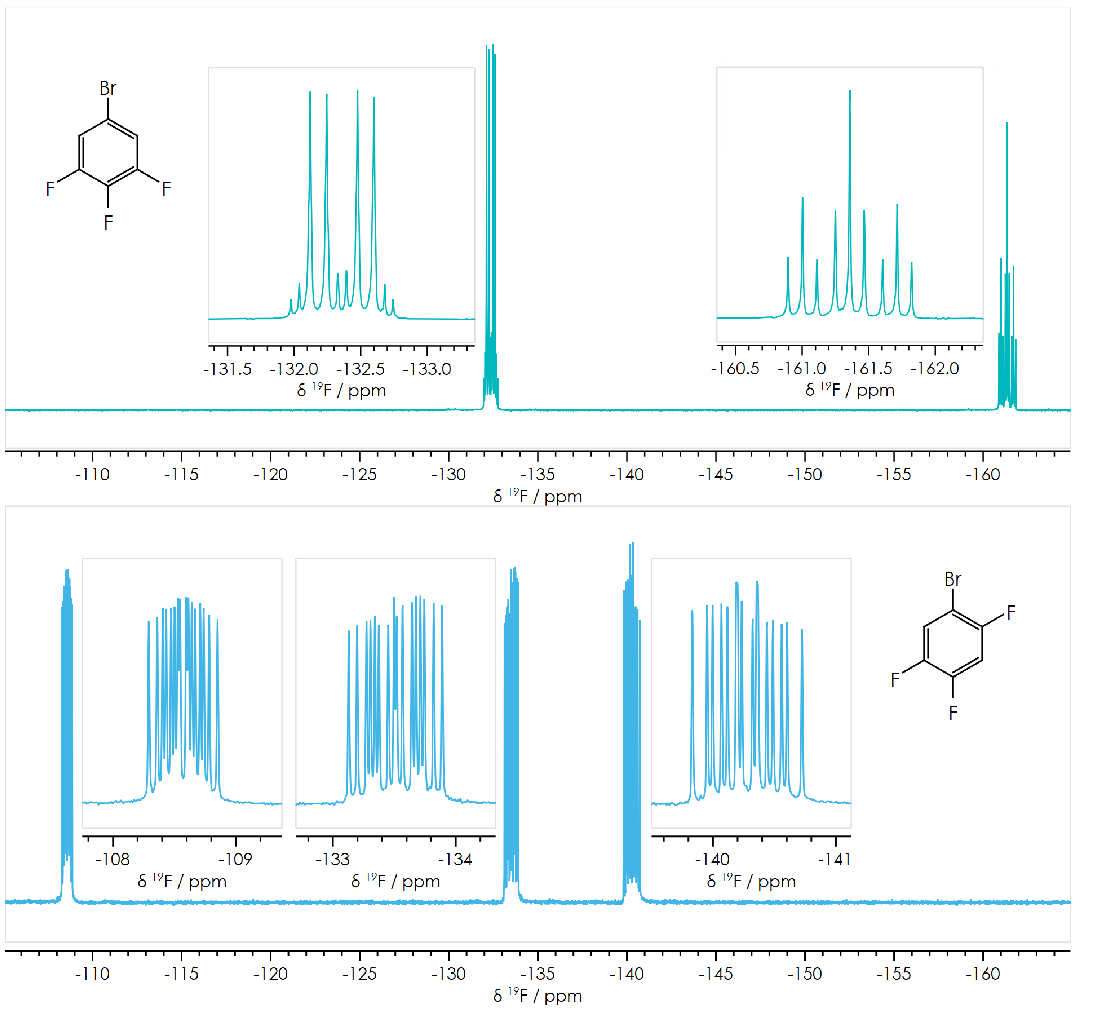
Figure 4 —
19
F spectra of 5-bromo-1,2,3-trifluorobenzene (top, sea green) and 1-bromo-2,4,5-trifluorobenzene (bottom, deep sky)
Summary
The data presented here displays that benchtop NMR is a valuable analytical tool for measuring 19F spectra and provides useful information for fluorine chemistry. With X-Pulse it is possible to measure both 19F and 1H spectra of a sample within a couple of minutes using the same probe.