Application Notes
NMR Core Analysis for Unconventional Reservoirs
Published: 03 Nov 2026 · Last updated: 03 Nov 2026
This Application Note was created in collaboration with Green Imaging Technologies

Introduction
Oil and gas production is highly dependent on understanding key properties of reservoir rock, such as porosity, permeability and wettability. Geoscientists have developed a variety of approaches to measure these properties, including log and core analysis techniques.
Advantages of NMR
Low field nuclear magnetic resonance (NMR) is routinely used in the oil exploration industry to examine the T2 relaxation time distribution of fluids in core plugs. These distributions can be interpreted to give information on pore size distributions, permeability, porosity, free fluid index and bound water volumes.
Instruments for routine measurements of relaxation distributions generally operate at 2MHz in order to reduce artefacts caused by ferromagnetic material in the samples and to match the operation of the NMR logging tools. Laboratory-based instruments are used to help calibrate downhole logging tools and for more accurate and advanced measurements on cores.
Higher field instruments are also available for use in applications where greater sensitivity is required – for example, in imaging studies.
Method
To visualise the fluids in small pores, the measurement parameter known as TE (Time to Echo) must be as short as possible. The Oxford Instruments GeoSpec rock core analyser acquires data with TE as short as 60 µs, the best commercially available performance in the industry. This class-leading performance is a direct result of our newly developed Q-Sense enhanced signal sample probe. This has substantially decreased acquisition times while simultaneously increasing signal to noise ratio.
In a typical laboratory NMR core analysis procedure, a sample is scanned when fully saturated with one fluid (like brine or oil). This gives the T2 distribution which represents the pore size distribution within the core sample.
The shorter the echo time provided by the NMR instrument, the shorter T2 that can be resolved, enabling smaller pore sizes to be detected. This is especially important in unconventional reservoirs, more specifically, shale oil, gas and heavy oil reservoirs.
In unconventional reservoirs, the very small pores are often the dominant contribution to the total porosity of the core samples, which is a key parameter in determining the estimated output of any reservoir. Before the short echo times provided by the GeoSpec instrument, measurements were being taken using longer echo times resulting in an undervalued total porosity and corresponding
undervalued reservoir potential.
Results
To illustrate the performance of the GeoSpec, data are compared on three different shale samples. Table 1 shows the results obtained at different echo times. All scans were run using the following parameters: Recycle delay: 500 ms, Gain 54 dB, T2 Max: 100 ms. Echo times used were 100 µs, 200 µs and 600 µs.
| Sample | TE (µs) (=2xTau) | Acquisition Time (min) | Number of Scans | Signal to Noise Ratio | NMR Volume (ml) |
| 1-1R | 100 | 1.5 | 64 | 203.72 | 4.512 |
| 200 | 7 | 272 | 201.74 | 1.983 | |
| 600 | 32 | 1312 | 200.71 | 0.939 | |
| 1-4R | 100 | 2 | 80 | 220.18 | 4.248 |
| 200 | 5.5 | 224 | 203.06 | 2.175 | |
| 600 | 21.5 | 864 | 200.16 | 1.151 | |
| 1-11R | 100 | 5 | 192 | 200.48 | 2.309 |
| 200 | 17 | 640 | 203.93 | 1.271 | |
| 600 | 46 | 1840 | 200.81 | 0.754 |
The results show that shorter TE times produce faster measurements and detect more signal in these samples. This means that a significant amount of signal comes from short T2 relaxation times and thus smaller pores. This is further confirmed in the adjacent figures.
Using the Green Imaging Technologies (GIT) Systems software, the adjacent figures show the T2 pore size distribution curves derived from the acquired T2 NMR data at different echo times for the three samples. This gives an indication of pore size distribution in the samples.
In the figures, the green line represents T2 pore size distribution acquired at 100 µs echo spacing, the red line represents T2 pore size distribution acquired at 200 µs echo spacing and the blue represents T2 pore size distribution acquired at 600 µs echo spacing.
It is evident from the variation in the curves for the three samples that more signal is acquired at shorter echo times. In all three graphs, the green line is representing a substantially greater variance of volumes and is a better measure of the actual pore size distribution in the core sample. It will also provide a more accurate porosity input for estimations of reservoir potential.
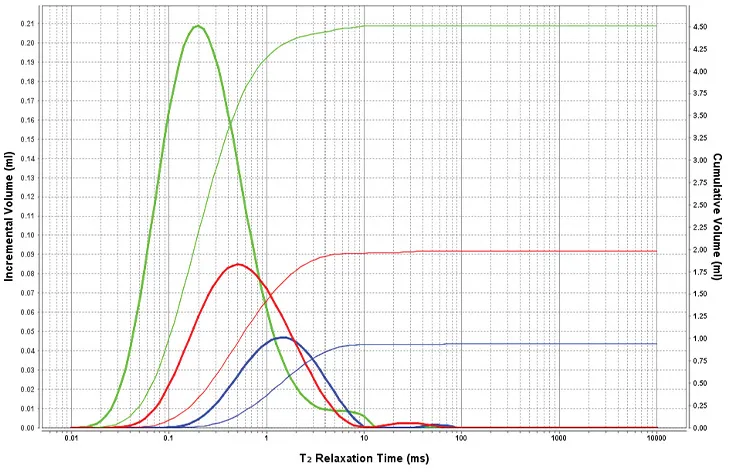
Fig. 1 — Sample 1–1R: T2 pore size distribution curves at 100 µs (green), 200 µs (red) and 600 µs (blue) echo spacing
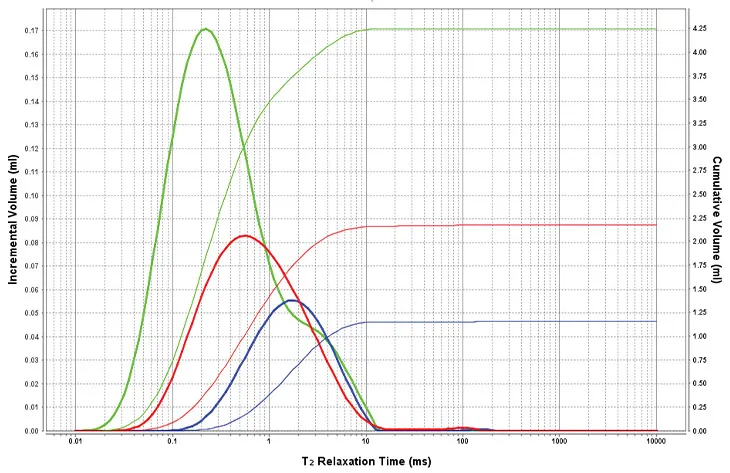
Fig. 2 — Sample 1–4R: T2 pore size distribution curves at 100 µs (green), 200 µs (red) and 600 µs (blue) echo spacing
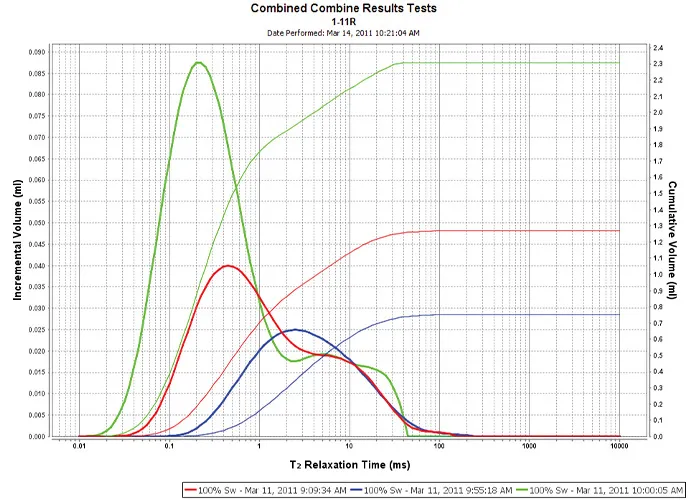
Fig. 3 — Sample 1–11R:T2 pore size distribution curves at 100 µs (green), 200 µs (red) and 600 µs (blue) echo spacing
Conclusion
It is clear that shorter echo time measurements are highly beneficial when calculating total porosity and pore size distribution, as the difference in detected NMR volume is greater by a factor of two or more for shorter echo times.
The shorter echo and acquisition times provided by the GeoSpec range of core analysers and enhanced by the GIT Systems software, provides one of the quickest and easiest ways to get an accurate pore size distribution and total porosity measurement of core samples. More accurate and timely data inputs make for a more comprehensive and timely reservoir model.
The Advantages of the Q-Sense Technology
- Improved Signal to Noise for faster analysis: Q-Sense offers a 2-fold improvement in Signal to Noise Ratio over existing rock core analysers. This major improvement in sensitivity allows a reduction in experimental time by a factor of four.
- Improved sensitivity for measurements on very low porosity rocks: With its significant improvement in sensitivity, Q-Sense provides scope to measure very low porosity samples (2% or less) within a reasonable time frame when the penalty for experiments on very low porosity rocks used to be measurement times in excess of one day.
- Shorter echo times to characterise tightly bound rocks: The fast recovery of the Q-Sense system allows the T2 measurement of samples with echo times down to 60µs. This is particularly important for characterising fluids in very small pores, such as clay bound water and gas shale where T2 values are typically of the order of milliseconds or less.
- Low susceptibility to probe detuning for improved ease of use: NMR probes fitted with Q-sense technology are now much less susceptible to detuning which means there is often no need to retune the probe over a wide range of rocks.
- External power dissipation for reduced thermal effects: Q-Sense technology is fitted with active energy dissipation to limit the heating effect of the RF pulses on the sample during T2 measurements, especially when samples are measured over a large number of closely-spaced echoes.
- Improved power handling capability for better 180° pulses: Q-Sense provides an improvement in 180° pulses. This results in T2 distributions with fewer artefacts and therefore fewer false readings.
- Built-In Calibration feature for a better accuracy over a wide range of conductive rocks: Q-Sense probes have a built in signal injection coil that can be used to calibrate the system sensitivity to ensure better accuracy in porosity measurements on samples with high saline content and on magnetically susceptible rocks.