The palm oil industry is one of the most productive vegetable oil producers. This is helped, in part, by the oil palm
having the highest yield (kg/ha/yr) of all the vegetable oil plants. Nevertheless, there is scope for increasing oil
production further by measuring the oil content at various stages in the process from the fields through to the mills.
Benchtop Time Domain Nuclear Magnetic Resonance (TD-NMR) is a well-established technique that has been successfully
adopted and used to measure oil content in food and agricultural products over many decades. TD-NMR instrumentation
uses permanent magnets and is therefore easy to maintain. Additionally, TD-NMR measurements have many advantages over
traditional methods including being non-destructive, rapid, repeatable, and solvent-free. As with near infrared (NIR)
spectroscopy, TD-NMR is often calibrated to "match" the oil and water content results generated by solvent
extraction and oven drying for which there are ISO methods.1-2 However, unlike NIR, it is also possible to
set up a primary calibration using the oil of interest, as the signal is directly and linearly related to hydrogen
content. The ability to calibrate against a pure oil standard has been applied to snack foods3 and fish
products.4
TD-NMR has numerous advantages over NIR and traditional extraction methods including:
- TD-NMR can measure all the oil in the samples, not just from the surface, therefore is ideal for large
inhomogeneous samples
- TD-NMR is not affected by factors such as colour and particle size
- The calibration, which is linear, can be produced using just three reference samples (subject to the accuracy of
the reference method). Alternatively, the instrument may be calibrated against the refined oil which has been
extracted from the seed, nut or fruit.
Figure 1 shows a good correlation between the TD-NMR results, using a 100% palm oil calibration, against Soxhlet
extraction across a wide range of concentrations. Thus, it is possible to measure the oil content of not only dried
palm fruit, or mesocarp, but also of the residues during crushing and extraction using just one calibration; thus
TD-NMR can be used as a tool to maximise oil yield by minimising losses during processing.
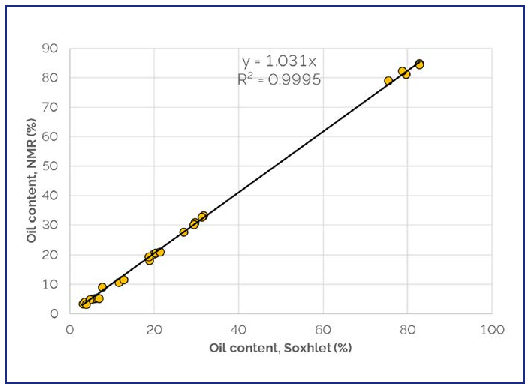
Fig. 1 — Comparison of NMR and Soxhlet results for palm fruit and the residues during various stages of
processing.
For these reasons, benchtop NMR has many potential uses in the palm oil industry which are described in further
detail below.
Measuring Oil in Palm Mesocarp for Bunch Analysis
Measurement of oil in palm mesocarp is mainly of interest to plant breeders wishing to measure the oil yield from
their crops using bunch analysis. Oil content is normally measured by Soxhlet extraction (after oven drying) which
limits the sample throughput. Although the mesocarp must be dry prior to NMR analysis, the sample throughput is much
greater than Soxhlet which is restricted by the analysis time as well as by the number of samples that can be analysed
at any one time. In addition, NMR has been shown to be just as accurate as the hexane extraction method but does not
require the use of solvents or other chemicals, fume cabinets and expensive disposal procedures.5-6
The method is simple; the samples are weighed in a vial then conditioned at 50°C for 20 minutes to ensure that all
the oil has melted prior to analysis. The measurement takes just 16 seconds making the time per sample short when
measured within a large batch of samples. The instrument may be calibrated against, and as a consequence can obtain
results equivalent to, the reference extraction method. Alternatively, a primary calibration can be obtained using
crude palm oil for the measurement of total oil content.
It has been shown that extraction methods don't always remove all the oil, whereas TD-NMR is able to measure all
the oil in the dry tissue, even that which remains after Soxhlet extraction.
A comparison of the results generated from Soxhlet extraction and an NMR oil calibration for dried palm mesocarp is
given in Figure 2.
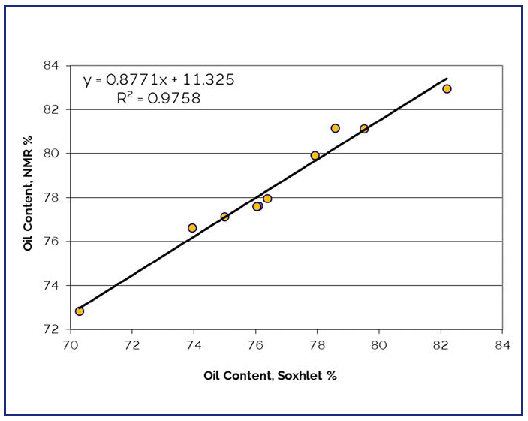
Fig. 2 — Comparison of TD-NMR vs. Soxhlet extraction results for dried palm mesocarp shows offset and scatter due
to oil not extracted by Soxhlet.
Note that the NMR results are typically higher than those from Soxhlet; this is because NMR measures all the oil,
whereas Soxhlet does not measure the unextracted oil. The latter is not constant and accounts for scatter in the data.
This scatter cannot be corrected using a calibration bias, so the unextracted oil content in the Soxhlet residue was
measured using NMR and a correction was applied to the individual Soxhlet results (Figure 3).
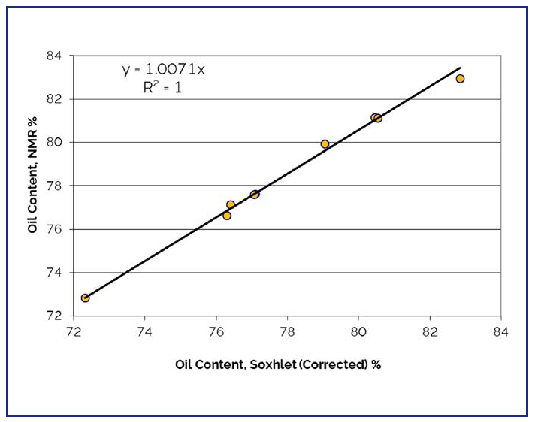
Fig. 3 — Results from TD-NMR vs. Soxhlet for dried palm mesocarp corrected for unextractable oil show direct 1:1
correlation and reduced scatter.
The most noticeable feature is that the scatter is reduced, as indicated by the improved correlation (R2).
Secondly, there is now a direct correspondence between the NMR and corrected Soxhlet results; that is, the line goes
through the origin. This further demonstrates that not only can NMR accurately measure oil content in the residue, for
optimization of the crushing/extraction process, but also it can measure "total" oil content from a sample
of the oil-producing crop.
Measuring Oil in Pressed Palm Fibre
It is important to measure the oil content of pressed palm fibre in mills to maximise the efficiency of the
extraction process, whether it be pressing or solvent extraction. However, this is a challenging measurement for many
techniques as the oil content is relatively low and non-uniform and, as a consequence, the sampling variation can be
large. It is important to note that this sampling variation, as well as incomplete extraction, can also lead to errors
in the reference method. However, given that NMR is non-destructive, it is possible to measure the same sample by
extraction after NMR analysis to avoid discrepancies due to sampling.
Figure 4 shows the correlation between the NMR signal/mass and the reference values determined on the same samples by
Soxhlet (after drying). Therefore, as outlined above, any discrepancies between the results and calibration line are
likely to be due to errors caused by the reference method itself.
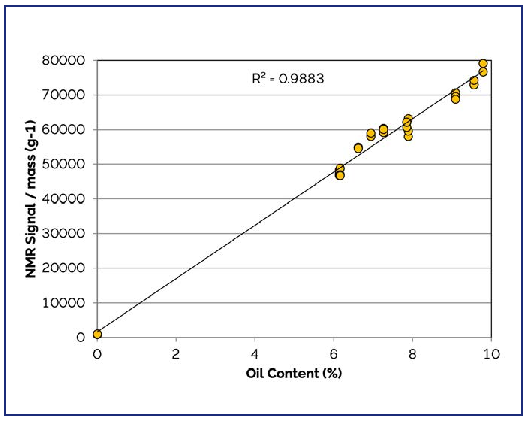
Fig. 4 — NMR calibration for oil in pressed palm fibre; the correlation coefficient and standard deviation are
0.99 and 0.28% respectively.
Oil and Moisture in Palm Kernels and Palm Kernel Cake
Palm kernel crushers would also like a rapid measurement of oil content to determine how much can potentially be
extracted. Nevertheless, palm kernels are not commonly measured because the hard nut is very difficult to crush into
smaller pieces. Crushing is needed to allow the solvent to penetrate the sample for better extraction leading to a
more accurate result. As the moisture content is relatively low, it is possible to measure the oil content of palm
kernels by NMR without drying. Furthermore, because radio frequency radiation penetrates the whole sample, palm
kernels can be measured by NMR without crushing. The only requirement is that they are conditioned at a higher
temperature to mobilise the oil prior to analysis.
NMR can also measure oil and moisture content in the palm kernel cake, which is useful for monitoring the efficiency
of the extraction process. In addition, NMR can measure the oil content of palm kernel meal, a by-product used for
animal feed.
Solid Fat Content
The melting profile of an edible oil is a function of the oil composition and is an important property as it defines
the applications for which the oils/fats can be used as ingredients. Fortunately, TD-NMR can also measure the
proportion of solid fat in the palm oils/fractions conditioned at different temperatures. Given this is a fundamental
measurement, it is not surprising that various standard methods exist which are used by oils/fats companies world-wide
to characterise their raw materials.7 The Direct method (AOCS Cd 16b-93, ISO 8292-1, IUPAC 2.150) is the
most commonly used due to its simplicity and precision.
Figure 5 shows that the melting profiles of palm olein and palm stearin obtained by TD-NMR, are very reproducible.
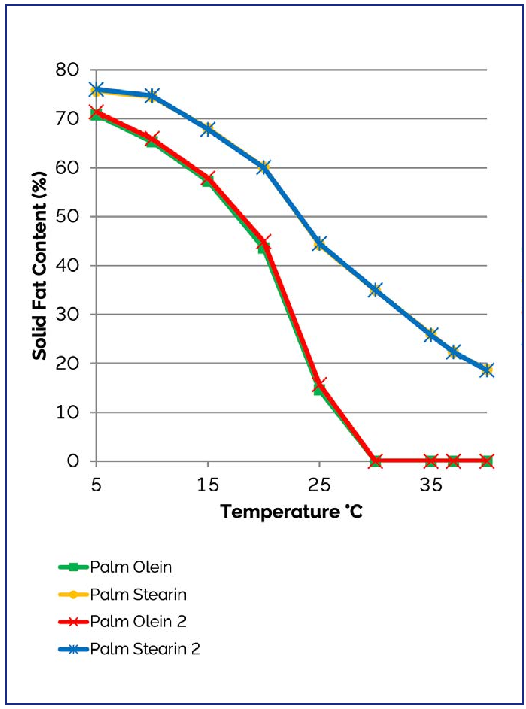
Fig. 5 — The melting profiles from two sub-samples of palm olein and palm stearin.
Conclusions
Benchtop NMR can be used at various stages of the palm oil production, from measurement of oil yield of the crops
through to processing and characterisation of the raw materials.
References
- ISO Method 10565:1998 Oilseeds—Simultaneous determination of oil and water contents—Method using pulsed nuclear
magnetic resonance spectrometry.
- ISO Method 10632:2000 Oilseed residues—Simultaneous determination of oil and water contents—Method using pulsed
nuclear magnetic resonance spectrometry.
- Application Note 2: Measurement of Oil Content in Dried Snack Foods. Oxford Instruments 2023.
- NMKL Method 199. Fat. Determination in fish, fish feed and fish meal by LF NMR.
- Junaidah J., Kushairi A., Jones B., Kho L. E., Isa Z. A. and Rusmin J. (2011) Innovation for oil extraction method
using NMR in bunch analysis. In: Proc. Int. Seminar Breeding for sustainability in oil palm, p. 1, International
Society for Oil Palm Breeders, Kuala Lumpar, 11 Nov.
- Application Note 18: Measurement of Oil Content in Dried Palm Mesocarp. Oxford Instruments 2018.
- Voda A. and Van Duynhoven, J. (2015) Bench-top NMR—Food: Solid Fat Content Determination and Emulsion Droplet
Sizing. In: Mobile NMR and MRI: Developments and Applications
- , p. 86, Royal Society Chemistry.