Application Notes
How to get the most out of your NMR system
Published: 03 Nov 2026 · Last updated: 03 Nov 2026
This Application Note was created in collaboration with Green Imaging Technologies

Introduction
There are several ways to optimise the performance of your NMR rock core system. Experts generally talk about this by referencing the signal to noise ratio (SNR) of the instrument because SNR is directly related to measurement time.
There are generally four ways to increase SNR and thereby decrease measurement time:
- Match sample size to probe size
- Optimise parameter selection
- Employ new technologies (Q-Sense)
- Use an instrument with higher magnetic field strength
Each provides benefits, but users need to be aware of some issues with each.
Why match sample size to probe size?
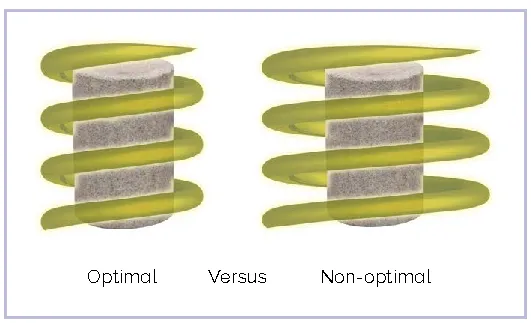
Matching probe size to sample size will maximise the filling factor during NMR measurements. The filling factor is the ratio of sample volume to probe volume and will affect acquisition times, so this number should be as close to 1 as possible.
The theoretical highlighted results show that if a 38.1 mm diameter core is measured in a 40 mm probe rather than in a 75 mm probe, the acquisition time is almost 20 times shorter.
| Sample Size (mm) | Relative Scan Times (s) | |||||
| Diameter | Length | 100 mm probe | 75 mm probe | 51 mm probe | 40 mm probe | 28 mm probe |
| 25.4 | 25.4 | 1016.8 | 181.0 | |||
| 38.1 | 50.0 | 108.5 | 19.3 | 3.6 | 1.0 | - |
| 75.0 | 60.0 | 5.6 | 1.0 | - | - | - |
What parameters can you optimise and why?
The main parameters that affect SNR are the number of signal averages and the signal filtering employed. Traditional signal averaging is performed by repeating the NMR measurement and averaging the results. This increases the measurement time linearly with the number of signal averages.
The SNR is directly related to the square root of the number of averages. Signal averaging can also be performed within the NMR measurement, for example by acquiring multiple points on each echo during an NMR T2 measurement. Averaging these points increases the SNR in the same way as traditional signal averaging does. This type of averaging does not require additional measurement time but will limit the timings within the NMR pulse sequence (for example, by forcing a longer Tau in a T2 measurement meaning that fewer small pores will be measured).
Digital filtering can increase the SNR by narrowing the filter thus reducing the noise but this will also limit the timing within the NMR pulse sequence. The filter width has an inverse relationship with SNR (small filter width leads to increases in SNR).
Optimising the filter width and the number of points acquired during the measurement can drastically improve SNR and scanning times, as seen in the following table and graph (Figure 1):
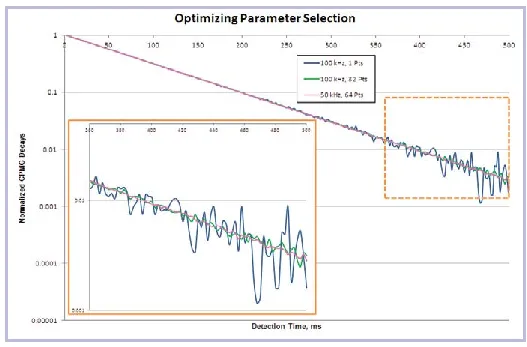
Fig. 1 — Graph showing the noise produced by differing filters and number of points acquired. For example, the 100 kHz filter with only 1 point acquired produces the most noise.
| Filter (kHz) | Number of Points | Relative Tau | Relative SNR | Relative Scan Time (s) |
| 100 | 1 | 1.0 | 1.0 | 88.4 |
| 250 | 64 | 3.4 | 2.4 | 15.3 |
| 100 | 32 | 3.4 | 4.0 | 5.5 |
| 50 | 64 | 14.2 | 9.4 | 1.0 |
These figures show that discussions of 'SNR' or 'minimum Tau' alone are almost meaningless without corresponding information on filter values and number of data points per echo.
The main drawback of decreasing the filter width or increasing the number of points averaged within the sequence is that these changes increase the minimum sequence timings, for example forcing a longer Tau for T2 measurements meaning that smaller pores may be ignored. Therefore, parameter optimisation may not be possible in some rocks with shorter T2s without losing information from the short T2 components (as found in shale and tight gas reservoirs).
If the Tau is too long, the porosity measurement is incorrect and pore information from the smaller pores is lost, as shown in the figure below (Figure 2).
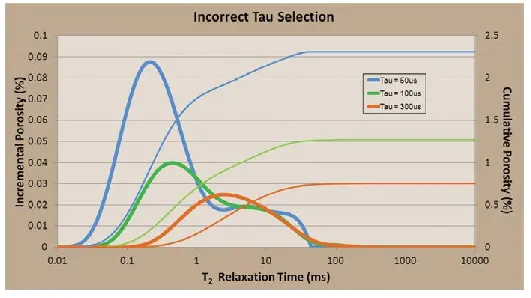
Fig. 2 — This graph shows how the T2 distribution (pore size) and measured porosity can change when differing Taus are used on shale.
Increasing the number of points acquired may cause problems when measuring rock samples with high magnetic susceptibility (for example high iron content). High magnetic susceptibility causes the echo peaks in a T2 sequence to have steeper sides. In a T2 measurement on such samples, if too many points are acquired, the calculated porosity will be too low because signal is being measured on the sides of an echo peak that is no longer flat.
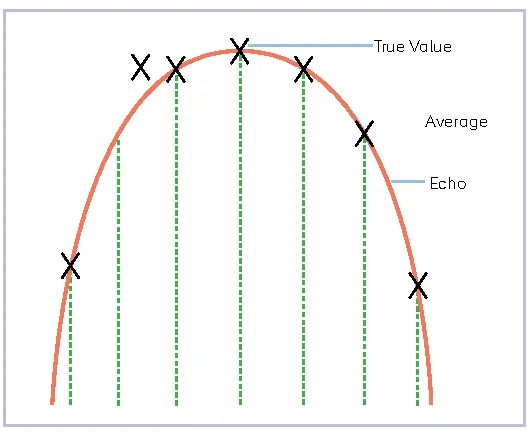
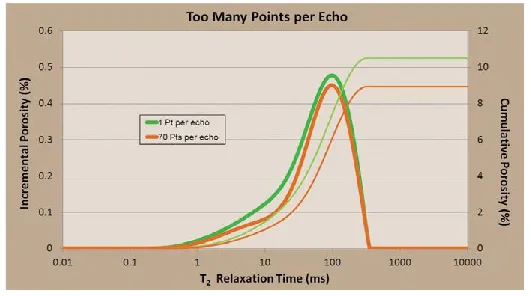
Fig. 3 — This graph shows the effects of using single point versus multi-point acquisition on a sandstone (porosity=14.7%, permeability=83 mD).
In these cases, what is being measured is a combination of pore size and magnetic susceptibility (i.e. a combination of T2 and T2*). Figure 3 shows an example of a sample that exhibits both of these issues. The distribution with one point per echo has the correct porosity and has the correct detail around the 10 msec point.
The following graphic illustrates the benefits of using optimisation techniques; in this example increasing sample throughput by 12 times!
What can new technologies offer?
Recent advances in NMR technology have significantly improved SNR and shortened Tau by using signal enhancement techniques. Oxford Instruments has developed the Q-Sense technology that improves SNR and sensitivity, and provides shorter echo times. With the new Q-Sense technology, users can realise performance advantages on the industry-standard 2 MHz system that would previously only have been achievable on higher field instruments.
These new technologies mean you can:
- Measure difficult samples quickly and accurately.
- Measure rocks with low porosity faster due to improved SNR.
- Measure rocks with very small pore sizes more accurately due to shorter Tau measurement times.
- Measure difficult carbonates with very small and very large pore sizes better due to short Tau times and the ability to handle high power and long duty cycle RF pulses (i.e. long echo trains).
- Increase the stability of the instrument due to the low/non-existent probe detuning effects for almost all rocks.
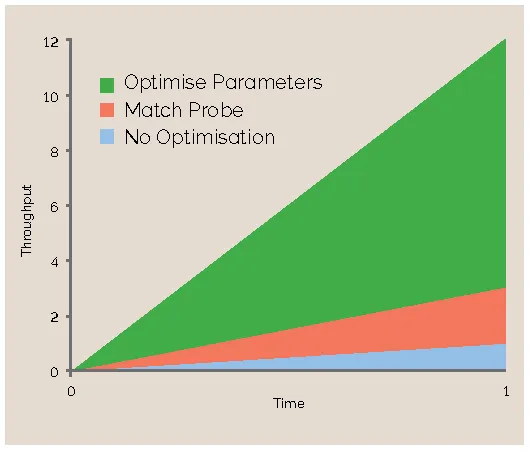
Fig. 4 — Optimisation on 1.5" mid permeability sandstone core. Probe size optimised from 53 mm to 40 mm diameter and employing a Tau of 250 μsec versus 50 μsec (which allows for increased filtering).
In addition to better SNR and short Taus, the advanced power dissipation provided by Q-Sense also allows for measurement of short Tau in combination with long echo trains. If the echo train is not long enough to characterise the longer T2 components, errors will arise in the resultant distribution as shown in Figure 5.
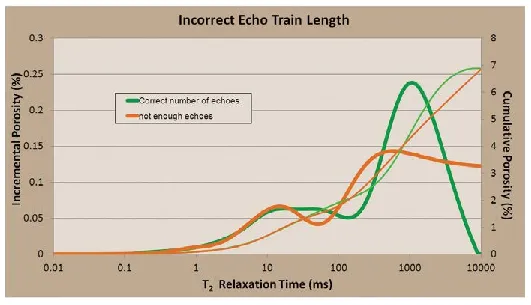
Fig. 5 — This graph shows an example of correctly acquiring the echoes and not acquiring enough echoes on a carbonate sample (porosity=13.5%, permeability=2.24 mD).
What can a higher magnetic field do?
One way to increase SNR and reduce acquisition times is to use an NMR instrument with higher field strength (for example 12 or 20 MHz). In rocks, the relationship between SNR and field strength is somewhere between a linear and squared relationship depending on the sample. So, using a higher field magnet will improve SNR. The main drawback of using higher field systems is that the results may not correlate with down-hole measurements taken at lower field.
New technologies, such as the Q-Sense offered by Oxford Instruments, avoid this problem by providing the advantages of a higher field magnet (improved SNR and shorter Tau) but at the standard 2 MHz field strength. Users therefore get high SNR and short Tau, but are still able to correlate measurements with down-hole data, and work at industry standard field strength.
Recommendations for consideration
Optimising parameters is the simplest and most economical method of increasing the throughput in the laboratory but it is also the easiest way to create errors in the results. Users should not begin the parameter optimisation process unless they fully understand the impact on their data. Software products such as GIT Systems integrate many of the parameter optimisation methods discussed herein and help ensure that testing results are accurate for users.
For a relatively modest expense, a user can optimise probe size for sample size by having more than one probe for each NMR instrument. That way the probes can be interchanged depending on the core being tested.
Although new NMR technologies and higher field systems are a higher capital expense, they do provide opportunities to significantly increase laboratory throughput and to employ newer testing methodologies. This brochure was prepared to provide a sampling of techniques that can help enhance NMR rock core testing.
Our NMR Rock Core Team is available to discuss what may be the best way to enhance the performance of your existing NMR system or what new technologies may enhance the testing you can currently perform.