Introduction
The long-term storage of highly reactive nuclear waste from various applications has been a hot topic in the
international scientific community for decades. The use of a multi-barrier concept in underground repositories is
considered the most promising solution. Hydrated cementitious systems, particularly Calcium Silicate Hydrates (C-S-H),
are extensively studied as technical barriers due to their ability to uptake radionuclides and provide a highly
alkaline environment that reduces radionuclide mobility. However, besides radionuclides, underground repositories also
contain numerous organic substances like cleaning agents and cement additives that on the other hand might increase
the mobility of radionuclides. Nitrilotriacetic acid (NTA) and gluconate (GLU) are examples of such substances with
strong complexation properties in alkaline media. Consequently, thermodynamic and kinetic data are required for
predicting the long-term impact of these compounds on the safety of a future repository. Time-resolved Laser-induced
Fluorescence Spectroscopy (TRLFS) is an analytical techniques, capable of directly identifying different species based
on their emission spectra and luminescence decay times. Therefore, based on TRLFS, thermodynamic data can directly be
obtained and subsequently used in a speciation analysis (e.g., by using chemometric data analysis (here PARAFAC) and
the PHREEQC software package).
This study examined the coordination of trivalent europium (as a natural analog
for actinides in the +III oxidation state) with NTA and gluconate in artificial cementitious pore water (APW). TRLFS
data were analyzed using the multi-way data evaluation method PARAFAC to identify europium species. The goal was to
deepen the understanding of lanthanides and actinides behavior in APW of cementitious repositories and to guide
future speciation studies. A special emphasis has been put on the influence of calcium ions present in cementitious
pore waters on the europium speciation.
Experimental
The two APW solutions were prepared by synthesizing C-S-H species with C/S ratios of 1.65 and 0.8, which correspond
to C-S-H solids in cement alteration stages two and three. After equilibration, the C-S-H samples were filtered and
the pH values of the obtained pore waters were measured. The pH values were deter-mined to 12.0 ± 0.1 for C/S = 1.65
and to 9.8 ± 0.1 for C/S = 0.8. To distinguish between the two APW solutions, they will subsequently be referred to as
APW-1.65 and APW-0.8 to account for the different C/S ratios in the preparation. The Eu(III) concentration in the APW
samples was adjusted to 50 µM. The stock solutions of the organic ligands were prepared by directly dissolving NTA and
GLU in the APW. The luminescence of Eu(III) in the APW samples was measured using a pulsed 10 Hz Nd:YAG laser (Quanta
Ray, Spectra Physics) combined with an optical parametric oscillator (primoScan, GWU). The excitation wavelength was
adjusted to 394 nm, which corresponds to the 5L6 ← 7F0 transition of
Eu(III). The luminescence signals were detected with an ICCD camera (Andor iStar DH320T-18F-93) coupled with a
spectrograph (Andor Kymera 328i equipped with a 300 l/mm grating blazed at 760 nm).
Discussion
It was found that the composition of cementitious pore waters derived from C-S-H samples with different C/S ratios
has a distinct effect on the europium speciation. This finding underlined the importance of the C/S ratio on the
speciation of +III actinide ions. Depending of the alteration stage of the cement the C/S ratio (and consequently also
the pore water chemistry, e.g., the concentration of Ca(II) ions) is changing, which will affect the +III actinide
speciation and subsequently their retardation/mobility in cement barriers. Using NTA as organic ligand, it was
observed that high concentrations of Ca(II) ions directly compete with Eu(III) in the formation of soluble NTA
complexes. At a calcium concentration of over 20 mM (found in cement porewaters at high C/S ratios typically found in
cement alteration stage two), NTA did not form any soluble Eu-NTA complexes under the experimental conditions applied.
Instead, the europium ions quantitatively formed hydroxide species of low solubility (this finding is supported by
thermo-dynamical speciation calculations). In the absence of calcium as an control experiment, the formation of the
[Eu(NTA)2(H2O)]3− complex was readily observed at low ligand concentrations of around
10 µM at pH = 12. Additionally, the formation of the 1:2 complex between Eu(III) and NTA was found to be generally
favored in alkaline environments, the 1:1 complex was only observed at a lower pH value of 9.8 in minor quantities
(see Figure 1, below).
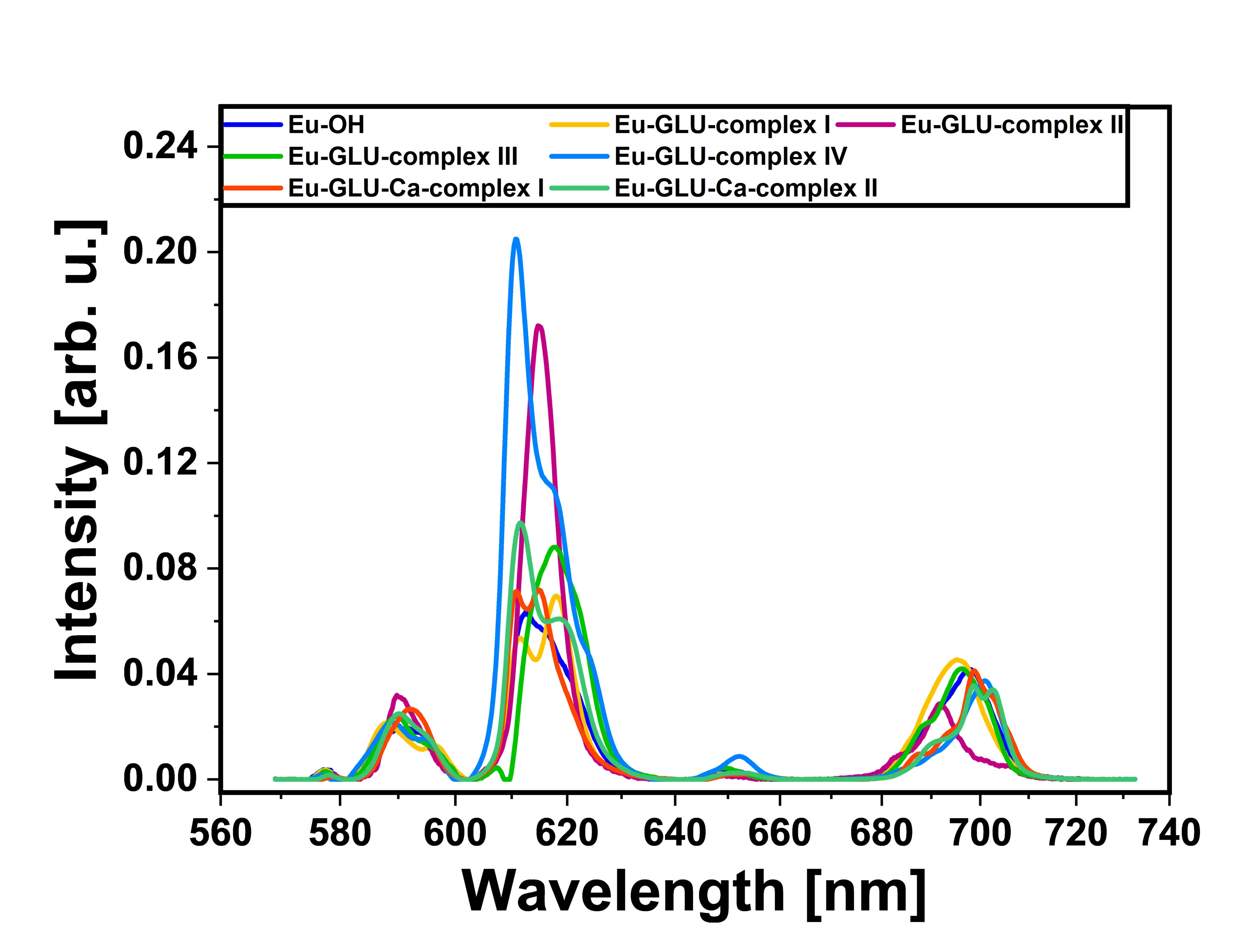
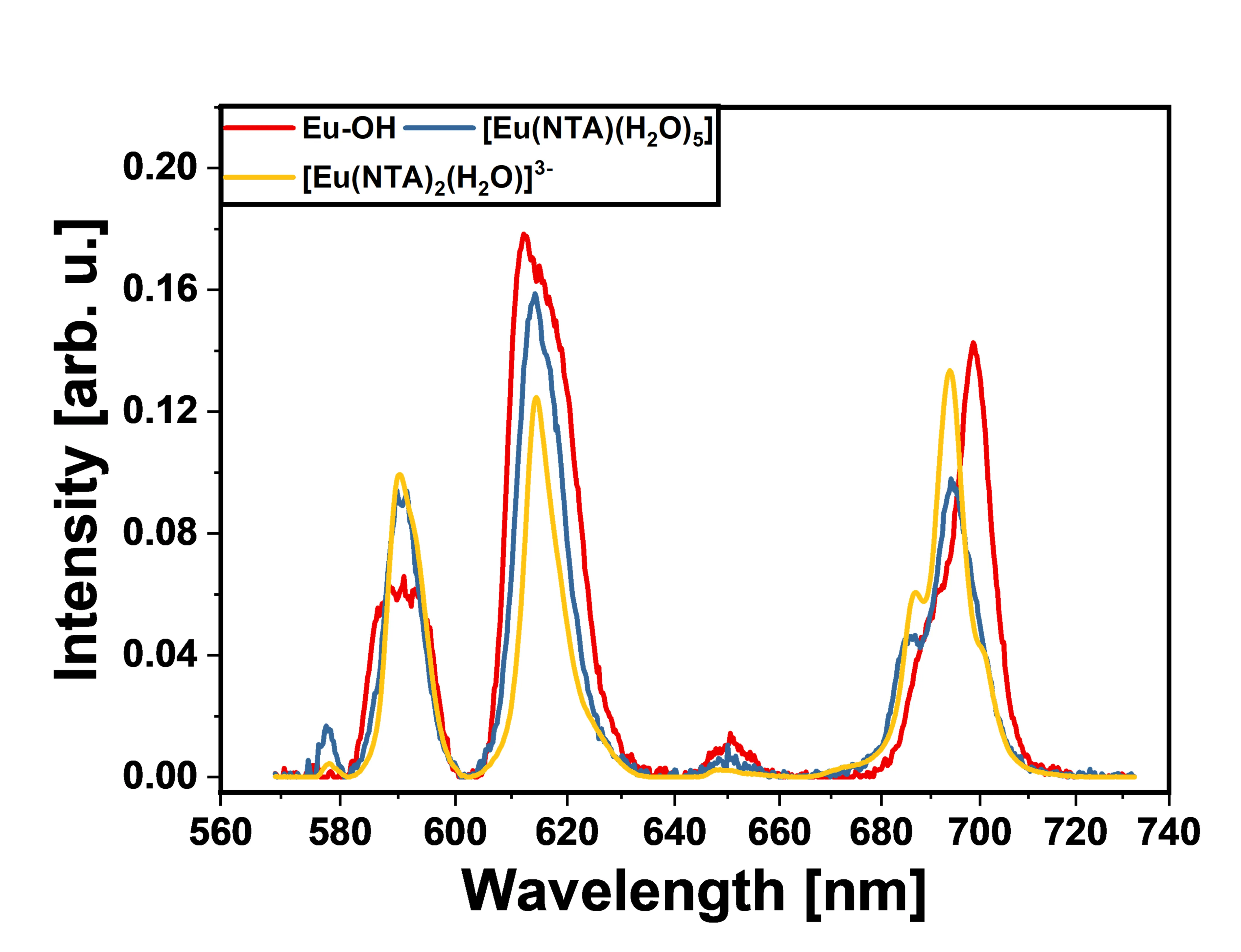
Figure 1: Luminescence spectra of Eu(III) complexes with gluconate (GLU, top) and NTA (bottom). The
spectra of the single species are the result of the PARAFAC analysis of the TRLFS data of APW-1.65. For GLU two
different ternary complexes with Ca(II) were identified. The luminescence was excited at λex = 394 nm.
Using gluconate (GLU) as the organic ligand instead of NTA, the presence of calcium ions had an opposing effect on
the europium speciation. Calcium ions were found to favor the complex formation between europium and GLU, reducing the
required ligand concentration for the formation of soluble complexes by a factor of ten. Moreover, experimental
evidence has been derived for the formation of ternary or quaternary complexes between calcium, europium, gluconate
and possibly hydroxide ions. Furthermore, the highly alkaline medium of cementitious pore waters favored the formation
of a variety of different complexes between europium and gluconate. Including two ternary or quaternary complexes, six
different Eu-GLU complexes could be identified under the present conditions (see Figure 1, bottom, for emission
spectra). A speciation diagram for APW-1.65 is shown in Figure 2 bottom).
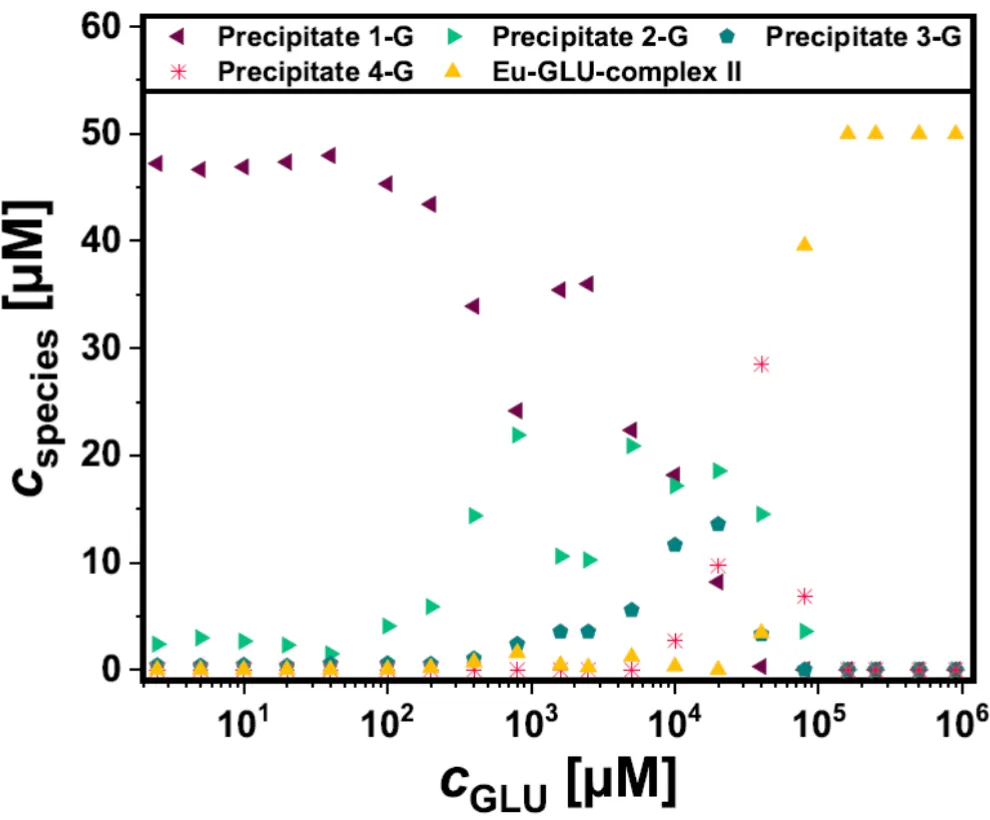
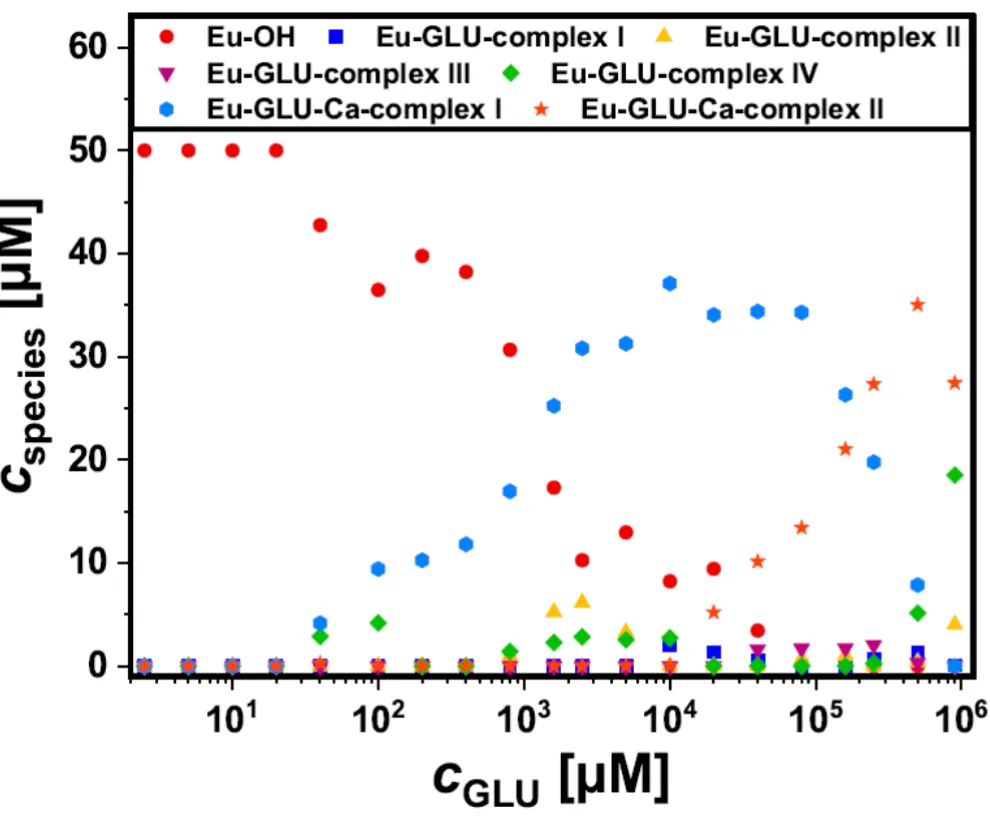
Figure 2: Speciation diagrams for Eu(III) in APW-0.8 (top) and APW-1.65 (bottom) in the presence of
GLU. Data shown are based on a PARAFAC analysis of the respective TRLFS data.
The combined presence of calcium and silica species in cementitious pore waters with low C/S ratios showed a very
unique effect on the europium speciation (see Figure 2, top). The formation of white solid precipitates was observed
in almost all samples in the APW-0.8. On further investigation, it was found that the structure of the solid changed
with increasing organic ligand concentration, resulting in a total of four different insoluble species with similar
emission spectra, mainly differing in the shape of the hypersensitive
5D0→7F2 peak. Furthermore, the four identified species were characterized
by largely different luminescence decay times. Given the present results, it is tempting to attribute the novel solid
phase to the formation of C-S-H like coprecipitates between dissolved europium ions together with Ca and Si. Work is
in progress to further investigate this novel precipitate with respect to its composition and structure. In this
context also the ubiquitous formation of Eu(OH)x species need to be re-considered with respect to the
spectroscopic parameters since these will be part of the chemical inventory in the cement environment.