Introduction
Electron Backscatter Diffraction (EBSD) is a scanning electron microscope (SEM) based technique that is increasingly applied to materials microstructural characterisation, as a tool for routine research and development work, as well as for industrial quality and process control.
EBSD is a surface technique, where electron diffraction occurs within a few tens of nanometres of the specimen surface. Any residual surface deformation or reaction product layers from standard specimen preparation techniques are detrimental for EBSD pattern generation. Hence, excellent specimen preparation is key to successful materials characterisation using EBSD.
This application note illustrates how Broad Beam Ion Milling has been used to produce improved quality of data from aluminium, zirconium, magnesium, titanium alloys and galvanized zinc coatings which are usually difficult to prepare by mechanical routes only.
Methodology
All specimens except the galvanised zinc were mounted in bakelite and mechanically polished to colloidal silica finish. They were then ion milled using the Fischione Instruments' Model 1060 SEM Mill employing a large ion beam (5mm), to remove the residual surface deformation. The galvanised surface was milled until the substrate was visible. The milled specimens were examined in a FEG SEM, and characterised using EBSD/EDS techniques using Oxford Instruments' NordlysMax² and NordlysNano EBSD detectors with Oxford Instruments' AZtec software.
On the following pages we show the results for:
- Zirconium
- Titanium
- Magnesium
- Galvanised Steel
- Aluminium
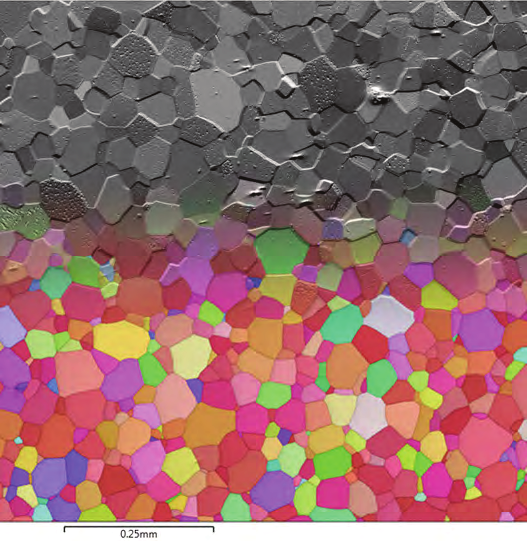
Forescatter detector image of titanium specimen merging into colour IPF map.
Results
Zirconium
Zirconium alloys are important in nuclear reactors owing to their low capture cross-section for thermal neutrons and good mechanical and corrosion properties. These materials are routinely characterised for their texture and quality using EBSD. However, they are difficult to prepare by standard mechanical polishing techniques and require careful chemical/attack polishing using aggressive acids for EBSD characterisation.
Figure 1 shows an SEM backscattered image from the ion milled specimen following standard metallographic attack polishing. A typical electron backscatter diffraction pattern (EBSP) is shown in Figure 2. An EBSD inverse pole figure coloured map is shown in Figure 3 and a corresponding pole figure is shown in Figure 4. EBSD acquisition details are shown in Table 1, together with a comparison of grain size and Kearns' factors used to quantify textures in zirconium alloys at the various binnings used for mapping the same area.
These data clearly show that high speed mapping and hit rates are achieved after ion milling, which is not always the case after mechanical polishing.
| 4x4 | 6x6 | 8x8 |
| Speed Hz | 550 | 733 | 850 |
| Acq time (mins) | 95 | 69 | 61 |
| Hit rate % | 95.7 | 87.5 | 92.7 |
| Mean grain size (μm) | 5.00 | 5.19 | 5.00 |
| Min grain size (μm) | 0.202 | 0.202 | 0.202 |
| Max grain size (μm) | 19.47 | 17.39 | 19.36 |
| Total grains | 3740 | 3594 | 3731 |
Table 1. Details of EBSD and the respective microstructural parameters.
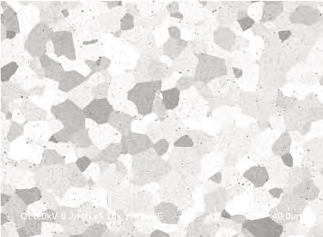
Fig. 1. SEM BSE image after ion milling.

Fig. 2. EBSD pattern from zirconium.
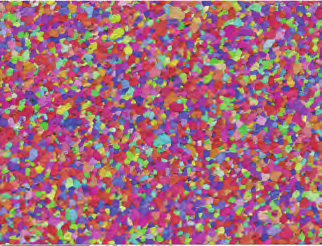
Fig. 3. EBSD IPF
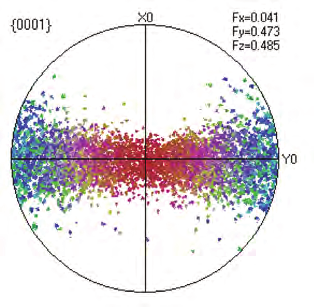
Fig. 4. EBSD (0001) pole figure.
Titanium
Titanium and its alloys are applied in a range of applications, from medical implants to aerospace components, owing to their high corrosion resistance and strength that can be engineered by alloying additions. Titanium requires careful mechanical polish for EBSD characterisation and, as with Zirconium alloys, it is not always possible to acquire EBSD data at very high speeds.
A forescatter image from an ion milled titanium specimen is shown in Figure 5 with a typical EBSD pattern in Figure 6. An EBSD inverse pole figure coloured map is shown in Figure 7 and a corresponding pole figure is shown in Figure 8. EBSD acquisition details are shown in Table 2.
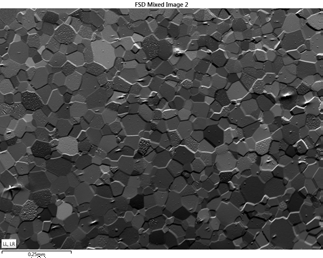
Fig. 5. Forescatter detector image.

Fig. 6. ESBP
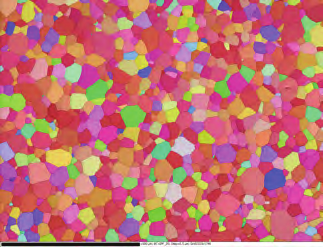
Fig. 7. 8x8, 864Hz, 19nA. Hit rate 97.6%. Time 79 minutes.
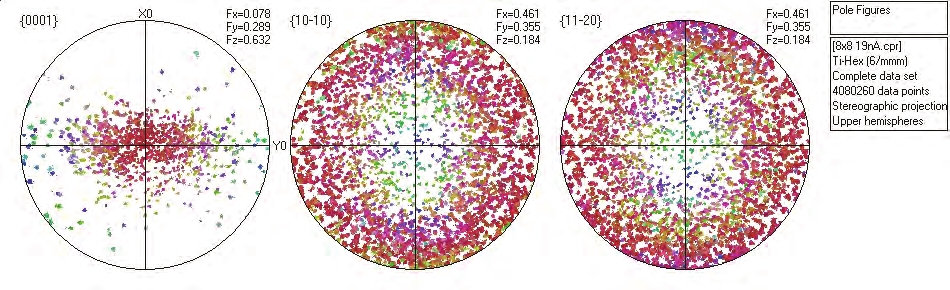
Fig. 8. EBSD (0001) Pole figure.
| 8x8 |
| Speed Hz | 864 |
| Acq time (mins) | 79 |
| Hit rate % | 97.6 |
| Mean grain size (μm) | 33.05 |
| Min grain size (μm) | 2.034 |
| Max grain size (μm) | 96.96 |
| Total grains | 809 |
| (0001)fz | Fz=0.632 |
Table 2. Details of EBSD and the respective microstructural parameters.
Magnesium
Magnesium and its alloys are the lightest structural metallic materials and so are used in many weight saving applications in modern cars.
Because magnesium corrodes very quickly under aqueous environments, it requires special precautions for mechanical and electrolytic polishing. Additionally, because magnesium is soft it is very difficult to obtain polished surfaces free of residual deformation for EBSD from mechanical polishing. However, mechanically polished surfaces can be used successfully for ion milling for EBSD characterisation. Figure 9 shows an SEM backscattered image from the ion milled specimen with a typical EBSP shown in Figure 10. Figure 11 shows an EBSD inverse pole figure coloured map and a corresponding pole figure is shown in Figure 12. Details of the conditions used for EBSD acquisition are shown in Table 3, together with a comparison of grain size and Kearns factors determined for the same area scanned at various detector binnings.
These data clearly show that high speed mapping and hit rates are achieved after ion milling.

Fig. 9. SEM BSE image after ion milling.
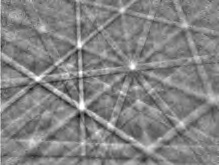
Fig. 10. EBSD pattern from magnesium.
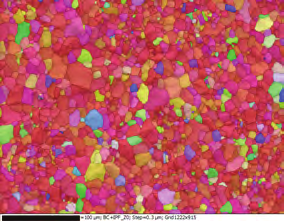
Fig. 11. EBSD IPF map after ion milling.
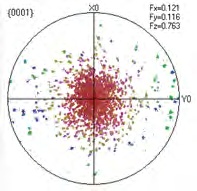
Fig. 12. EBSD (0001) pole figure.
| 4x4 | 6x6 | 8x8 |
| Speed Hz | 550 | 733 | 850 |
| Acq time (mins) | 72 | 25 | 22 |
| Hit rate % | 92.7 | 93.1 | 90.8 |
| Mean grain size (μm) | 7.93 | 7.97 | 8.01 |
| Min grain size (μm) | 0.338 | 1.015 | 1.015 |
| Max grain size (μm) | 34.11 | 34.00 | 34.12 |
| Total grains | 1332 | 1327 | 1318 |
| (0001)fz | 0.763 | 0.763 | 0.763 |
Table 3. Details of EBSD and the respective microstructural parameters.
Galvanised Steel
Galvanising is a well established process for preventing steel from rusting by applying a zinc coating. The coating prevents rusting through the formation of a tenacious layer of zinc carbonate through its reaction with oxygen, water and carbon dioxide and also by acting as a sacrificial anode once the coating is scratched. Although this sacrificial action is of value for corrosion protection, it also means that during mechanical polishing using aqueous media the zinc coating corrodes preferentially. Ion milling has the advantage that such a galvanic reaction is obviated such that the steel substrate and zinc coating can be polished together.
For this example, ion milling was done on the galvanised surface without any surface preparation. Topography from the original surface caused some indexing problems, but successful preparation was achieved for EBSD, as shown in the EBSD from the steel and zinc coating shown in Figure 13. EBSD mapping was done on a region that contained both the substrate and the galvanised coating. Such a region is shown in a series of EBSD pattern quality, phase and IPF coloured maps in Figure 14.
These maps clearly show that ion milling is an excellent preparation for EBSD. The present results show that the zinc coating comprises a duplex grain structure, while the steel substrate has a deformed structure.
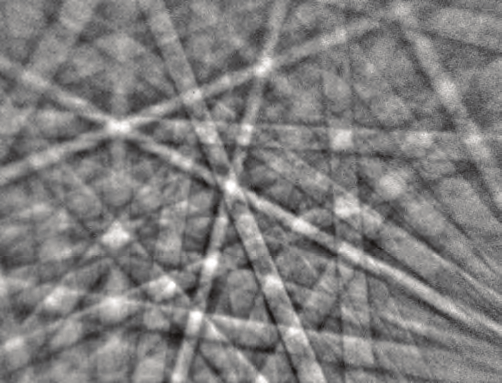
Fig. 13. EBSD pattern from a) steel and...
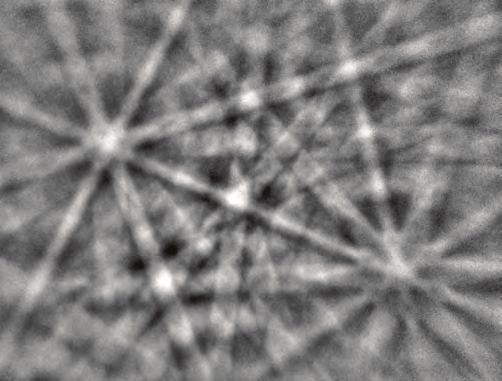
b) zinc.
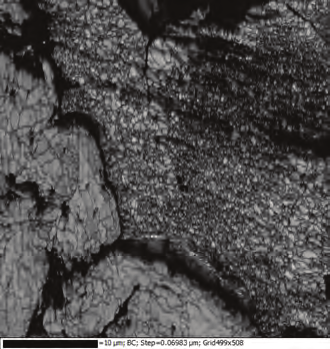
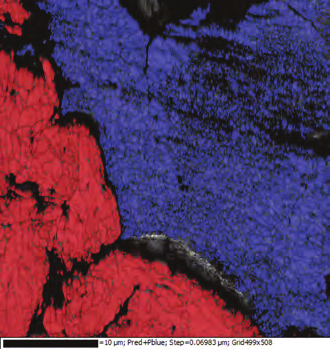
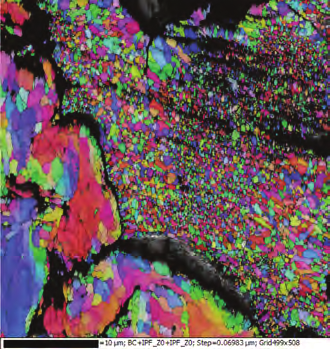
Fig. 14. EBSD a) pattern quality, b) phase (red=steel/ferrite, blue=zinc) and c) IPF maps from a region with both the steel substrate and the zinc coating
Aluminium
Aluminium alloys are extensively used in engineering structures and components where light weight or corrosion resistance is required, such as transportation, beverage cans, packaging, building/construction and electrical conductors.
Aluminium alloys are relatively soft and so require very careful mechanical preparation for successful EBSD. Therefore these alloys are usually prepared electrolytically. Electrolytical polishing has the disadvantage in that it can preferentially remove second phase particles and also leave artefacts on polished surfaces.
This example shows an Al alloy ion milled following mechanical polishing. A typical EBSD pattern is shown in Figure 15, an IPF coloured map in Figure 16 and a corresponding pole figure in Figure 17.
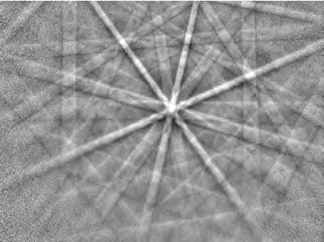
Fig. 15. EBSP.

Fig. 16. IPF coloured map.
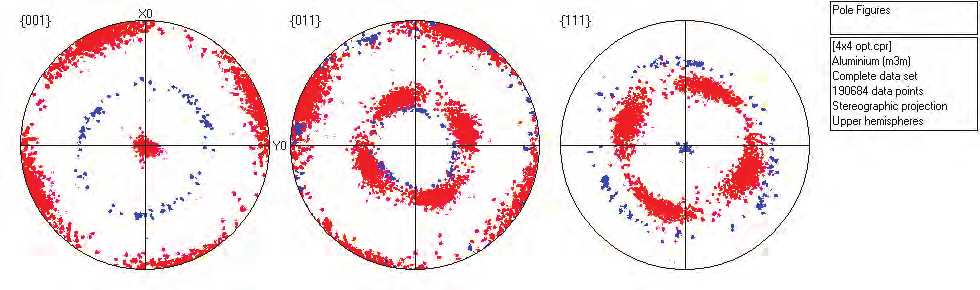
Fig. 17. Pole figures.
Conclusion
This work has illustrated that ion milling is an attractive route for materials like zirconium, magnesium and zinc, which are difficult to prepare for EBSD characterisation using only mechanical polishing routes. Additionally, the specimen surfaces are of very high quality, allowing high speed EBSD acquisition from low symmetry structures.
Acknowledgements
H S Ubhi1, A. C. Robins2, Rocco Cerchiara2 and P. E. Fischione2.
1 Oxford Instruments Analytical Ltd, High Wycombe, Bucks, HP12 3SE. UK.
2 A. Fischione Instruments, Inc. 9003 Corporate Circle, Export, PA 15632, USA.