Application Notes
Dragonfly – High Speed Multi-modal Confocal System
Author: Dr Alan Mullan and Dr Claudia Florindo
Published: 01 Feb 2020 · Last updated: 19 Dec 2022
Until recently, there was no instrument compatible with live-cell imaging that could deliver deep-tissue imaging, as well as single-molecule localisation microscopy. In 2017, Andor launched Dragonfly, a multipoint confocal system that was a revolution in the way imaging systems are conceived.
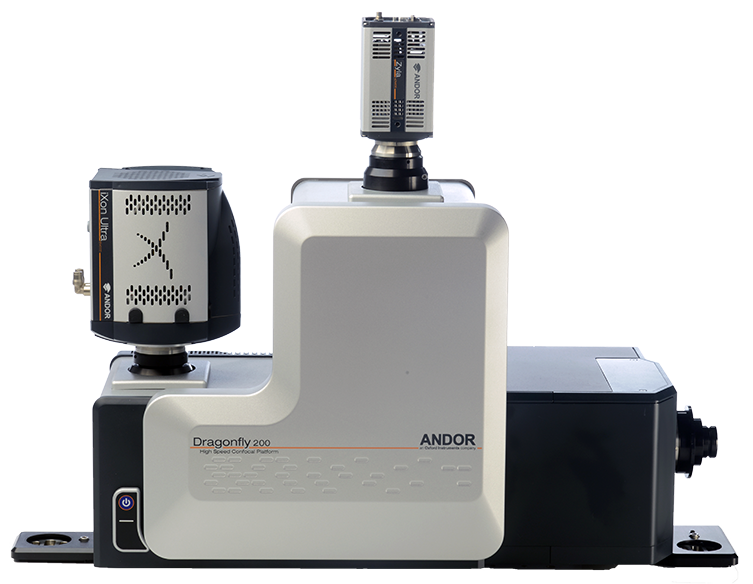
Dragonfly makes it on to this list as it is a new approach to confocal imaging systems - a confocal that is both fast and has multiple imaging techniques embedded in the system. This means that researchers can use confocal, multicolour TIRF, widefield, SRRF-Stream real-time super-resolution and 3D dSTORM with just one system. Samples from up to 2.5 mm thick can be imaged at high speeds. Samples can also be imaged at very high resolution achieving up to 20 nm resolution. Dragonfly gives the scientists the freedom to choose the most suitable imaging modality for their experiments.
Dragonfly uses the Borealis illumination which provides excellent uniformity across the image. Borealis illumination together with the image stitching capability, allows larger model organisms or tissue sections to be imaged quickly and effectively.
Large data sets can be subsequently be imaged in Imaris making for a very efficient workflow.
The Dragonfly is typically configured using an EMCCD camera for when the maximum sensitivity is required, and a sCMOS camera, either Zyla or Sona, when field of view and imaging speed are most important.
- Li-En Jao et al. (2018) Researchers Use Image Analysis to Better Understand Centrosome Maturation
- case study about the paper: Co-translational protein targeting facilitates centrosomal recruitment of PCNT during centrosome maturation invertebrates.
- Claudia Florindo (2019) “Dragonfly and Andor cameras the perfect combination of speed, resolution and sensitivity to image vesicle trafficking in live cells.”
- case study about the paper: The class II phosphoinositide 3-kinases PI3K-C2α and PI3K-C2β differentially regulate clathrin-dependent pinocytosis in human vascular endothelial cells.
- Schueder F, Lara-Gutiérrez J, Beliveau BJ, et al. (2017) Multiplexed 3D super-resolution imaging of whole cells using spinning disk confocal microscopy and DNA-PAINT. Nat Commun. v8, pg 2090.
- Andor (2018) Organoids in the study of liver development and cancer. [Application Note]
- Li W, Bai X, Li J et al. (2019) The nucleoskeleton protein IFFO1 immobilizes broken DNA and suppresses chromosome translocation during tumorigenesis. Nat Cell Biol. v21 pg 1273
- Divakaruni SS, Van Dyke AM, Chandra Ret al. (2018) Long-Term Potentiation Requires a Rapid Burst of Dendritic Mitochondrial Fission during Induction. Neuron. V100 pg 860