Introduction
Semiconductor technology is becoming increasingly important in global healthcare enabling novel understanding, discovery and treatment of disease to make healthcare more affordable and efficient, both in and out of the clinic.
With the global healthcare industry being valued at US $1.65 trillion in 2016 and expected to reach US $2.69 trillion by 2025, it is an important growing industry. Key drivers behind this ongoing market growth are growing and aging populations, over urbanization, rising disease prevalence all of which are putting further strain on our healthcare systems which are already grappling with issues relating to access, quality, and cost. Convergence of technology from the seemingly disparate fields of semiconductor device processing, life sciences are fast revolutionising healthcare and medical research by enabling quick and accurate diagnosis. This in turn is increasing the speed and efficiency of treatment for various conditions as well as biomedical research and development.
Previously …
In the previous edition of this white paper series we provided an overview the various processing challenges and solutions for fabrication of microfluidics and active elements of these devices as outlined in Figure 1. Plasma based processes form a critical tool for the fabrication of microfluidics with control and precision while enabling the flexibility of design for various applications. The range of plasma processing techniques offered by Oxford Instruments allows researchers and device manufacturers to work with multiple material platforms (Silicon, Glass, Polymer etc) and have full control over the properties of microfluidic features.
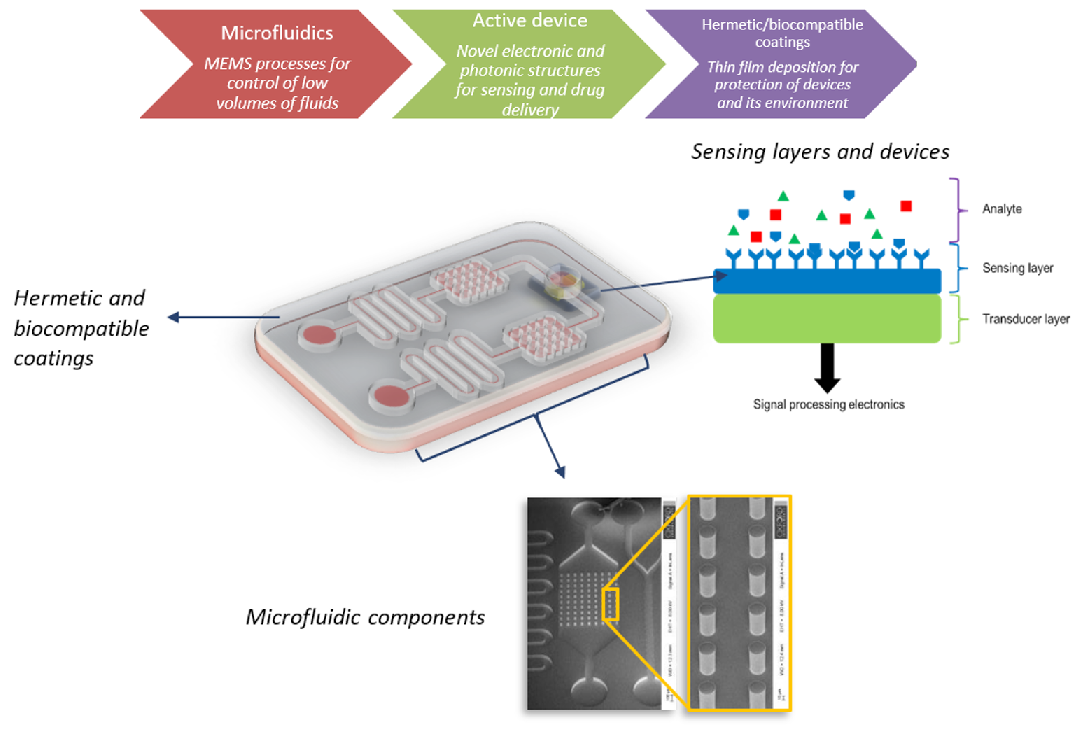
Fig. 1 — Major processing requirements for biomedical device fabrication
Creation of Hydrophobic, Hydrophilic and Functional Surfaces
A key requirement of microfluidics fabrication for biomedical devices is the ability to control surface properties after the creation of channels. In this paper we will overview processing solutions for hydrophobic and hydrophilic surface creation which is critical for both active functions of the device as well as for post processing challenges such as bonding, sealing and de-scum.
Surface roughness is very important for microfluidic flow characteristics like pressure gradients, friction, heat transfer, turbulence etc., which can be achieved by carefully optimizing the channel fabrication processes as described above. However, an equally important surface technique is the control over its hydrophobicity. Tuning this property over the device surface enables control over fluid flow and interaction. In addition, there also a need to match the hydrophobicity of all the surfaces that fluid comes in contact with to enable uniform interactions and flow. For example: a Si-wafer with SiOx on its surface can be too hydrophilic while a PMMA device too hydrophobic. Such a control not only enables improvement of efficiency in pumping fluids but also important for fabricating structures for operations such as mixing, positioning or separating purely by engineering hydrophilic-hydrophobic surface transitions. This provides the additional advantage of decreasing the size and complexity of devices by avoiding the need for active control measures which usually require additional energy sources or pumps to control the fluid.
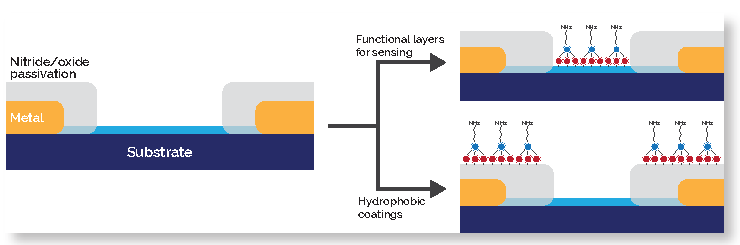
Fig. 2 — Schematic illustration of the function of organic coatings, showing functional layers for sensing, hydrophobic coatings, metal, substrate, and nitride/oxide passivation layers
A hydrophobic surface does not allow water to flow into it without additional pressure while a channel with a hydrophilic surface naturally allows water penetration. This effect can be used to control the flow of liquid. Hydrophobic surfaces are not only useful for microfluidic device operation but also in various other facets of biomedical device fabrication such as mould fabrication, bonding, moisture barriers etc.
There are several ways to engineer hydrophilic and hydrophobic surfaces using Oxford Instruments Plasma Technology processes as follows:
- Surfaces functionalized with polar molecules are generally hydrophilic due to their ability to bind water molecules through hydrogen bonding. Such surfaces attract water through capillary action. This can be achieved by treating most surfaces to Oxygen plasma which creates –OH groups on the surface to aid hydrogen bonding (Figure 2 a, b). Hydrophilic surfaces can also be created by deposition of films with tailored surface functional groups to strongly promote hydrogen bonding.
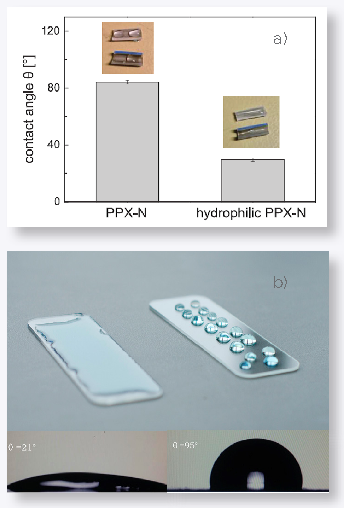
- Fig. 2 — (a) Conversion of hydrophobic parylene PPX-N to hydrophilic using an Oxygen Plasma treatment on the Plasmalab 80 plus (reproduced from Heidari Zare et al., CC BY 4.0). (b) Zeonor, a common cyclic olefin copolymer (COC), is rendered hydrophilic by deposition of tetraethylorthosilicate-acrylic acid films in a Plasmalab 100 PECVD (reproduced with permissions from J. Chem. Educ. 94, 221, (2017), Copyright 2018 American Chemical Society).
- Pillars etched into silicon surfaces can allow the tunability of surfaces from hydrophilic all the way to superhydrophobic depending on their dimensions and spacing. Such structures can be fabricated using plasma processing techniques described in the first part of this white paper series. For example, wide pillars fabricated in devices such as in ref 3 aid flow through capillary action due to its enhanced hydrophilic surface area.
- Black Silicon is another surface which is attracting a lot of interest in the recent past. This surface is composed of nanostructured silicon that contains high-aspect-ratio densely packed features. These features which look like nanospikes or nanoneedles, on the surface can be produced through Oxford Instruments plasma etching processes. The exact process mechanism is still under investigation, however it is generally understood that particulates, both homogeneously nucleated gas phase and from reaction chamber deposit onto the Si surface and act as micromasks. This is followed by a highly anisotropic plasma etch process then to create grass like high-aspect-ratio needles. This surface has a deep black colour and is the source of its name as it absorbs >99% of incident light. Black silicon was a deleterious feature during plasma etching of silicon and this process window was avoided but more recently it has found several applications including antibacterial surfaces and biomedical sensing. Oxford Instruments offer several black Si processes (both bosch and cryo type) to accurately control and tailor properties such as density, diameter, area and height in line with application requirements. A couple of examples of this ability can be seen in Figure 3.
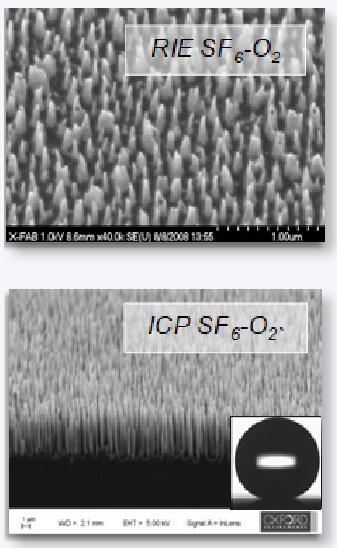
- Fig. 3 — Different morphologies of black silicon structure etched using Oxford Instruments processes. High and deep spikes are often used as super hydrophobic surfaces (right) which exhibit water contact angles of up to 170° (right inset, courtesy of TU Ilmenau).
- Organic layers like Amino propyl triethoxy Silane (APTES), Hexamethyl Disilazane (HMDS) and many other such films (like APTMS and APTMES) can also be deposited using vapour deposition techniques as it yields a denser and more homogeneous coating (even over large wafer sizes) when compared to liquid phase techniques. Additionally, wet processes present the issue of inhomogeneous coating of structured surfaces due to trapped air that prevents the liquid from entering all areas of the device. These layers not only allow wettability control but also enable the chemistry required to functionalize the active surfaces to immobilize antibodies, enzymes, proteins or any other required biomolecules. For example, the amine group in APTES layers are quite commonly converted to an aldehyde group which form an imine linkage to the primary amine group in proteins. Oxford Instruments vapour deposition solutions come equipped with isothermally heated delivery lines and walls to avoid condensation of such organic compounds. The deposition chambers are equipped to process such layers via thermal as well as plasma-based processes.
Conclusion
The wide application scope of semiconductor based biomedical devices demands precise control over the interaction of bio-analytes with the several surfaces as it passes through the device. This control can only be achieved via modification of surfaces and walls in its components. The properties of the surface and the strategy its modification is determined by the end application, nature of the fluid, composition and target biochemistry. This spread in requirements presents a strong challenge for biomedical device engineering. In this paper, several Oxford Instruments plasma and thermal processing strategies have been described to address this challenge.
Next Time …
Biosensors are devices that detect biological species and transform the resulting biochemical signal into a physical one that can correlates with the concentration of the target species. These are made up of microfluidics that perform the task of manipulating, processing and transporting analytes in a form that is ready to be processed by these active systems. These active components are commonly fabricated using fabrication processes for electronic, photonic or MEMS based sensors combined with surface functionalization techniques. In the next paper, techniques and challenges for application of such sensors for bio-detection will be outlined.
References
- Heidari Zare et al., Biointerphases, 12, 1, (2017)
- S.P. Flynn et al., J. Chem. Educ.
- 94, 221, (2017)
- Saineimi et al., Sensors and Actuators B
- 132, 380, (2008)
- J. Am. Chem. Soc., 2007, 129, 7228–7229; Proc. Natl. Acad. Sci. U. S. A., 2010, 107, 1870–1875; Biomater. Sci., 2018, 6, 1424–1432