Recent laboratory and on-sky studies have shown that modern CMOS sensors can deliver high quality photometry across a range of astronomical applications [1, 2], with precision reaching the milli-magnitude level and performance comparable to CCD detectors [3]. Measurements of on-sky and detector noise sources have also been found to agree with theoretical noise models [4]. In addition, modern back-illuminated CMOS detectors reduce several limitations associated with front-illuminated sensors, including strong sub-pixel sensitivity variations caused by electrode structures and micro-lenses [5].
In this work, we evaluate the on-sky performance of the Andor Marana 4.2BV-11 CMOS camera at the Next Generation Transit Survey (NGTS) facility, a site optimised for high-precision photometry. This study builds on our previous laboratory characterisation of the same camera [6], where key detector properties such as read noise, dark current, glow, spatial and temporal noise structure, linearity, photon response non-uniformity, quantum efficiency, and front-window transmittance were measured [6-8].
We directly compare the Marana CMOS camera with the Andor iKon-L 936 CCD camera already installed on the NGTS telescopes. The CMOS and CCD cameras were operated simultaneously using identical telescope hardware, filter configuration, sky conditions, and photometric reduction pipeline. The aim is to assess whether modern CMOS detectors can provide a reliable alternative to CCDs for bright-star time-series photometry and exoplanet survey applications.
Observatory and Instruments
The NGTS Facility
NGTS is a ground-based observatory located at ESO's Paranal Observatory in Chile[9]. Motivated by the success of the Wide Angle Search for Planets (WASP) programme [10], NGTS was designed to deliver high-precision time-series photometry of bright stars for the detection and characterisation of transiting exoplanets.
NGTS consists of 12 Newtonian telescopes, each with an f/2.8 optical system and a 20 cm aperture, manufactured by ASA Astrosysteme GmbH. The telescopes are housed within a single enclosure and arranged in two rows of six, with a separation of 2 m between neighbouring units. Each telescope uses a hyperbolic primary mirror together with a corrector lens and is equipped with a deep-depleted CCD camera optimised for high sensitivity at red optical wavelengths (see Section 2.2). The cameras are mounted on customised focusers and used with an NGTS-specific filter covering the 520–890 nm wavelength range. The quantum efficiencies (QEs) of the cameras are shown in Figure 1. Wheatley et al. [9] provide further details of the instrument design and operation. The NGTS facility has discovered 36 exoplanets and 8 eclipsing binaries. For bright stars with TESS magnitudes T < 12 mag, NGTS photometry has been shown to be scintillation limited [11].
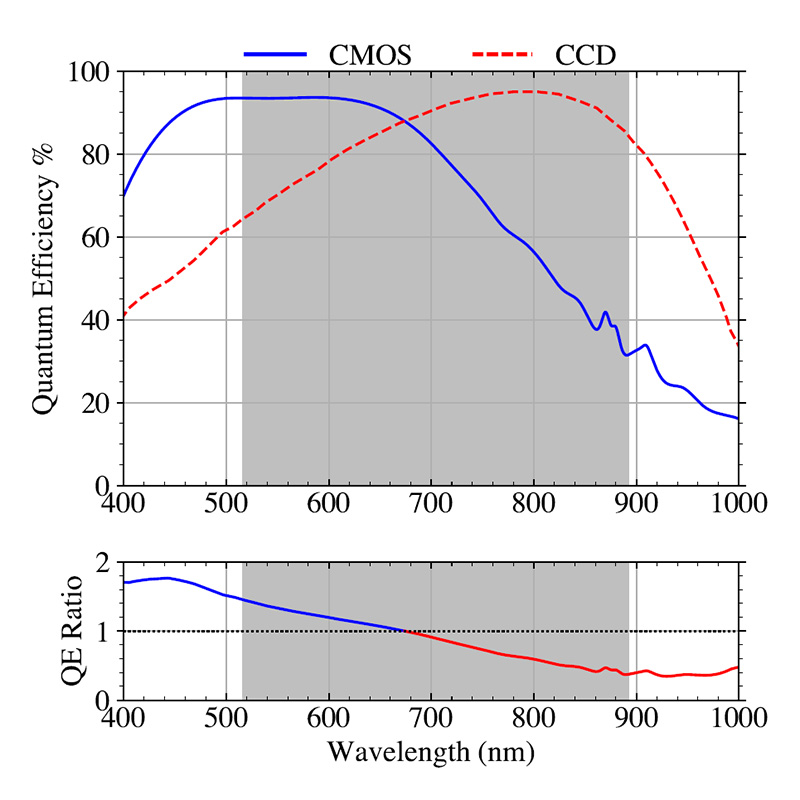
Figure 1 – Top: QE of the cameras as a function of wavelength. The grey shaded region indicates the transmission range of the custom NGTS filter. The blue solid line shows the QE of the Marana CMOS camera, while the red dashed line shows the QE of the iKon-L CCD. Bottom: Ratio of the camera QEs, defined as CMOS/CCD.
The iKon-L 936 CCD Camera
The Andor iKon-L 936 BR-DD is the primary CCD camera used on the NGTS telescopes. It uses a back-side deep-depleted e2v sensor with 2048 × 2048 pixels, each 13.5 μm in size, and includes fringe suppression and dual anti-reflection coatings. The camera provides high red sensitivity, with QE > 90 % at 750 nm (see Figure 1), making it well suited to observations of K and M dwarfs. Its five-stage Peltier cooling system enables low dark current at operating temperatures down to −100°C, while vacuum sealing supports long-term stable operation. Following laboratory testing [9], the iKon-L CCDs were deployed on NGTS in 2015. NGTS operates them in 3 MHz readout mode at −70°C, typically using 10 s exposures. Readout, autoguiding, image statistics, and mount-settling overheads produce a total dead time of approximately 3 s between exposures.
The Marana 4.2B-11 CMOS Camera
The Marana 4.2B-11 is a thinned, back-side illuminated CMOS camera with a 2048 × 2048 sensor and 11 μm pixels. It provides low read noise, high frame rates, and high sensitivity across the visible spectrum, with a peak QE of 95 % at 550 nm (see Figure 1). The sensor is vacuum housed and cooled with a five-stage Peltier system, allowing air-cooled operation at −25 ◦C. Its measured performance is summarised in Table 1.
| Camera | CMOS | CCD |
| Model | Marana 4.2B-11 | iKon-L 936 |
| Digital output | HDR, 16-bit | 16-bit |
| Readout modes | 100 MHz | 3 MHz |
| Gain, e-/ADU | 1.131 | 1.99 |
| Full well capacity, e-/pix | 69026 | 82000 |
| Non-linearity, % | 0.122 | 1 |
| Read noise, e-/pix | 1.571 | 12.9 |
| Dark current, e-/pix/s | 1.617 @ -25°C | 0.005 @ -70°C |
| PRNU*, % | 0.131 | 1.79 |
| DSNU**, e- | 0.232 | 3.79 |
| Readout time, s | 0.042 | 1.5 |
| Detector size, mm | 22.5 x 22.5 | 27.6 x 27.6 |
| Pixel size, µm | 11 | 13.5 |
| NGTS pixel scale, arcsec/pix | 4.01 | 5.01 |
| NGTS field of view, deg | 2.27 x 2.27 | 2.84 x 2.84 |
| Shutter | Shutterless | 45 mm Mechanical |
| Weight, kg | 3.0 | 4.6 |
| *Photo Response Non-Uniformity, ** Dark Signal Non-Uniformity | | |
For the NGTS on-sky tests, the Marana CMOS was operated in High Dynamic Range (HDR) mode at a constant temperature of −25°C and with 10 s exposures to match the iKon-L CCD. HDR mode uses simultaneous High Gain and Low Gain pixel-level readout paths to combine low read noise with extended dynamic range. Each channel is digitised separately and combined into a 16-bit HDR image [6, 12-14]. The installation of the camera at the NGTS is shown in Figure 2.
The camera also applies internal image corrections. In this work, the Anti-Glow correction was enabled to reduce glow artefacts, while the Spurious Noise Filter was disabled. (see Apergis et al. [6], and our previous application note for details).
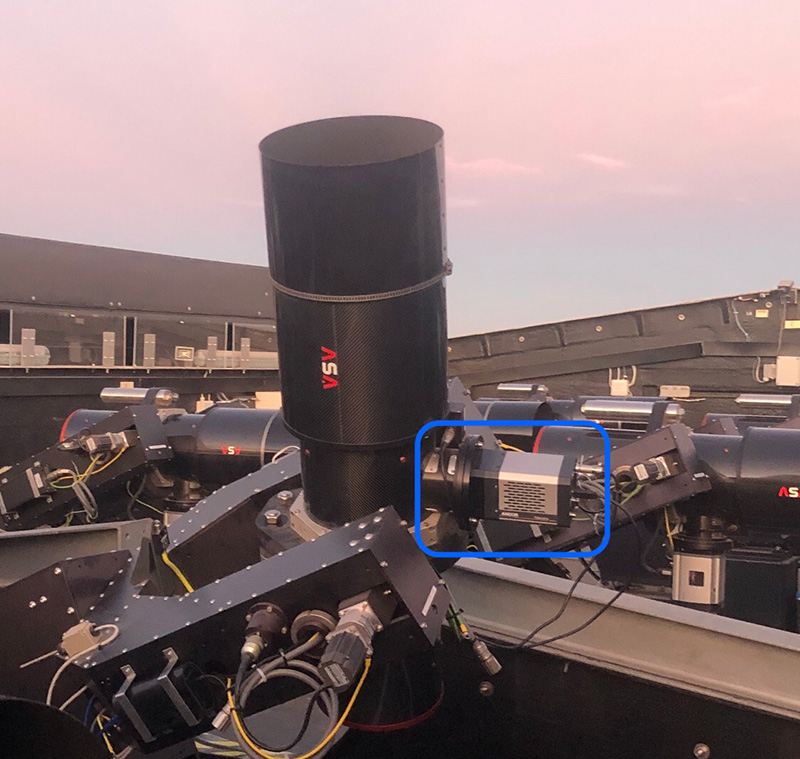
Figure 2 – The Marana sCMOS camera, shown within the blue rectangle, is mounted on one of the NGTS telescopes at Cerro Paranal, Chile.
Methods, Results, and Discussion
Observations
Observations were carried out from December 2023 to September 2024, with the CMOS camera installed on NGTS telescope 06 and compared against the same CCD camera on neighbouring telescope 01 throughout the campaign. We observed known transiting exoplanet hosts, including WASP [10], KELT [15], and confirmed TOI systems.
The CCD observing schedule was replicated so that the CMOS camera observed the same field centre simultaneously, although with a smaller field of view (see Table 1). Both cameras used 10 s exposures; the CCD cadence was 13 s, while the CMOS cadence was 10.042 s. The CMOS observations used the standard NGTS 520–890 nm filter, although this filter is not optimised for the bluer CMOS quantum-efficiency response (see Figure 1). CMOS images were saved as FITS files with timestamps, telescope coordinates, and camera settings recorded in the headers. In this work we analyse data from nights where known transiting exoplanet systems were observed.
An example of the transit for WASP-4 detected simultaneously on the CMOS and the CCD is shown in Figure 3.
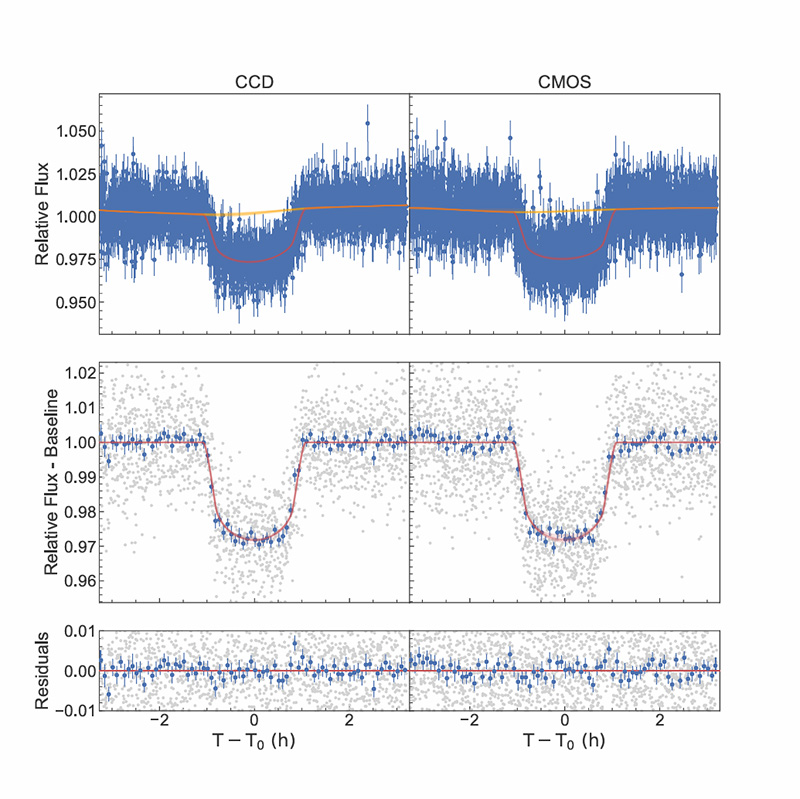
Figure 3 – Normalised WASP-4 transit light curves from NGTS observations, shown for the CCD (left) and CMOS (right) cameras. Top: Undescended light curves with the GP detrending function in yellow and transit model in red. Middle: Detrended light curves binned to 5 min, with the best fit model in red. Bottom: Residuals from the best-fit model.
Photometric Noise
We constructed a photometric noise model for both the CMOS and CCD cameras using the detector read noise and dark current (see Table 1), sky background, target shot noise, and expected scintillation noise at Paranal Observatory [11]. To compare the two cameras consistently, all noise terms were converted to electrons using the measured gain values. Since the CMOS and CCD have different pixel sizes, we adopted a fixed physical aperture radius of approximately 55 μm, corresponding to 5 CMOS pixels and 4 CCD pixels. This aperture is well matched to the typical 19 μm point spread function full width at half maximum for NGTS and is optimal for stars with 9 < T < 11 [16].
Detector Noise
The two main detector noise sources in digital imaging are read noise and dark current. Read noise is introduced during charge-to-voltage conversion and analogue-to-digital conversion; it includes noise components independent of exposure time and incident signal. Although early CMOS sensors typically had higher read noise than CCDs, modern devices such as the Marana camera achieve low values.
Dark current arises from thermally generated charge and depends on both exposure time and detector temperature [17, 18]. In CMOS sensors, additional on-chip circuitry can also produce infrared glow from the sensor periphery or pixel amplifier transistors [19-21]. This glow has a weaker temperature dependence than dark current and therefore becomes more important at low temperatures.
Sky Background Noise
Sky background is an important noise source in photometry, particularly for faint targets. It includes all non-target light within the photometric aperture, such as scattered light, unresolved background sources, zodiacal light, moonlight, and night-sky airglow [22,23]. Although the mean sky background is subtracted during photometric extraction, its Poisson noise remains in the noise budget. Differences in sky background noise between the CMOS and CCD cameras are mainly driven by their different quantum efficiencies across the NGTS filter bandpass (see Figure 1).
Source Noise
For ground-based photometric observations, the noise contribution due to light from the target star has two components: Poisson shot noise and scintillation noise. Poisson shot noise from the target star is simply given by the square root of the measured brightness of the star in electrons.
Scintillation noise arises from the fact that incident light from the target star will fluctuate in intensity as it moves through turbulent regions in the Earth's atmosphere [24]. We adopt the median value for Paranal Observatory of CY = 1.54 m2/3s1/2 as reported by O'Brien et al. [11]. Unlike the Poisson shot noise from the star, the fractional scintillation noise is independent of the flux from the target star [11]. Thus, for bright stars, scintillation noise will form a hard limit to the fractional photometric noise. Including all the above noise sources, we produce a theoretical model expected for those two cameras, in both full moon and a no-moon scenarios. We also implement the photometric RMS of the lightcurves from all the available stars as shown in Figure 4.
The Marana CMOS camera is not instrument-noise limited for this sample, with the dominant contributions arising from scintillation, target shot noise, and sky background. Similar to the CCD, however, the CCD read noise becomes comparable to the sky-background noise under no-moon conditions, suggesting that instrumental noise may become relevant in the lowest-background regime.
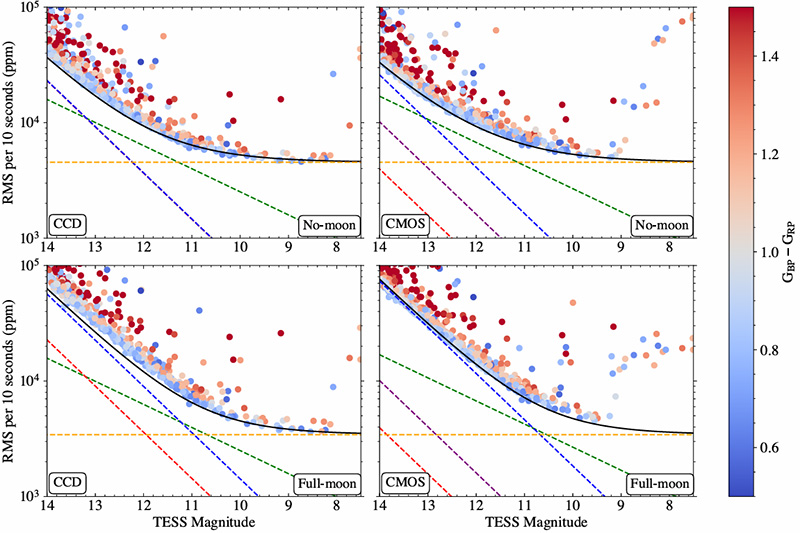
Figure 4 – Photometric precision as a function of stellar magnitude for 10 s exposures, comparing theoretical predictions with observations taken during new moon (top panels) and full moon (bottom panels). The left and right panels show the CCD and CMOS results, respectively. The black line shows the total modelled noise, including scintillation, photon shot noise, dark current, sky background, and read noise. Data points show the measured noise from a detrended relative photometry of 746 stars with 8 < T < 14 and are coloured based on their Gaia DR3 GBP – GRP colour.
Systematic Noise
All noise sources described above are expected to be uncorrelated. However, photometric data often contain some correlated (red) noise from systematic effects [25]. To assess this, we binned the CMOS and CCD light curves over timescales from the native cadence to 1800 s and compared the measured RMS with the expected 1/√N white-noise scaling (see Figure 5). Previous NGTS studies using iKon-M CCDs found low levels of red noise after correcting for airmass and colour-dependent atmospheric extinction with SysRem [26,27].
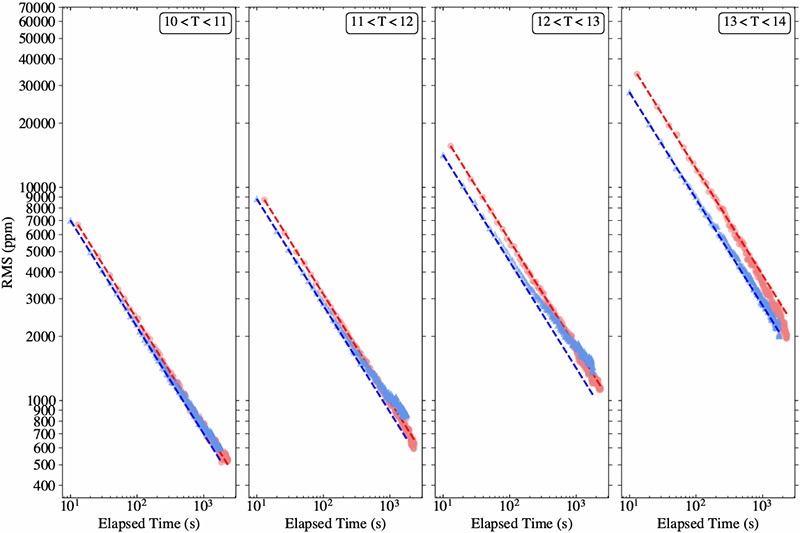
Figure 5 – Noise as a function of binning timescale for CCD (light red circles) and CMOS (light blue triangles) observations obtained on the no-moon night. Dashed lines show the expected white-noise scaling, proportional to 1/ √n for for each camera. RMS values were measured using non-variable, non-saturated stars, with 45 randomly selected CMOS stars averaged in each magnitude bin and the same stars used for the CCD comparison.
Camera Efficiency
We compare the flux collected per unit time by the CMOS and CCD cameras, accounting for their 10 s exposure times and different dead times: 0.042 s for the CMOS and 3 s for the CCD. The comparison also includes the camera quantum efficiencies, the NGTS 520–890 nm bandpass, and stellar effective temperature, assuming identical telescope throughput. For stars with T < 12 mag, fluxes were measured using aperture photometry with the same physical aperture radius of 55 μm, equivalent to 20 arcsec. We then calculated the CMOS-to-CCD electron flux ratio per unit elapsed time and compared it with stellar effective temperature (see Figure 6).
The CMOS-to-CCD flux ratio is always greater than unity, showing that the CMOS camera collects more electrons per unit time. This is mainly due to its much shorter dead time. The ratio increases for hotter stars because the CMOS camera has higher blue sensitivity than the CCD (see Figure 1). No clear dependence on stellar magnitude is observed.
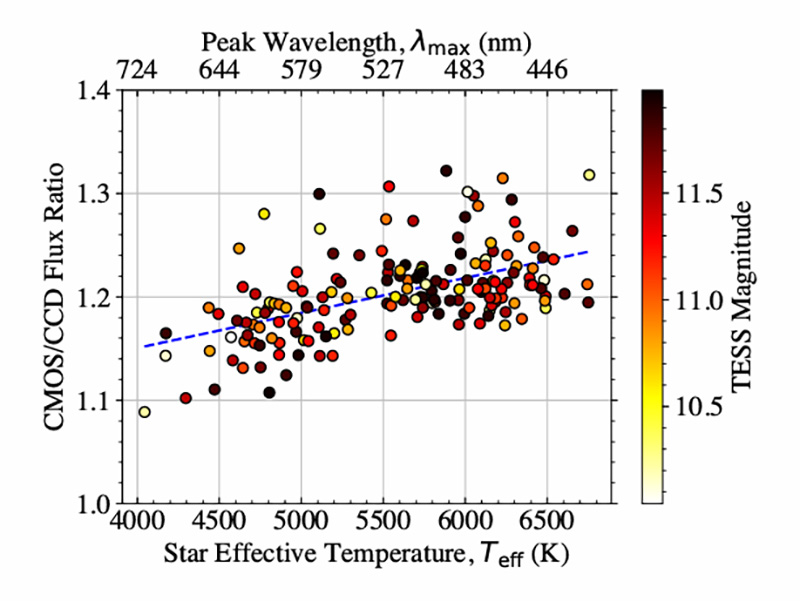
Figure 6 – Flux ratio for bright stars (T < 12 mag) observed with the CMOS and CCD cameras, plotted as a function of stellar effective temperature and corresponding to blackbody peak wavelength. Points are colour coded by TESS magnitude, and the blue dashed line shows the best-fit linear relation.
Conclusions
The Marana 4.2B-11 CMOS camera was tested on-sky at Paranal using an NGTS telescope to assess its suitability for high-precision exoplanet transit photometry.
Simultaneous CCD observations were obtained with the same targets, exposure time of 10 s, and observing conditions. The CMOS camera achieved the precision predicted by our noise model. For bright stars (T < 11 mag), the photometry was scintillation limited, while for fainter stars (T > 13 mag), it was sky-background limited. Unlike the CCD, the CMOS camera was not limited by readout noise, and its higher dark current did not dominate the noise budget.
The low level of red noise indicates that the CMOS camera introduces minimal instrumental systematics. The short CMOS readout time of 42 ms provides a higher duty cycle than the CCD, allowing more flux to be collected over a given observing duration. This improves photometric precision despite the slightly lower CMOS quantum efficiency and the NGTS filter being optimised for the CCD response. Overall, the Marana CMOS camera is well suited to high-precision time-series photometry. Its fast readout, low read noise, and shutterless operation offer clear advantages over traditional CCDs.
As CMOS technology continues to improve, these detectors are likely to become increasingly important for astronomical time-series applications.
References
- Alarcon et al. 2023, PASP, 135, 055001
- Mu et al. 2024, Res. Astron. Astrophys., 24, 055009
- Xiao et al. 2025, ApJL, 982, L27
- Layden et al. 2025, JATIS, 11, 026003
- Karpov et al. 2020, in Proc. SPIE Conf. Ser. Vol. 11454, X-Ray, Optical, and Infrared Detectors for Astronomy IX, (Bellingham, WA: SPIE), 114540G
- Apergis et al. 2025, RASTI, 4, rzaf049
- Karpov et al. 2021, Rev. Mex. Astron. Astrof. Conf. Ser., 53, 190
- Qiu et al. 2021, Res. Astron. Astrophys., 21, 268
- Wheatley et al. 2018, MNRAS, 475, 4476
- Pollacco et al. 2006, PASP, 118, 1407
- O'Brien et al. 2022, MNRAS, 509, 6111
- Ma & Wang 2013, in Proc. Int. Image Sensor Workshop, Snowbird, Utah (International Image Sensor Society), 129
- Tang et al. 2020, J. Real-Time Image Proc., 17, 703
- Lou et al. 2023, An over 140 db dynamic range CMOS image sensor combined DCG and logarithmic response, IEEE Trans. Electron. Dev.
- Pepper et al. 2004, AIP Conf. Ser. Vol. 713, The Search for Other Worlds, (New York, NY: AIP), 185
- Howell 2000, Handbook of CCD Astronomy, (Cambridge: Cambridge Univ. Press)
- Shockley & Read 1952, Phys. Rev., 87, 835
- Aberle et al. 1992, J. Appl. Phys., 71, 4422
- Stefanov 2022, CMOS Image Sensors, (IOP Publishing: Bristol)
- Janesick et al. 2007, in Proc. SPIE Conf. Ser. Vol. 6690, Focal Plane Arrays for Space Telescopes III, (Bellingham, WA: SPIE), 669003
- Wang et al. 2015, in Proc. International Image Sensor Workshop, Vaals, The Netherlands (International Image Sensor Society)
- Maihara et al. 1993, PASP, 105, 940
- Wüst et al. 2022, Atmos. Chem. Phys. Disc., 2022, 1
- Osborn et al. 2015, MNRAS, 452, 1707
- Pont et al. 2006, MNRAS, 373, 231
- McCormac et al. 2017, PASP, 129, 025002
- Tamuz et al. 2005, MNRAS, 356, 1466