Application Notes
Carbon Capture, Utilization and Storage: NMR Applications
Published: 03 Nov 2026 · Last updated: 03 Nov 2026
This Application Note was created in collaboration with Green Imaging Technologies

Introduction
Nuclear Magnetic Resonance (NMR) and Magnetic Resonance Imaging (MRI) technologies offer some very compelling measurements useful for those studying carbon capture, utilization and storage (CCUS). CCUS seeks to reduce the impacts of carbon dioxide (CO2) emission on the climate by capturing the CO2 from industrial applications and energy production and storing this CO2 in subsurface reservoirs, and potentially utilizing the carbon for non-emitting applications.
Potential storage sites for CO2 include non-producing oil and gas reservoirs, coal fields and deep saline aquifers. To reliably store CO2 in the subsurface, several factors must be considered, including the quality of the reservoir and the effectiveness of the seal in the cap rock. The quality of the reservoir is best characterized using porosity, permeability and pore size distribution data, and one of the key characteristics of a good seal cap rock is low permeability. NMR is well suited to investigate and understand all of these characteristics.
The usefulness of NMR/MRI for CCUS studies has been realized for many years and some of the applications of NMR/MRI for this sector will be summarized in the following sections.
Pore network characterization
NMR has always been seen as a very good measure of porosity, permeability and pore size distribution. In relation to CCUS applications, a detailed understanding of the pore network is essential to understanding how CO2 injected into the network will interact with the rock matrix, and with other fluids present in the network.
NMR measurements are a proven method of providing information on the pore size distribution, pore network connectivity, and wettability of the reservoir rocks. Experiments can be devised to analyze the effects of injecting CO2 on the pore pressures within the network, providing information on the changes to the original stress equilibrium in a formation that can alter the physical properties of a rock and hence alter the ability of that rock to store CO2. (Lian Xu et al, 2019).
The act of storing CO2 in a reservoir can change that reservoir's ability to store said CO2. NMR measurements made in the lab can help provide an understanding of these changes, to provide decision makers with a full picture of how a pore network will be affected before launching a CCUS project.
Capillary pressure
The behaviour of injected CO2 in a storage unit's pore network is highly affected by capillary pressures within the network. Understanding the capillary pressure characteristics of the pore network is essential to understanding how CO2 will spread throughout the network. It is also key to ensuring a seal cap rock will remain intact once injection begins and then over the evolution of the carbon reservoir. Phenomena such as fingering and other multiphase fluid flow characteristics must be well understood in order to ensure the long term viability of a reservoir for CO2 storage. (Lian Xu et al, 2019).
Capillary pressure measurements are essential to the study of residual or capillary trapping in saline reservoirs, which have the largest estimated storage capacity for CO2. One of the four methods of trapping CO2 in a saline reservoir is via capillary trapping, hence having a capillary pressure curve is key to estimating the CO2 storage capacity of a saline reservoir. (Teng et al, 2018).
There are multiple ways to derive the capillary pressure curve from NMR data. In one study, a 400 MHz NMR system was used to characterize the porosity and water saturation of the core samples during the experiments. This data was then coupled with pressure drop data across the sample to derive the capillary pressure curves.
Figure 1 below from this study shows a drainage capillary pressure curve (a) and a series of images at the inlet for different samples and injection rates (b). (Teng et al, 2018).
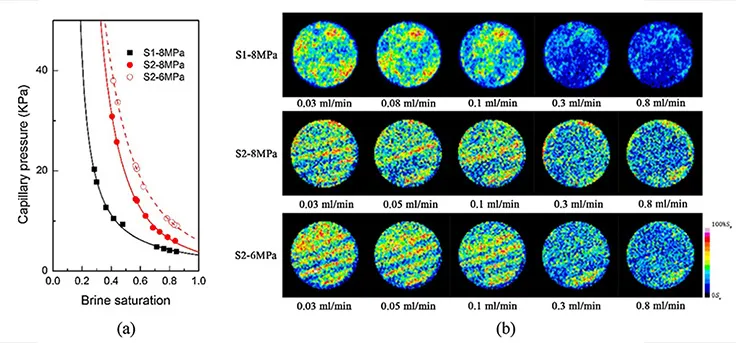
Fig. 1 — a) CO2-Brine capillary pressure curves, b) associated inlet slice saturation for different injection rates
Similar MRI measurements can be done with the Oxford Instruments GeoSpec 12 instrument, although with reduced dimensionality.
Green Imaging Technologies' GIT-CAP capillary pressure NMR measurement technique (Chen and Balcom, 2005; Green et al., 2008) provides rapid, data rich capillary pressure curves for rock cores. Providing more data points per capillary pressure curve ensures that the reservoir is well characterised, and the capillary pressure effects of injecting CO2 can be fully understood. A comparison of capillary pressure curves obtained using the GIT-CAP and traditional techniques shows an excellent agreement as in Figure 2 below.
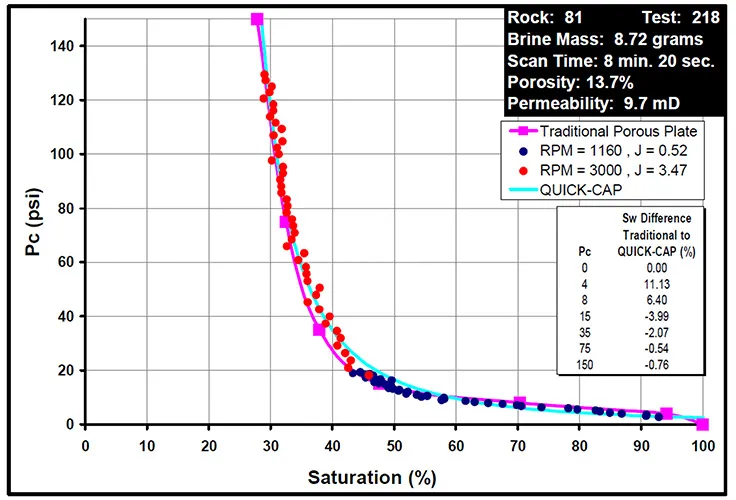
Fig. 2 — A comparison of capillary pressure curves obtained using the GIT-CAP and traditional techniques
Core flooding
When evaluating oil and gas reservoirs and other geological formations for potential CO2 storage, it is important to understand gas-fluid-rock interactions in the reservoir. A core flood study with a rock core sample from the reservoir in question is essential to understanding these interactions.
NMR/MRI is well suited to these studies as it can measure the fluid flow and distribution in a non-destructive manner during the flood experiments. (Yongchen Song, 2012).
Core flooding involves putting a rock core sample in a pressure vessel, inserting that vessel into the NMR or MRI instrument, then measuring the fluid in the core and the fluid being injected into the core. A core flood experiment is useful for CO2 application as it allows users to understand CO2/brine and CO2/hydrocarbon displacement mechanisms, as well as monitor CO2 immiscible and miscible displacement.
Some interesting experiments have been conducted using MRI to image flood experiments injecting supercritical CO2. Figure 3 below shows a series of MRI images obtained after supercritical CO2 is injected into two different brine saturated samples at two different flow rates.
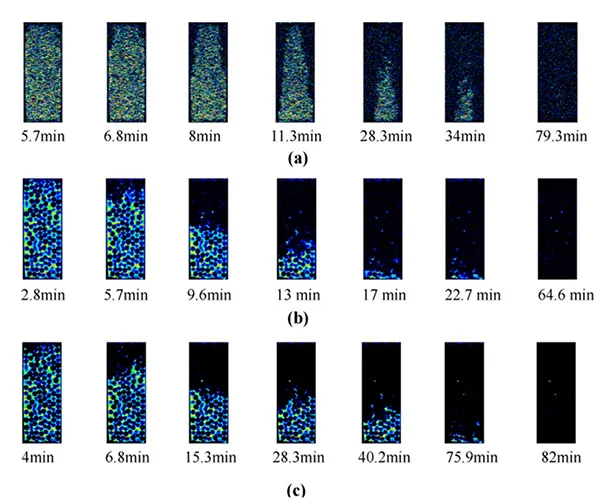
Fig. 3 — MRI of miscible CO2 displacement in two different samples at various flow rates: (a) in the first sample with flow rate 0.03 ml/min; (b) and (c) are the same sample but different flow rates (0.03 ml/min and 0.01 ml/min). Brighter colors indicate water while darker indicate CO2.
The data was recorded on a 400 MHz NMR system but could easily be done (with reduced dimensionality) using the Oxford Instruments GeoSpec 12. The signal intensity decreases as the NMR active brine is displaced by NMR inactive CO2. (Teng et al, 2018).
Changes to the rock structure
Carbon dioxide can be a highly reactive and volatile substance in certain environments and understanding how it will interact with a porous medium is key to understanding whether or not a reservoir is suitable for storing CO2. Differential NMR experiments can be useful in looking at the effects of CO2 on a pore network by allowing researchers to saturate or flood a core with CO2 and then measure how the CO2 effects the porosity, permeability, pore size distribution and even wettability of the pore network.
The Figure 4 below is from one such study (Y. Peysson et al, 2009) which looked at the drying effects of injecting CO2 into a reservoir, which can cause salt precipitation leading to changes in the permeability of the well and potentially an alteration of the rock matrix. NMR-based pore size (T2) distributions were employed to track the change in saturation of a shaly sandstone sample as a function of time. The change in saturation was monitored for both diffusion and convection driven drying. Figure 4 shows the drying rates for each drying method derived from the NMR data. The drying rates are approximately 10 times greater for convection driven drying in comparison with diffusion based drying.
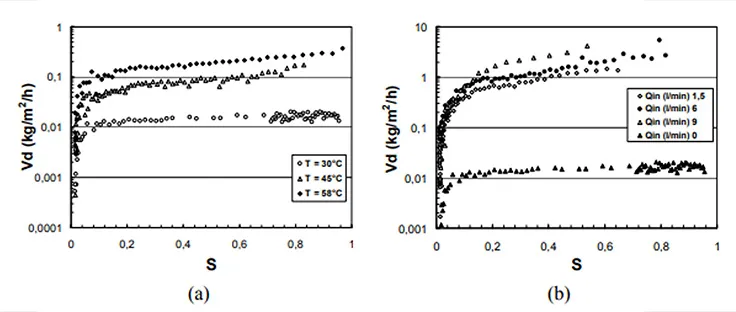
Fig. 4 — Drying rate in kg/m2/hour versus average saturation in the diffusive driven drying (a) for the 3 temperatures and convective driven drying (b) for the 3 air flow rates
Conclusion
CCUS is a quickly expanding segment of research driven by mandates to reduce the amount of CO2 being emitted into the atmosphere. A lot needs to be understood about the reservoirs being considered for carbon storage and NMR/MRI can be a very useful tool in providing the reservoir understanding required. NMR/MRI technologies are uniquely positioned to provide data on pore networks, fluid flows, and gas-fluid-rock interactions directly related to the ability of reservoirs to store CO2.
References
- Chen, Q. and Balcom, B.J. "Measurement of Rock Core Capillary Pressure Curves Using a Single-Speed Centrifuge and One Dimensional Magnetic Resonance Imaging", Journal of Chemical Physics
- (2005) 122, 214720.
- Green, D., Gardner, J., Balcom, B.J., McAloon, M.J. and Cano-Barrita, F. de J. "Comparison Study of Capillary Pressure Curves Obtained Using Traditional Centrifuge and Magnetic Resonance Imaging Techniques", SPE Improved Oil Recovery Symposium, Tulsa, Oklahoma, U.S.A., 19–23 April 2008.
- Peysson, Y., Fleury, M., Norrant, F. and Blazquez Pascual, V. "Diffusive And Convective Drying On A Shaly Sandstone Using NMR Measurements", Proceeding of the International Symposium of the Society of Core Analysts, Noordwijk, The Netherlands, 27–30 September 2009.
- Song YC, Jiang LL, Liu Y, Yang MJ, Zhao YC, Zhu NJ, Dou BL, Abudula A. "An Experimental Study On CO2/Water Displacement In Porous Media Using High Resolution Magnetic Resonance Imaging", International Journal of Greenhouse Gas Control
- (2012);10:501–9.
- Teng Y, Jiang LL, Liu Y, Wang DY, Song YC. "MRI Study On CO2 Capillary Trap And Drainage Behavior In Sandstone Cores Under Geological Storage Temperature And Pressure", International Journal of Heat and Mass Transfer
- (2018);119:678–87.
- Xu, L., Li, Q., Myers, M., Chen, Q. and Li, XC. "Application Of Nuclear Magnetic Resonance Technology To Carbon Capture And Storage: A Review", Journal of Rock Mechanics and Geotechnical Engineering
- 11 (2019) 892–908.