Buyers' Guides
Practical Advice on Selecting the Best Atomic Force Microscope for Your Needs
Published: 12 Nov 2026 · Last updated: 12 Nov 2026
Summary
Choosing an atomic force microscope (AFM) requires more than comparing technical specifications or checking whether particular features are available. AFMs that appear similar in brochures can differ substantially in performance, ease of use, environmental control, productivity, reliability, and long-term flexibility. The right choice depends on the measurements you need to make, the samples and conditions involved, who will use the instrument, and how those needs may evolve.
This guide presents a practical process for making that decision: define your priorities, consult with AFM suppliers to understand the available options, and evaluate the strongest candidates through relevant evidence and personalised demonstrations. It also explains why some common comparisons, particularly noise specifications and published images, can be misleading without the right context. The goal is to help you ask better questions, recognise important trade-offs, and enter supplier discussions prepared to identify an AFM that will support both your immediate work and future directions.
Download the full Buyer's Guide here or continue reading below.
Contents
- About the Author
- Introduction: How to Approach the Selection of an AFM
- Defining Your Priorities and AFM Requirements
- Evaluating and Comparing Potential AFMs Against Your Priorities and Requirements
- Five Key Takeaways for Selecting the Right AFM
About the Author
Ben Ohler started his journey through the world of AFM as a doctorate student at the University of California, Santa Barbara, where he used AFM to characterise the biophysical properties of lipid bilayers and nanostructures. He worked for over ten years as an Applications Scientist and later as a Product Manager with the Veeco/Bruker AFM group. He then joined Oxford Instruments Asylum Research in 2013 where he is now Senior Product Line Manager for the AFM group.

"I won't claim to be unbiased, but my goal here is not to convince you to buy a specific AFM. Instead, I hope to share some practical considerations that may not be obvious at first but are critical to making a good choice." Ben
Introduction: How to Approach the Selection of an AFM
Selecting the best atomic force microscope (AFM) for your work is not easy, but it’s an important decision. Whether you work in academia or industry, the success of your projects will depend in part on how well the AFM is suited to your specific needs.
As you survey the options, you’ll find many different AFMs available from several credible suppliers. Some may appear quite similar on websites and in brochures, but differences in capabilities, performance, and ease of use can be subtle. These differences are not always well captured in marketing materials or published specifications, yet they can have a significant impact on real-world use. A good decision requires carefully comparing the available options against your individual priorities and requirements.
This Buyer’s Guide is intended to help you work through that process in three main steps:
- Taking inventory of your priorities and requirements
- Consulting with AFM suppliers to understand your options
- Evaluating potential AFMs against your priorities and requirements
The provided guidance and explanations will help you define what matters most for your work, evaluate your options, and make more confident, better-informed decisions.

Three steps for selecting the best AFM for your needs
Defining Your Priorities and AFM Requirements
There’s no single “best AFM” for every field of work or every type of AFM measurement. The right choice depends on what matters most in your situation, including not only your immediate needs but also how those needs may evolve over time.
Think of this section as preparation for discussions with AFM suppliers. Take inventory of what you know about your work:
- What do you want to accomplish?
- What do you need to measure?
- What limitations are you facing today?
- Which capabilities may become important in the future?
The better you can communicate your priorities and requirements, the better suppliers can help you understand the available options and the trade-offs among them. Below are some of the key factors to consider.
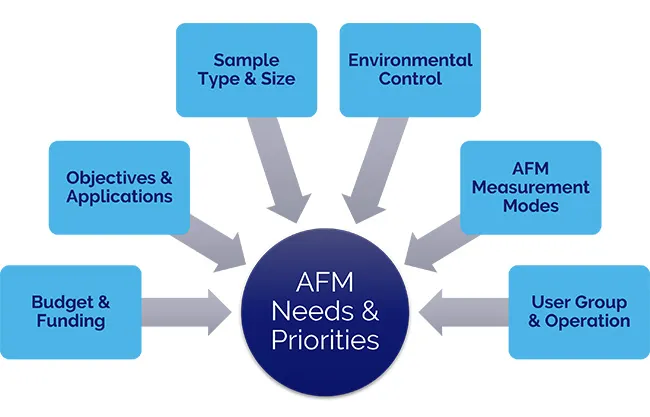
Key factors to consider when defining AFM requirements
AFM Budget and Funding Considerations
Budget is usually one of the first factors buyers consider. Grant applications and corporate budgets may offer some flexibility, but practical limits still apply. Entry-level AFMs from top-tier suppliers typically start around $150,000, though their more limited capabilities and performance may not suit all needs. Highly specialised models can exceed $600,000. For many buyers, a suitable solution will fall closer to the middle of that range.
If you take only one piece of advice from this guide, it should be this: talk to AFM suppliers before you apply for funding. It is very difficult to set the right budget without first discussing your needs and understanding the available options. We understand that funding decisions take time and are never guaranteed, and we welcome these early conversations. They help ensure that your budget is built around an AFM that can meet your needs, rather than an assumption that later leaves your options too limited.
Objectives and AFM Applications
Before choosing an AFM, think carefully about what you want to accomplish. Are you already using AFM? If so, share some of your results. What do you want to do that you can’t do now, or what do you want to do better? What AFMs have you used previously, and what did you like or dislike about them?
You may already know a great deal about AFM, but our team has extensive experience across many AFM applications and deep knowledge of both our AFMs and competitors’ AFMs. Take a step back and tell us about your unsolved problems and challenging research topics. We may be able to contribute ideas that add to your own.
If you’re new to AFM, that’s fine too. How are you hoping to use it? Are there specific examples or publications that inspired your interest? Either way, it’s helpful to discuss your plans and aspirations as openly as possible. We routinely enter into non-disclosure agreements when needed to support those conversations.
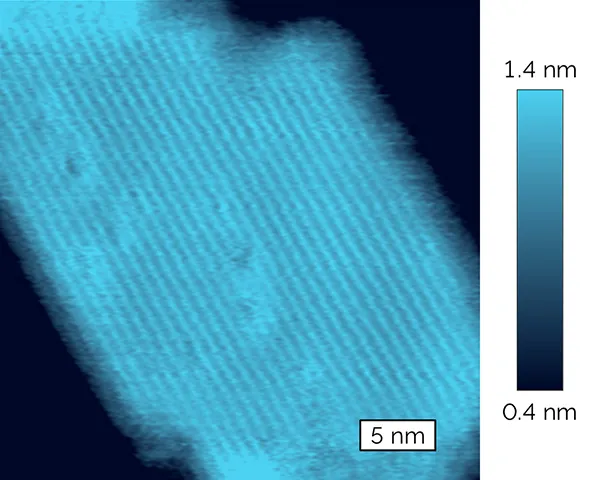
Polyethylene has crystalline regions where the polymer chains are tightly packed with sub-nm periodic spacing. The Jupiter Discovery AFM easily measures not only the average periodicity but also resolves nanoscale defects in chain packing.
AFM Sample Types and Sample Size
The types of samples you plan to characterise are closely related to your objectives, but they deserve separate consideration. Sample size can be a critical factor in determining your AFM options. Across the industry, AFMs are broadly categorised as small-sample and large-sample systems. Small-sample AFMs are typically designed for samples mounted on metal discs roughly 15 mm in diameter (sometimes slightly larger). Large-sample AFMs are designed for samples up to 200 mm or even 300 mm in diameter. If your work requires intact wafers or other large samples, the need for a large-sample AFM is clear.
Without a clear need for large samples, however, don’t assume that a large-sample AFM is automatically the safest or most versatile choice. Small-sample AFMs have traditionally offered higher performance because it’s easier to achieve ultra-high resolution and fast scanning when the sample is small. Jupiter Discovery, Oxford Instruments’ next-generation large-sample AFM, has greatly narrowed the performance gap compared with our ultra-high-performance Cypher and Vero small-sample AFM families. However, many other large-sample AFMs on the market still involve significant performance compromises.
Another consideration is that small-sample AFMs sometimes offer capabilities unavailable on large-sample systems. For example, Vero AFMs use a unique interferometric cantilever-sensing technology that can be especially advantageous for certain applications, such as quantitative measurements of piezoresponse and nanomechanical properties. Both our Cypher and Vero small-sample AFMs are available with video-rate imaging capabilities. As we’ll consider next, the Cypher and Vero models offer the most advanced environmental control capabilities among commercial AFMs. Unless you have a clear need for large samples, it may be better to keep your options open.
Environmental Control in AFM
Environmental control requirements can be just as important as sample size in determining which AFMs are suitable for your work. These considerations typically include the temperature at which the sample is characterised and the medium surrounding the sample, whether that’s a gas, vapour, or liquid.
Depending on the AFM and its accessories, samples may be heated or cooled in either gases or liquids. Many Oxford Instruments AFMs support sample temperatures from approximately −20 °C to 300 °C, although the available range depends on the model, accessory, and surrounding medium.
Operation in gas or vapour environments may seem straightforward at first, but think carefully about how precisely the atmosphere needs to be controlled. Do you need to control humidity or operate under dry or inert gas? Does the gas or vapour need to be exchanged or continuously flowed? Some applications may even require glovebox operation with sub-ppm water and oxygen levels. Chemical compatibility may also be an important consideration.
Similarly, for liquid measurements, consider chemical compatibility and whether perfusion or exchange of the liquid is required. Electrochemistry is one specialised example, in which the sample is characterised in liquid as part of an electrochemical reaction.
Finally, consider how often environmental control will be part of your work. If you expect to use it routinely, make that clear in discussions with AFM suppliers so they can prioritise solutions that make setup and operation as straightforward as possible. Even if environmental control is not an immediate priority, it’s worth discussing which capabilities could be added later as your requirements evolve.
AFM Measurements Beyond Topography
Most people associate AFM with high-resolution imaging of surface topography, and that remains its most common use. However, modern AFMs can also measure a wide range of electrical, mechanical, and functional material properties. Examples include conductivity, work function, capacitance, stiffness, elastic modulus, viscoelastic response, and piezoelectric or ferroelectric behaviour.
Also consider whether you need to observe how a sample responds to changing conditions or applied stimuli. Depending on the AFM and its accessories, measurements may be performed while applying an electrical potential, a magnetic field, or while stretching the sample. If you have a more specialised experiment in mind, be sure to discuss it with AFM suppliers.
Think about which properties or responses may be relevant to your current and future work, even if topographic imaging is your immediate priority. These capabilities vary significantly among AFM models and suppliers and may substantially affect your options.
Who Will Use the AFM and How It Will Be Operated
Consider who will operate the AFM and how they expect to use it. Will it serve one group of experienced users or many people with different levels of experience? Will most measurements be routine, or will users frequently develop specialised experiments? How heavily will the instrument be used, and will measurement throughput be important? Sharing this information with AFM suppliers can help them identify options that fit both your measurement requirements and the way the AFM will actually be used.
Evaluating and Comparing Potential AFMs Against Your Priorities and Requirements
The factors above are a good starting point for deciding which AFMs may be appropriate for your work because they cover many of the measurement capabilities that vary from one instrument to another. Once you’ve narrowed the field, the next question is how to evaluate your options. That means looking critically at the evidence suppliers provide, observing how the AFMs perform in practice, and considering both day-to-day use and long-term ownership.
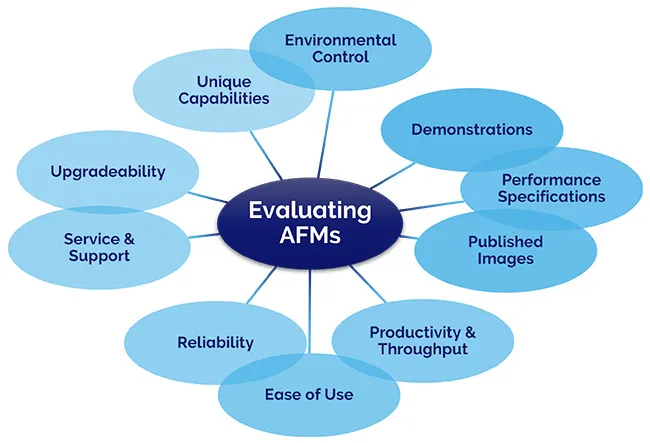
Criteria for evaluating AFMs against your requirements
AFM Performance Specifications
Use caution when comparing AFM specifications. There is no industry-wide standardisation in how specifications are defined or measured, so values with similar names may not represent equivalent tests. A few specifications, such as maximum XY and Z scan range, are relatively straightforward. Even maximum sample size can be misleading, however. One common large-sample AFM has a 200 mm diameter sample chuck but can access only a substantially smaller area.
Noise specifications are among the most difficult to interpret. Most present-day AFMs use closed-loop scanners rather than open-loop scanners. Closed-loop scanners use integrated position sensors to ensure accurate scan motion, while open-loop scanners rely on fixed calibration. Because piezoelectric materials are inherently nonlinear and inconsistent in their motion, open-loop scanners can suffer from significant errors. Closed-loop scanners avoid these errors by correcting the motion based on sensor feedback. The trade-off is that every position sensor has an electronic noise floor, which limits the smallest motion it can accurately measure.
Manufacturers often specify sensor noise but measure it in different ways and over different bandwidths. At smaller scan sizes, AFMs may also use scan-control methods that reduce the influence of sensor noise. As a result, sensor noise specifications are difficult to compare meaningfully and are not good predictors of actual imaging resolution.
Another common specification is “height noise” or “vertical noise floor,” which attempts to characterise noise in the Z direction. It may sound like a direct indication of the minimum surface roughness or feature height an AFM can measure, but manufacturers use fundamentally different definitions.
For Oxford Instruments AFMs, height noise is a direct measurement of vertical noise in the mechanical loop connecting the sample and tip, internally referred to as on-surface noise. We position the tip at a fixed point in contact with a flat sample, disable the Z feedback loop that normally tracks topography, and measure noise directly through the calibrated cantilever deflection over a specified bandwidth. Because the tip is in contact with the surface, vertical motion between the tip and sample couples directly into the cantilever deflection. This provides a rigorous measure of the mechanical stability that is critical for high-resolution imaging.
Another major AFM supplier measures “vertical noise floor” very differently. The tip is similarly engaged at a fixed point on a flat sample, but the imaging feedback loop remains enabled, and the output of that loop is measured rather than the cantilever deflection. The result depends strongly on the selected feedback gains. Lowering the gains until the feedback loop no longer responds to much of the mechanical noise can produce an arbitrarily low apparent vertical noise value.
Feedback-enabled measurements can be made more meaningful by imaging an atomically flat material such as MoS2 and confirming that the feedback tracks sharp atomic steps. Even then, insufficient feedback gains can suppress the measured noise. The important point is that this method and our direct on-surface measurement do not measure the same thing. The resulting specifications therefore cannot be directly compared, despite being presented under similar names.
The lesson is not that specifications should be ignored. Straightforward specifications can help determine whether an AFM meets basic requirements, and well-defined performance measurements can provide useful evidence. But specifications should not be treated as directly comparable simply because they use the same terminology. When the measurement methods differ, the numbers may tell very different stories. The best way to resolve those uncertainties is to evaluate actual performance on relevant samples, preferably through a live demonstration.
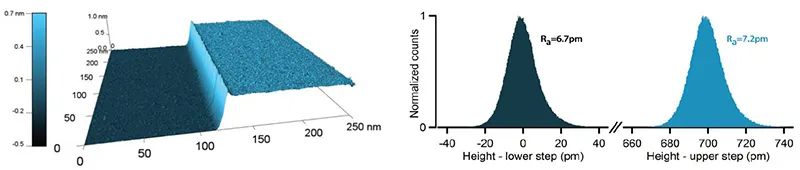
A feature of height such as this single step of MoS2 requires that realistic imaging gains be used during the measurement of the AFM noise floor. The apparent surface roughness (Ra) of the atomically flat terraces puts an upper limit on the true AFM instrument noise floor.
Published Images
Published images in brochures and on websites can provide useful evidence of what an AFM can achieve, but they may not represent what you should expect in routine use. Marketing materials naturally feature the best, most impressive results, while much of the experimental context is missing. Was the image acquired easily under normal time constraints, or was it a “hero experiment” that required many attempts, expert optimisation, and some luck? Treat published images as evidence of best-case capability, not necessarily of routine performance.
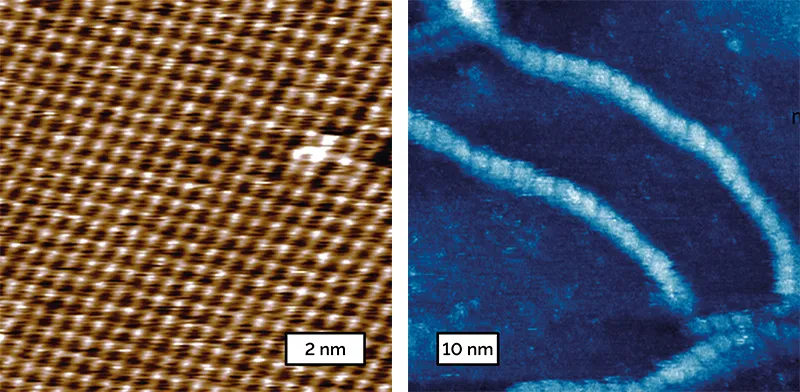
Example AFM images of a conducting polymer layer C8-BTBT (left) and a DNA sample (right). Left: C8-BTBT epitaxial layer on boron nitride imaged using tapping mode in air. Defects in the lattice of the molecular crystal are observed. Sample courtesy X. Wang, Nanjing Univ. Right: DNA double helix imaged in buffer using blueDrive tapping mode in the fully-sealed Cypher ES liquid cell. Both the major and minor grooves of the helix are observed. Scan size 65 nm.
Demonstrations
Since specifications and published images provide only limited insight into routine performance, the best way to evaluate an AFM is through a personalised demonstration. AFMs are usually purchased to support specific projects rather than simply to serve as general-purpose tools, so the demonstration should prove that the instrument can perform the measurements you’re buying it to make. Whenever possible, ask suppliers to measure your own samples using the techniques and conditions that matter to your work. At minimum, insist on receiving measurements performed specifically for you rather than relying only on previously published examples.
A live in-person demonstration provides the most complete picture. It allows you to observe not only the quality of the results, but also how the AFM is set up, how easily users can find and measure the area of interest, how readily they can acquire high-quality data, and how quickly they can obtain useful results. Ask to participate in the demonstration and try the instrument yourself.
It may be tempting to avoid the time and expense of a live demonstration, but buying an AFM is a major investment. No one expects you to buy a car without a test drive or a home without touring it in person, so why choose an AFM without seeing how it performs on the measurements that matter to you?
Environmental Control
Most AFM manufacturers support at least basic environmental control, but similar descriptions can conceal substantial differences in capability. The mere existence of an accessory, whether it’s sample heating, liquid perfusion, an electrochemical cell, or something else, does not by itself indicate how precisely and reliably the environment can be controlled or how practical it will be for routine experiments. Important differences include whether the sample chamber is fully sealed, chemical compatibility, support for fluid or gas exchange, flexibility to combine different controls, imaging stability during operation, and ease of setup and use.
For example, many AFMs use relatively simple liquid cells or allow gas to be purged around the sample. Often, these are based on “soft-sealed” designs in which a silicone gasket loosely shrouds the sample. Sample heating and cooling are often provided by separate stages that are temporarily installed in the AFM and connected to standalone controllers. Depending on your usage, these designs may be entirely adequate.
In contrast, Oxford Instruments Cypher ES, Cypher VRS1250, Vero ES, and Vero VRS1250 models were designed from the ground up for precise environmental control. The key difference is that they are based on a fully sealed, pressure-tight sample chamber design with modular sample stages and probe holders. Because these capabilities are tightly integrated into the AFM, they provide more seamless setup and operation, lower drift, and better imaging stability. For users who expect environmental control to be a routine part of their work, these differences give these Cypher and Vero models the most advanced environmental control capabilities among commercial AFMs and enable experiments that would be very challenging or impossible on many other systems.
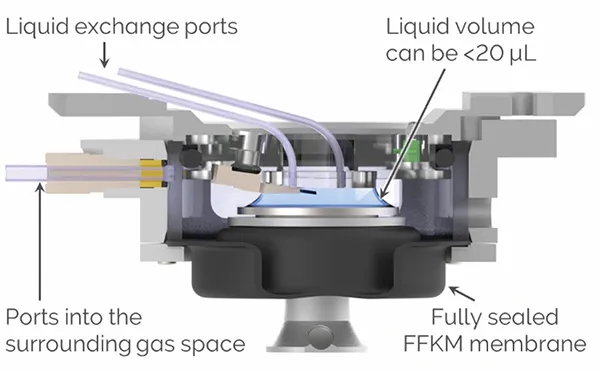
Fully sealed sample chambers enable precise environmental control in Oxford Instruments’ Cypher and Vero AFM series. Options similar to the shown liquid perfusion cell are available for controlled gas environments, sample heating and cooling, and electrochemistry. For more details, see this short video: Exceptional Environmental Control on Cypher and Vero AFMs
Ease of Use
Ease of use deserves careful consideration, especially when an AFM will serve many users with different levels of experience. An instrument that is easier to learn, set up, and operate can reduce training demands, help users become productive more quickly, and make it easier to obtain consistent results. Even experienced users benefit when routine tasks require less time and attention.
Ease-of-use claims can be difficult to judge from brochures or software screenshots. Look at the complete measurement workflow from start to finish. Oxford Instruments AFMs illustrate several ways instrument design can simplify use. Most use software-controlled motorised setup rather than manual knobs and adjustments. Jupiter Discovery uses pre-mounted probes that can be handled with fingers rather than tweezers, while Ergo software provides a guided interface and automates many imaging steps that traditionally required more user input. The best way to evaluate these differences is during a live demonstration. Ask to perform key steps yourself rather than simply watching an experienced application scientist operate the instrument.
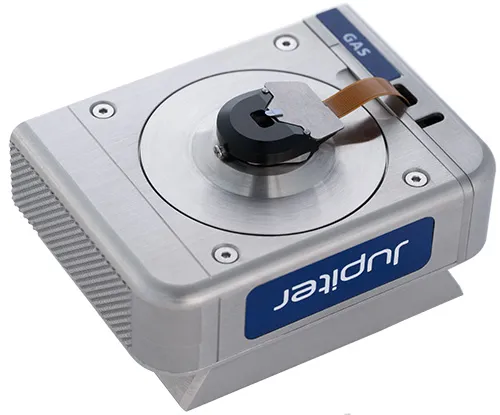
Pre-mounted probes make probe exchange on the Jupiter Discovery AFM quick and easy. For a vivid demonstration, see this short video: Jupiter Discovery Time to Results
Productivity and Throughput
Productivity is another area that deserves serious consideration. For industrial customers, measurement throughput can be critical. Even in academic research, completing AFM measurements efficiently leaves more time for other work. Productivity includes the entire measurement process, from instrument setup through data acquisition and analysis. Ease-of-use features can streamline many of these steps, but image acquisition often becomes the main bottleneck. Typical AFMs scan at around one line per second, so a 256- or 512-line image may take roughly 4 to 9 minutes. Oxford Instruments Jupiter, Cypher, and Vero AFMs can acquire images 10 to 20 times faster, often in well under one minute.
As with other specifications, there’s no industry standard for defining fast scanning, so it is best evaluated during a demonstration under conditions and on samples that are relevant to you. Effective fast scanning requires support and optimisation from all components of the AFM, including the XY and Z scanners, cantilever detection, probe excitation, and feedback control. Some conventional AFMs offer add-on “fast scanning” options without equivalent system-level optimisation, and image quality may suffer at higher scan rates. A well-designed fast-scanning AFM should preserve image quality and measurement accuracy while increasing productivity.
Automation can provide another major productivity benefit, particularly for repetitive industrial measurements. Jupiter Discovery can automate measurements across multiple user-defined sample locations, reducing operator intervention and helping maintain consistent measurement conditions. Together, fast scanning and automation can shorten the time to each result, increase the number of locations measured, and make repetitive measurements more practical and consistent.
Reliability
Reliability is a factor that often goes unconsidered. While all advanced instrumentation can occasionally fail, accidental damage is a more common problem than random failure. For most AFMs, the most common and costly damage occurs to scanners, making scanner architecture an important consideration.
Many AFMs use piezo tube scanners, a design that dates to the early development of the technique. Piezo tubes are brittle, and even a relatively small impact can crack the tube and require an expensive scanner rebuild. This vulnerability has contributed to AFM’s reputation as a delicate technique.
Oxford Instruments AFMs instead use metal flexure scanners driven by robust piezo stacks. The stacks are mechanically more robust than thin-walled piezo tubes and are protected by the surrounding flexure structure, making normal bumps and handling much less likely to cause damage. This can be especially important in shared facilities, where many users with different levels of experience operate the AFM.
Service and Support
Service and support should also be considered carefully. Even a reliable AFM may occasionally need repair, but support extends beyond fixing hardware. Training, technical guidance, and access to experienced application scientists can be important throughout the life of the instrument, particularly as users develop new or unfamiliar measurements.
When comparing suppliers, consider who will support your system, where service and application personnel are located, what assistance is available remotely, and what support will remain available after installation.
Upgradeability
Research needs often evolve over the life of an AFM, so it’s worth considering whether the instrument can grow with them. Many AFMs offer limited upgradeability beyond adding accessories or measurement modes. Cypher and Vero AFMs, however, were designed as modular platforms that support much more extensive upgrades, including conversion to more advanced system configurations (e.g., adding environmental control or video-rate scanning capabilities), adding blueDrive photothermal excitation, or even converting a Cypher to a Vero with its unique interferometric cantilever sensing. Few other AFMs offer such substantial upgrade paths.
Unique Capabilities
Finally, consider whether an AFM offers capabilities that are fundamentally different from those available on most systems. We’ve already discussed examples such as fast scanning and the advanced environmental control capabilities of Cypher and Vero AFMs.
Other examples include video-rate imaging on Cypher and Vero VRS1250 models, which can capture movies of nanoscale dynamics at up to 45 frames per second. Vero AFMs also use interferometric cantilever sensing in place of conventional optical beam deflection, providing substantial improvements in sensitivity, accuracy, and repeatability for certain measurements. Jupiter Discovery offers a distinctive combination of capabilities not found on other large-sample AFMs: a 100 µm XY scan range, fast scanning, and available blueDrive photothermal excitation.
These unique capabilities can open new directions for research and give users access to tools that are not widely available. They can also strengthen funding proposals, since funding agencies may be reluctant to support the purchase of an AFM if similar capabilities are already available nearby.
Selecting an AFM shouldn’t be a decision you make alone. Discussions with experienced suppliers can help you understand your options, evaluate how well they address your needs, and clarify the trade-offs among them. We welcome those conversations and hope this guide helps you on your journey towards selecting the best AFM for your requirements.
Five Key Takeaways for Selecting the Right AFM
Start the conversation with AFM suppliers early. Talk to AFM suppliers before setting a budget or applying for funding. It’s difficult to budget appropriately until you understand which options can meet your needs, and early conversations are welcome and useful even when funding is uncertain.
Begin by defining how an AFM will best support your work. Think about your objectives, samples, current limitations, ideas for future measurements, and who will be using the AFM. These are the most valuable inputs as you speak to AFM suppliers and start identifying which AFMs are most suitable for your work.
Look beyond AFM specifications and feature checklists. Similar terminology does not always indicate equivalent measurements or capabilities. Consider how features are implemented, how well they work together, and whether they will be practical for the measurements you expect to perform.
Request relevant evidence and demonstrations. Ask AFM suppliers to measure your samples using the techniques and conditions that matter to your work. Whenever possible, attend a live demonstration, participate in the measurement process, and try the instrument yourself.
Think beyond the initial AFM purchase. Ease of use, productivity, reliability, service and support, upgradeability, and distinctive capabilities can matter long after the initial purchase. The best choice should meet your immediate requirements without unnecessarily limiting where your work can go next.
Downloads
- AFM-Buyers-Guide.pdf