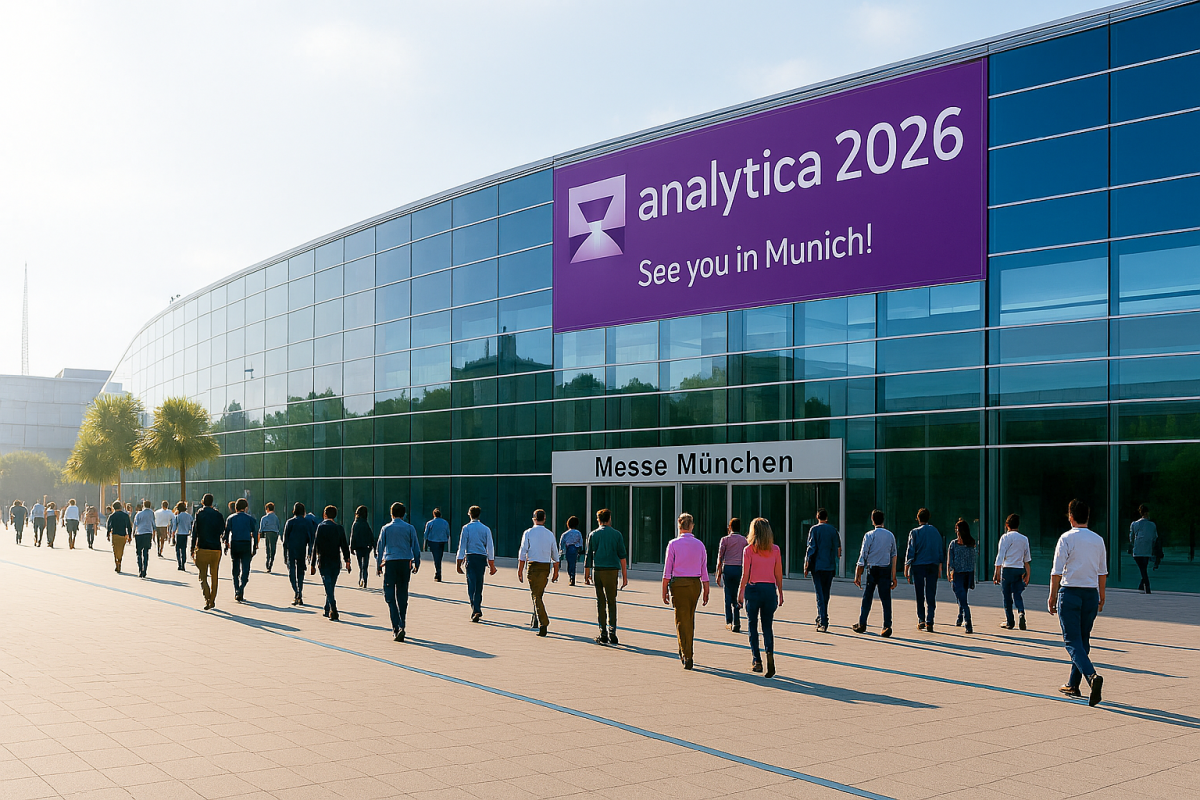

ANALYTICA 2026

A decisive shift in laboratory decision-making.

The value of an instrument is no longer defined by measurement alone. 

Oxford Instruments helps turn measurement into evidence laboratories can trust.
Speak with our Team
Request a quote

Six Signals shaping laboratory investment

Analytica 2026 made the direction clear: AI automation, connected workflows and sustainable operations are becoming practical investment criteria.

For laboratories planning their next purchase, funding case or method decision, the buying question has changed. The strongest investments are no longer judged by measurement capability alone, but by how well they remove workflow constraints, strengthen evidence and support decisions that stand up to challenge.

The six signals below show where that shift is already changing laboratory priorities:

AI is becoming part of defensible workflow design

AI is moving from future-facing feature to practical workflow requirement.
As EBSD datasets become larger and more complex, confidence depends on more than processing speed. Phase identification, uncertain regions, pattern quality and the reliability of the final map all shape how far the interpretation can be trusted. AZtecCrystal and MapSweeper support the post-acquisition work needed to refine complex datasets before conclusions are drawn.

  • Improve confidence in interpretation by supporting more consistent analysis of complex EBSD datasets.
  • Make data review more defensible through refinement and explanation of how results were produced.
  • Reduce variation between users where interpretation previously depended on experience, familiarity or manual judgement.
  • Extract more value after acquisition, strengthening the link between raw data and conclusion.

Throughput is becoming as important as resolution

Resolution still matters but the constraint is whether the right measurement can be made.
High-throughput EBSD changes what becomes practical. Faster detection can open the door to larger maps, more samples and more routine characterisation, but only if the data remains useful beyond acquisition. Symmetry S3 supports the speed of capture and the AZtec workflow carries data to analysis, connecting higher capacity with interpretation rather than simply producing more information to process.

  • Increase characterisation capacity where sample volume, instrument access or acquisition time limits output.
  • Shorten the path from sample to result by reducing the time spent waiting for usable EBSD data.
  • Protect confidence at higher speed by connecting faster acquisition to a workflow built around data quality and interpretation.
  • Free expert time for higher-value analysis by reducing the specialist effort required for routine acquisition constraints.

Correlative evidence is becoming the new standard

A single measurement can inform. A connected evidence chain can persuade.
For complex samples, confidence often depends on how well different signals agree: what the structure shows, what the chemistry confirms, and whether molecular or crystallographic information supports the same interpretation. Unity BEX, AZtec, WITec Raman and RISE Raman-SEM support this shift by bringing complementary evidence closer to the sample context, helping reduce uncertainty before conclusions are drawn.

  • Connect complementary evidence where one technique alone leaves questions unresolved.
  • Reduce uncertainty in interpretation by bringing structure, chemistry and molecular insight into closer context.
  • Support conclusions that need to hold up in publications, QA, method validation, failure analysis or procurement decisions.
  • Move beyond isolated observations towards a stronger, more defensible understanding of the sample.


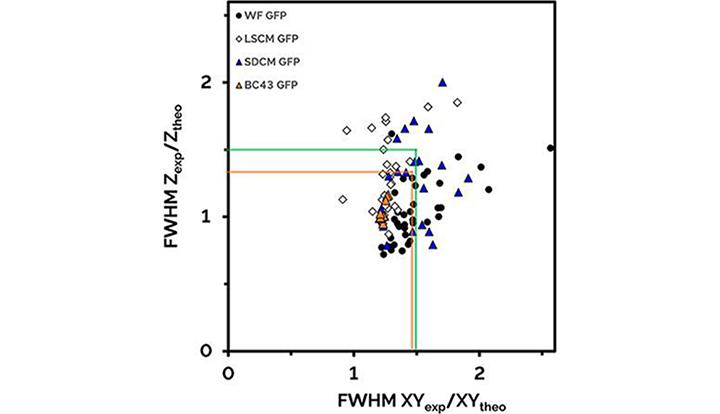
Lateral and axial resolutions of different types of fluorescent microscopes as a ratio of the theoretical full width half-maximum (FWHM).
Acceptable normalized resolution, within green square. Orange square shows that all measured BC43 (BC43 GFP) results are significantly better that the proposed spec of QUAREP-LIMi (green square). Note the variation observed on competing widefield (WF-GFP), laser scanning ( LSCM GFP) and spinning disk (SDCM GFP) competitors products. Figure adapted from data and specifications included in Faklariset al.

Raman is moving to routine workflow use

No longer at the edge of analysis, Raman is becoming part of the evidence chain.
Raman is moving closer to the centre of the analytical workflow as many of today's samples cannot be understood by morphology or composition alone. Molecular insight helps explain what has changes, where it has changed and why that change matters. WITec Raman, WITec360 and RISE Raman-SEM bring molecular specificity into the wider evidence chain, so chemical and structural changes can be interpreted in context rather than in isolation.

  • Bring molecular insight into routine analysis where structure, chemistry or composition cannot be understood from morphology alone.
  • Support a broader range of applications across research, materials, microplastics, semiconductors, pharmaceuticals, polymers, thin films and chemical imaging.
  • Improve confidence across users and sample types by building Raman capabilities than scale beyond a single specialist or project.
  • Connect Raman with sample context through correlative workflows that connect to electron microscopy, atomic force microscopy and plasma techniques.

Benchtop NMR is moving closer to regulated analytical workflows

No longer purely a convenience, benchtop NMR delivers greater workflow resilience with less infrastructure burden.
The strongest case for benchtop NMR is not convenience. It is analytical fit. Where the question is well defined, selected assays may not need the infrastructure burden of high-field NMR to produce a result that is reproducible, interpretable and defensible. X-Pulse 90 supports that evaluation, where broadband benchtop NMR can improve access, turnaround time or solvent burden without weakening confidence in the result.

  • Assess realistic method- transfer opportunities where assays could move to the bench.
  • Reduce the pressure on high-field NMR capacity by identifying workflows that do not always need superconducting infrastructure.
  • Support analytical resilience where access, infrastructure, solvent use or turnaround time constrain the current method.
  • Build a credible validation pathway by focusing on where benchtop NMR can deliver repeatable, defensible analytical decisions.

Sustainability is now part of the investment case

No part of laboratory performance, investment cases increasingly assess reliability, resource use, workflow efficiency and long-term operating confidence.
Sustainability is most valuable when it strengthens scientific productivity. A system that reduces repeat measurement, lowers infrastructure burden, protects uptime and can be properly supported over its lifetime does more than reduce operating impact. It preserves confidence in the results it produces. 

That confidence depends on what happens beyond installation. Oxford Instruments Service Packages protect uptime, maintain performance and keep essential workflows producing trusted results.

  • Reduce avoidable repeat work through workflows that produce stronger evidence and fewer disconnected steps.
  • Lower operational burden where solvent use, helium dependency, consumables or infrastructure requirements influence the investment case.
  • Protect uptime and confidence with service planning, supportability and long-term system performance.
  • Strengthen procurement and funding justification by connecting scientific capability to total cost of ownership and lifecycle value.

Turn the signal into practical actions

The most valuable laboratory investments begin with a clear view of the problem behind the purchase.

Whether the issue is capacity, evidence, method transfer or long-term performance, defining the workflow question early makes it easier to identify your needs, justify investment and choose with confidence.

Oxford Instruments helps you clarify workflow requirements, assess application fit and move confidently from purchase planning to the right next decision.

Request a Quote

Request more information by filling in our contact form. 

The brochure contains more information on the BC43 Benchtop Confocal Microscope.

Download the Method Paper

Learn how routine QC metrics help to improve data confidence in BSL-3 studies.

AI as baseline expectation

Throughput it resolution

Correlative evidence standard

Raman goes mainstream

Benchtop NMR & pharmcopeia

Sustainability in procurement

Powerful Software for Restricted Environments

Imaris for BC43: Quantitative analysis outside containment

Imaris 11 enables advanced 2D/3D/4D visualisation and analysis outside the BSL-3 lab, with automated workflows that streamline batch processing and ensure reproducible analysis

  • Explore volumes and time-series, generate isosurfaces and export publication-ready views.
  • Segment and quantify structures using intensity-based or AI-assisted tools.
  • Apply QC-aware metrics from the method paper to ensure consistent measurements across instruments and time.

Fusion for BC43: Acquisition in containment

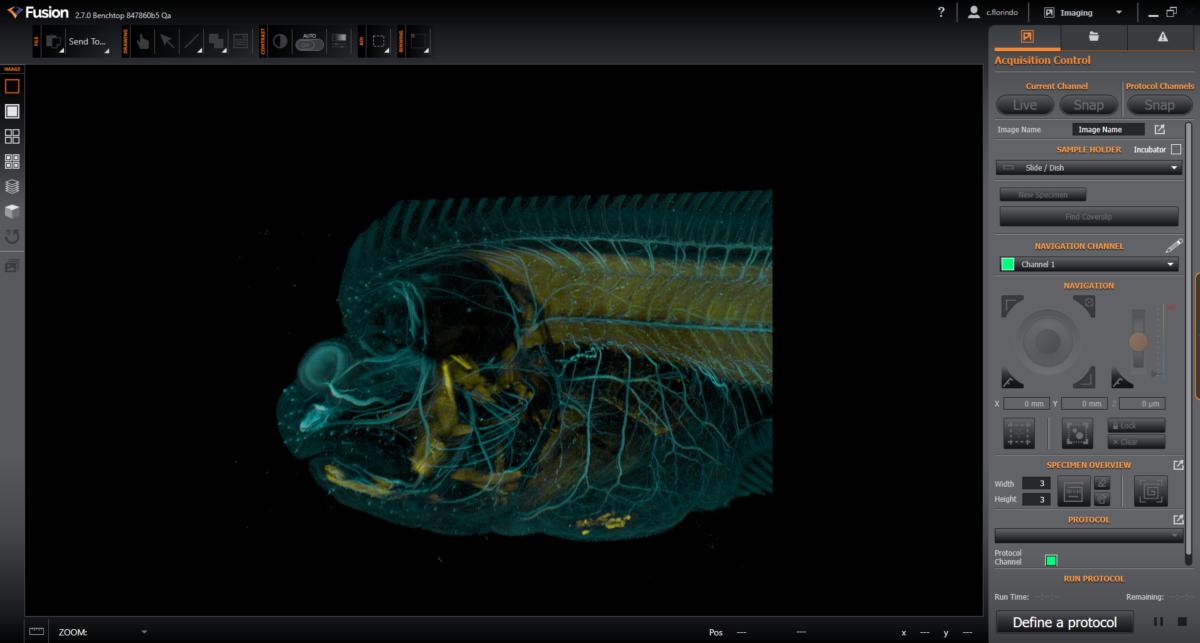
All Andor benchtop microscopes ship with Fusion for BC43, optimised for fast setup and robust acquisition in restricted-access labs.

  • Define multidimensional experiments (time, Z, tile, multi-position, multi-well) with guided protocols and reusable templates, reducing setup time in PPE.
  • Use real-time GPU-accelerated deconvolution and in-line 3D stitching to monitor experiment quality as data are acquired.
  • Capture overview montages at low magnification and then return to the same fields for high-resolution imaging without complex navigation.

Try Imaris free for 10 days

Analyse BC43 datasets with advanced 2D/3D visualisation and quantitative tools, and evaluate how Imaris supports reproducible imaging workflows for BSL-3 environments.

Get Imaris

Proven Imaging Across the Full Spectrum of BSL-3

Lateral resolution (confocal) Avg FWHM₍xy₎ ≤ 280 nm (Full FOV) Ensures quantitatively reliable imaging with defined performance limits, supporting reproducibility across long-term and multi-user studies.
Axial (Z) resolution Avg FWHM₍z₎ ≤ 725 nm (Full FOV) Provides dependable optical sectioning in thick samples such as infected organoids and tissue sections.
Illumination uniformity U ≥ 65% (488 / 561 / 638 nm)
U ≥ 20% (405 nm)
Reduces intensity bias across the field of view, supporting quantitative comparisons with minimal intervention.
Illumination centering C ≥ 65% Confirms correct beam alignment for stable, repeatable illumination over time and across users.
Chromatic co-registration (lateral) Max r₍xy₎
View Specs

What BSL-3 Teams Ask Before They Decide

Yes. BC43 is a compact, fully enclosed benchtop confocal system designed to operate inside BSL-3 laboratories, fitting standard containment, airflow, and infrastructure constraints without requiring darkrooms or optical tables.

BC43 supports defined, validated fumigation workflows that allow the system to remain in place during whole-room decontamination, with documented procedures that preserve warranty coverage when followed correctly.

BC43 is supported by Installation Qualification (IQ) and Operational Qualification (OQ) documentation with measured performance metrics, enabling traceable quality control aligned with audit and institutional requirements.

Yes. Stable illumination, automated focus control, and QC-tracked performance metrics support reproducible imaging and data comparability across users, time points, and extended infectious-disease studies.

BC43’s modular design, remote support options, and defined service procedures minimise the need for on-site intervention, allowing maintenance or component replacement without frequent external access to containment labs.

Working in Restricted Access Labs?

Tell us about your containment setup and imaging challenges, and we’ll help you assess whether BC43 and our IQ/OQ and fumigation workflows are a good fit.

Contact Us